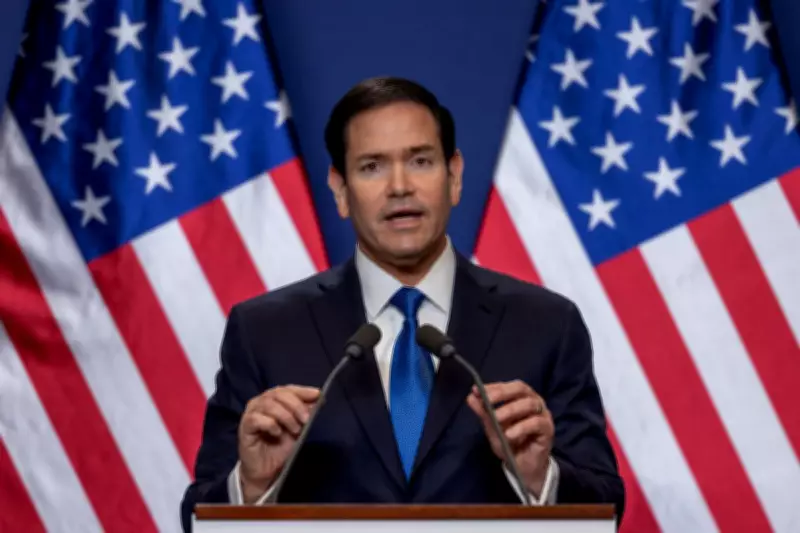
Marco Rubio to Deliver Critical Iran Briefing to Senior US Lawmakers
US Secretary of State Marco Rubio is scheduled to conduct a rare classified briefing for top congressional leaders at the White House on Tuesday. This high-level meeting occurs as Washington deploys its most substantial concentration of aircraft and warships to the Middle East since the military buildup preceding the 2003 Iraq War.
Exclusive Audience and Escalating Military Posture
The briefing's audience is expected to include the so-called "gang of eight," comprising senior lawmakers from both major political parties in the House and Senate, alongside the chairs and ranking members of the House and Senate intelligence committees. This select group routinely receives classified intelligence briefings from the White House, often concerning preparations for significant military operations.
Rubio last publicly briefed this group on January 5, following the US operation to capture Venezuela's Nicolás Maduro. The current briefing coincides with the arrival of the USS Gerald Ford, the world's largest aircraft carrier, in the region. Military analysts suggest this deployment positions the US to potentially execute a strike against Iran if ordered by President Donald Trump.
Timing with State of the Union and Diplomatic Stakes
The secretary of state's briefing is set for just hours before President Trump delivers his State of the Union address on Tuesday evening, where foreign policy is anticipated to be a central theme. Trump has consistently demanded that Iran abandon its nuclear program, cease ballistic missile production, and end support for proxy groups like Hezbollah and the Houthis in Yemen.
US-Iran negotiations are scheduled for Thursday in Geneva. Iranian Deputy Foreign Minister Majid Takht-Ravanchi stated in an NPR interview that Iran is "ready to reach an agreement as soon as possible" and wants "to do whatever's necessary to make it happen." However, he clarified that talks would focus solely on Iran's nuclear program, a limitation unlikely to satisfy the White House's broader demands.
Trump's Ultimatums and Military Assessments
Last week, President Trump declared that Iran must either reach a deal or the US would have to "take it a step further," warning that "really bad things" would happen to Iran within a ten-day timeframe. Concurrently, the US has evacuated non-essential personnel from its embassy in Lebanon due to threat assessments, and Rubio has reportedly postponed a meeting with Israeli Prime Minister Benjamin Netanyahu.
Media reports indicate that General Dan Caine, Chair of the Joint Chiefs of Staff, has warned Trump that a conflict with Iran could severely deplete US stockpiles of anti-missile systems, including Patriot, THAAD, and ship-launched interceptors. Trump responded on Truth Social, asserting that Caine "has not spoken of not doing Iran" and would lead effectively if ordered to act.
Strategic Decisions and Advisory Dynamics
The Guardian has reported that Trump has not yet decided on launching strikes against Iran, with his decision likely depending on the outcomes of upcoming talks in Doha with top Iranian officials. The US delegation will be led by Steve Witkoff, Trump's longtime friend and Middle East envoy, alongside his son-in-law Jared Kushner.
Other key advisers include Vice President JD Vance, Secretary of State Marco Rubio, CIA Director John Ratcliffe, Defense Secretary Pete Hegseth, White House Chief of Staff Susie Wiles, and Director of National Intelligence Tulsi Gabbard. Trump faces a choice between a limited military strike to influence negotiations or a larger offensive aimed at destabilizing Iran's government.
Expert Analysis and Historical Parallels
Retired Air Force General Charles Wald, former deputy commander of US European Command, noted that the USS Gerald Ford's presence near Crete enhances capabilities to protect Israel from potential Iranian counterattacks. Wald emphasized that the military buildup and Trump's ultimatums could compel action, drawing a parallel to previous US policy in Syria.
"The problem is that Trump has ... kind of implied a red line," said Wald, now a distinguished fellow at the Jewish Institute for National Security of America. "If they don't get the agreement, and then they don't do anything, it's going to be twice as bad as when Obama didn't do anything in Syria for the chemical weapons."
As tensions mount, the convergence of diplomatic efforts, military deployments, and high-stakes briefings underscores a critical juncture in US-Iran relations, with global implications for security and stability in the Middle East.