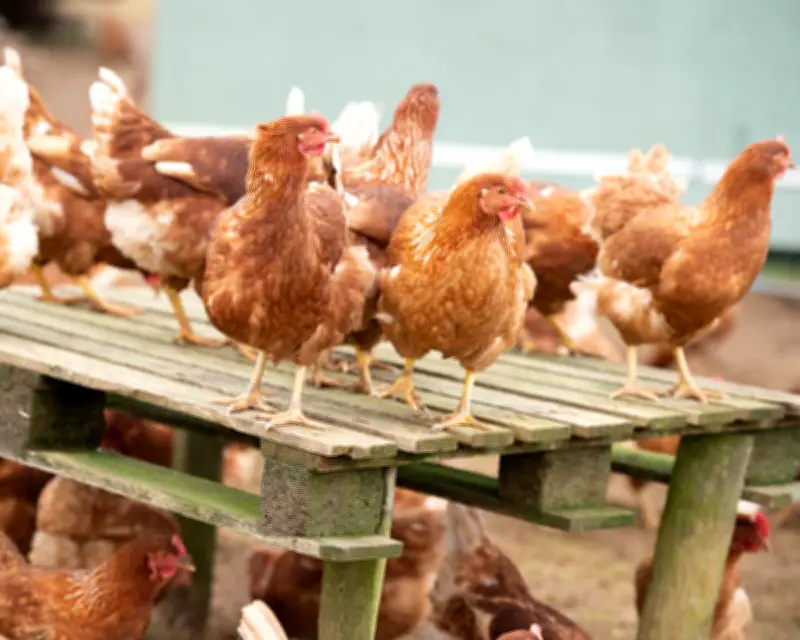
Campaigners have warned that the government's planned poultry sector growth plan poses a risk to national security, citing heavy reliance on imported animal feed that leaves the UK vulnerable to supply chain shocks.
Government's push for poultry growth
Earlier this month, environment secretary Emma Reynolds told the Groundswell agriculture festival that improving food security required consuming more homegrown produce. She highlighted the establishment of the Farming and Food Partnership Board, which includes industry leaders such as the National Farmers' Union president and the Food & Drink Federation chief executive. Reynolds stated: "I would like to see us use different levers of the state and use the board to really boost the level of food production in the UK."
In a parliamentary committee hearing, Reynolds identified planning constraints as one of the biggest barriers to poultry sector growth. The Guardian previously reported that ministers were rewriting planning rules to facilitate intensive livestock farms despite concerns over water pollution, air quality, and local opposition.
Criticism from campaign groups
Ruth Westcott, campaign manager at Sustain, the alliance for better food and farming, argued that producing more UK poultry threatens food security rather than solving it. "Intensive poultry farming is highly resource-intensive, polluting and inefficient, so it can never be a solution to food security," Westcott said.
Sustain and Communities Against Factory Farming (CAFF) are urging the government to abandon the poultry growth plan and instead focus on homegrown protein sources like pulses, legumes, nuts, and beans. Maya Pardo, CAFF campaign lead, noted: "The government's own national security assessment warns that 'animal farming at current levels is unsustainable without imports – soy from South America makes up 18% of produced animal feed'. Besides destroying the Amazon rainforest to feed factory-farmed chickens, heavy reliance on imports of animal feed also leaves us vulnerable to supply chain shocks and ecosystem collapse, which is a national security issue."
Broader food security concerns
Last month, the government's farming roadmap outlined a 25-year vision emphasizing food security, warning that geopolitical instability, climate crisis, environmental degradation, and supply chain disruptions already affect UK food security. It cautioned of potential "severe food price shocks" and, in extreme cases, reduced food availability.
This echoes a recent report by UK national security officials, which warned of severe threats from climate change and ecosystem collapse, with food shortages and economic impacts potentially just years away. Meanwhile, Italian coffee company Lavazza recently warned that coffee prices would remain high due to geopolitical tensions and climate costs.
Nature-friendly farming advocated
Harriet Bell, regenerative farming lead at Riverford, welcomed planning reform that helps farmers invest in reservoirs, renewable energy, and polytunnels, but stressed it "must not become a free pass for developments that undermine healthy water systems, biodiversity or animal welfare." She noted that the government's farming roadmap recognizes nature-friendly systems can sustain or enhance food production while building resilience and reducing fertilizer dependency. Bell urged the forthcoming organic action plan for England to play a key role in turning ambition into reality.
Tim Benton, professor of population ecology at the University of Leeds, said food security will soon become the "organising principle" for agricultural policy. In an increasingly volatile world, he argued the government should move away from risk registers focused on pinpointing specific events and instead acknowledge: "We're in a new world where events are happening all of the time and will continue all of the time."