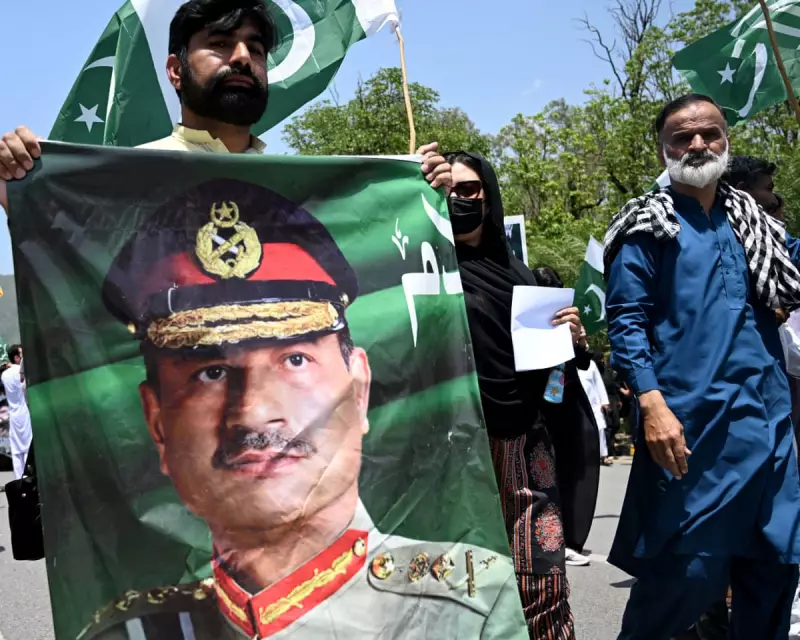
Pakistan's parliament has approved a highly controversial constitutional amendment that dramatically expands the authority of the country's army chief while granting him lifelong protection from criminal prosecution. The move has been condemned by critics as signalling the funeral for democracy in the nuclear-armed nation.
Unprecedented Powers for Military Leader
The 27th constitutional amendment, passed by the parliamentary lower house on Wednesday, primarily benefits Field Marshal Asim Munir, Pakistan's powerful army chief who is widely regarded as the country's de facto ruler. The legislation will now return to the senate for minor adjustments after it was initially approved on Monday, before likely receiving presidential assent from Asif Ali Zardari to become formally enshrined in the constitution.
Under the new provisions, Munir - who was nominated to become a five-star general earlier this year - will acquire unprecedented authority. He will be elevated to the newly created position of chief of defence forces, giving him oversight not only of the army but also the navy and air force. Crucially, the amendment grants him lifelong immunity from criminal prosecution.

Judicial Independence Undermined
The constitutional changes substantially weaken the powers and jurisdiction of Pakistan's supreme court, which had remained the sole remaining check on executive authority. The amendment establishes a new federal constitutional court above the supreme court, where judges will be selected by the executive branch.
This development has drawn sharp criticism from legal experts who argue it undermines any semblance of an independent judiciary. The authority to transfer judges between courts will now rest solely with the president, removing established accountability processes.
Salahuddin Ahmed, a constitutional lawyer, stated that the amendment completely destroys any notion of independence in the judiciary in Pakistan. He warned that this effectively has set us on the way to a lifelong dictatorship in Pakistan.
Swift Passage Signals Military Dominance
Analysts note that the rapid passage of the amendment through both parliamentary houses within hours signals both the weakness of the ruling coalition government and the untouchable power of Munir. The ruling coalition, led by Prime Minister Shehbaz Sharif, represents an uneasy alliance of two formerly rival parties.
Government figures have defended the constitutional changes as necessary for modernising and improving efficiency within both the military and judiciary. However, opponents maintain the legislation serves only to cement military rule and push Pakistan further toward outright authoritarianism.
Aqil Shah, an adjunct associate professor at Georgetown University and author of The Army and Democracy: Military Politics in Pakistan, commented that Munir had entrenched himself and future chiefs in power through an unprecedented constitutionally protected role. He added that the immunity provision makes a mockery of the principle of civilian supremacy by placing him above all reproach.
Pakistan's political landscape has been dominated by military influence throughout its history since independence in 1947. The country has experienced decades under direct military rule when generals suspended the constitution entirely. Although Pakistan transitioned to a fragile democracy after General Pervez Musharraf's fall in 2008, elected civilian governments have largely remained manipulated or controlled by the powerful military establishment behind the scenes.
In recent years, the military has been accused of consolidating greater control over national affairs while strengthening the authority of its most senior generals. As army chief since 2022, Munir has undertaken international travel in a capacity resembling head of state, including two unprecedented White House meetings with Donald Trump, during which the US president referred to him as my favourite field marshal.

Pakistan's largest opposition party, Pakistan Tehreek-e-Insaf (PTI), boycotted the parliamentary vote. Despite enjoying substantial public support, the party's influence has been systematically dismantled since Munir became army chief, with most of its leadership currently imprisoned. The party's popular leader, former prime minister Imran Khan, has been detained for more than two years with little prospect of imminent release.
The Tehreek-e-Tahafuz-e-Ayeen-e-Pakistan (TTAP), a multiparty opposition alliance including PTI, accused the government of shaking the foundations of the constitution. In a joint letter, more than 100 lawyers and civil society activists described the amendment as tampering of the constitution and noted the absence of meaningful debate or engagement with members of the legal community, judiciary and civil society.