
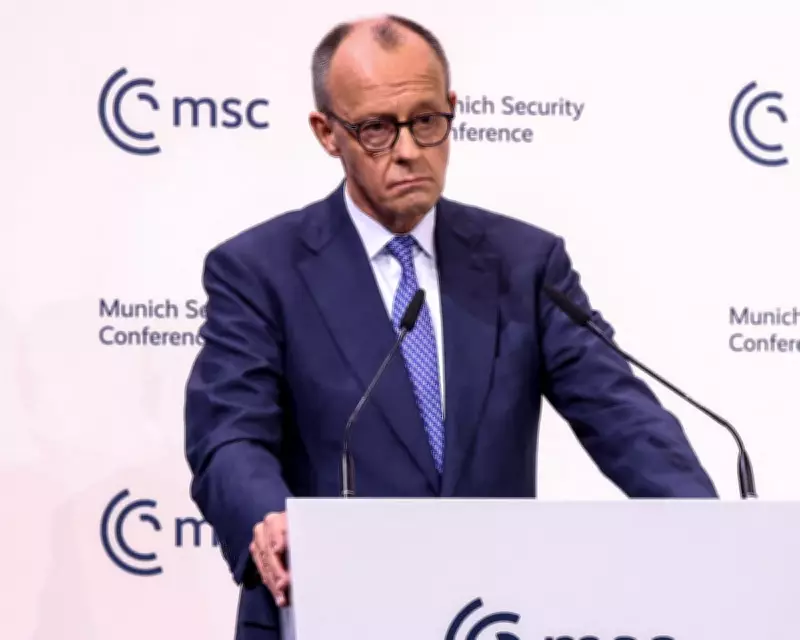
German Chancellor Challenges US Unilateralism at Munich Security Conference
In a significant address at the Munich Security Conference on Friday, German Chancellor Friedrich Merz delivered a pointed message to the United States, arguing that American unilateral power has reached its limits in the current geopolitical landscape. Speaking to an audience of global security leaders, including US Secretary of State Marco Rubio and European heads of state, Merz emphasized that even the world's sole superpower cannot navigate the complexities of great power rivalry alone.
The End of the Old International Order
Merz opened his speech with a sobering assessment of the current global situation, stating bluntly that the international rules-based order that has governed relations since the Cold War "no longer exists in that form." The German leader acknowledged that this system was imperfect even at its best, but its erosion has created a new reality where major powers increasingly make their own rules.
"In the era of great power rivalry, even the United States will not be powerful enough to go it alone," Merz declared, switching to English to ensure his message resonated with American policymakers. "Dear friends, being a part of NATO is not only Europe's competitive advantage. It is also the United States' competitive advantage."
Direct Criticism of American Policies
The German chancellor received his most enthusiastic applause when he directly challenged several key policies of the current US administration under President Donald Trump. Merz made clear distinctions between European and American approaches to several critical issues:
- "The culture war of the Maga movement is not ours," Merz stated, drawing a clear line between European and American political values.
- "We do not believe in tariffs and protectionism, but in free trade," he added, referencing Trump's recent threats to impose new tariffs on European countries.
- "We stand by climate agreements and the World Health Organization," Merz affirmed, highlighting European commitment to multilateral institutions.
Merz emphasized that "freedom of speech ends here with us when that speech is directed against human dignity and the basic law," establishing clear boundaries for democratic discourse.
European Defense and Partnership-Based Leadership
The German chancellor outlined a vision for Europe's future role in global security, advocating for what he termed "partnership-based leadership" rather than hegemonic dominance. Merz stressed that Europe must reduce its excessive dependence on the United States while simultaneously strengthening NATO's European pillar.
"We won't do that by writing off NATO," Merz clarified, addressing concerns that European defense initiatives might undermine the transatlantic alliance. Instead, he proposed establishing a "strong, self-sustaining pillar" within NATO that would enhance European capabilities while maintaining alliance cohesion.
Merz revealed that he has begun discussions with French President Emmanuel Macron about developing a European nuclear deterrent, though he emphasized that any such capability must be "firmly integrated into NATO's nuclear deterrent" and would not create unequal security arrangements within Europe.
Context and Historical Significance
The Munich Security Conference has become a crucial barometer for transatlantic relations, particularly since the beginning of Trump's second term. Last year's conference saw US Vice President JD Vance deliver a controversial speech criticizing European democracies, setting a tense tone that has persisted throughout the past year.
Merz's address comes at a particularly significant moment, marking both the fourth anniversary of Russia's invasion of Ukraine and one year since Vance's contentious remarks. The German chancellor noted that the Ukraine conflict has "forced Europe to return from a vacation from world history," compelling the continent to confront the realities of power politics once again.
Strategic Implications and Future Directions
As one of the European nations most actively increasing its defense spending, Germany finds itself in a position to advocate for greater European autonomy within the transatlantic framework. Merz argued that Europe must fully exploit its "enormous military, political, economic and technological potential" to become a more sovereign actor on the world stage.
The chancellor drew a fundamental distinction between different forms of international leadership, stating: "Autocracies may have followers, democracies have partners and allies." This formulation directly challenged the unilateral approach that has characterized much of Trump's foreign policy.
Merz concluded with a call for renewed transatlantic cooperation, urging both sides to "repair and revive transatlantic trust together." His speech set the tone for discussions throughout the conference, highlighting both the challenges and opportunities facing the US-European partnership in an increasingly competitive global environment.
The German leader's remarks reflect growing European concerns about American reliability as a security partner while simultaneously acknowledging that neither Europe nor the United States can effectively address global challenges without close cooperation. As tensions between major powers continue to shape international relations, Merz's vision of partnership-based leadership offers one possible path forward for democratic nations navigating an increasingly complex world.




