
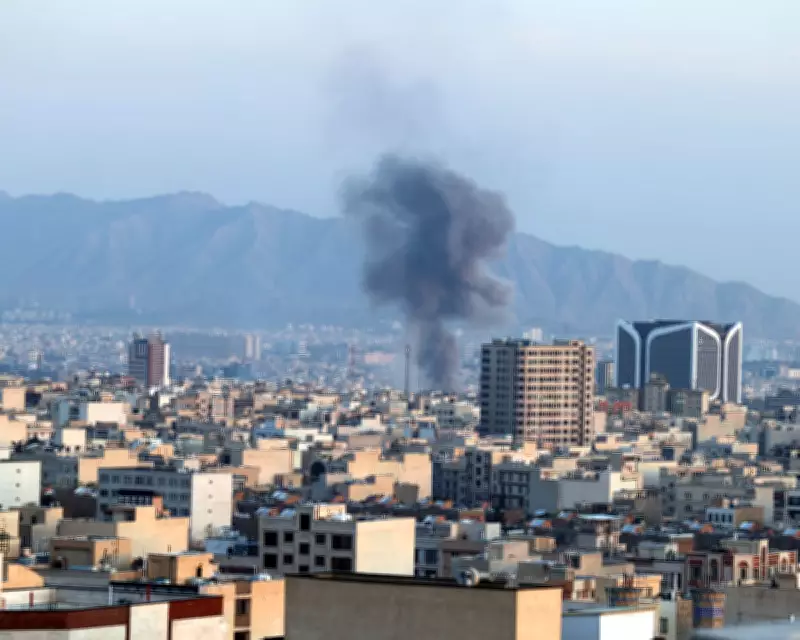
Seven Days of Conflict: Key Questions on the US-Israeli War Against Iran
One week into the joint US-Israeli military campaign against Iran, the Middle East has been set ablaze, with violence spreading in a widening arc from central Asia to the edge of Europe. The operation, codenamed "Epic Fury" by the US and "Roaring Lion" by Israel, has been marketed as a high-impact demonstration of intimidating power, yet its impact beyond chaos and bloodshed remains unclear. What is certain is that predictions of regional destabilization have rapidly materialized, threatening millions of lives and livelihoods.
What Is the Background to This War?
For decades, Iran, a regional powerhouse that views Israel and the US as arch-enemies, has sought to expand its influence across the Middle East by supporting militant groups like Hezbollah in Lebanon and the Houthis in Yemen. Iran has also developed a nuclear program it claims is for civil purposes, a claim disputed by Washington. Negotiations to limit Tehran's nuclear ambitions were ongoing until last Saturday, when the US abandoned them and initiated bombing.
Israel's longstanding regional policy, particularly towards Iran, Lebanon, Iraq, Gaza, Yemen, and Syria, has focused on keeping enemy forces "weak" through regular use of overwhelming military power, including assassinations. This approach has resulted in tens of thousands of civilian deaths, a decline in diplomacy, and increased global animosity toward Israel. Senior figures in targeted armed factions are often quickly replaced, and militant groups either rebuild or are substituted by others.
Israeli Prime Minister Benjamin Netanyahu has urged the US to seriously consider attacking Iran for years, dismissing international agreements on Tehran's nuclear program. Successive US administrations have resisted this belligerent stance, with diplomats and Middle Eastern governments warning that bombing Iran would engulf the region—a scenario now unfolding.
What Are the Objectives of Israel and the US in This War?
Various explanations have been offered for the war's objectives, including combating general threats from Iran and its proxies, destroying Tehran's nuclear program (despite former President Donald Trump claiming he had already "obliterated" it with strikes last summer), and attempting regime change through aerial bombardment. On Friday, Trump called for an "unconditional surrender."
Some in US Christian evangelical circles view the bombing as part of a holy war leading to Armageddon, which they crave as it would precipitate the return of Jesus Christ. Hours after the first strikes, Trump stated the objective was "to defend the American people by eliminating imminent threats from the Iranian regime." Netanyahu has said removing Iran's missile and nuclear threat is his goal, but he also welcomes regime overthrow if it occurs.
An emerging strategy involves the US and Israel encouraging anti-government groups inside and outside Iran, including Kurdish militants, to rise up and fight. If successful, this could lead to an unpredictable civil war.
What Do We Know About Civilian Casualties So Far?
According to the Iranian Red Crescent Society, US and Israeli attacks have killed 1,230 people in Iran since the bombing began a week ago. One of the most shocking strikes targeted a girls' primary school in Minab, southern Iran, killing dozens of children. A separate US submarine torpedo attack on an Iranian warship off the south coast of Sri Lanka killed at least 87 sailors, though Sri Lankan authorities saved some from drowning.
Israel's strikes on Lebanon, a country it has repeatedly bombed and invaded over decades, have displaced hundreds of thousands of people. The Lebanese health ministry reports Israeli strikes killing 217 people and wounding 798, with the government warning of a humanitarian disaster due to mass displacement.
Twelve Israelis have been killed by Iranian attacks, and six US personnel have died. Casualties have also occurred in the UAE, Bahrain, and Kuwait from Iranian drones and missiles, with other Iranian attacks hitting countries outside the region, including Azerbaijan and Cyprus.
Who Is Leading Iran Now and What Might Come Next?
On the first day of the war, Iranian Supreme Leader Ali Khamenei was killed. The regime immediately began working on a possible successor, with Khamenei's son Mojtaba seen as a potential heir. No new leader has been announced, though an interim body is managing affairs.
So far, the government remains in control of Iran's armed forces and police. The major danger is total state collapse, with regional powers fearing the country could fragment. Recent history shows US military operations initially celebrated as successes, such as the 2001 Afghanistan war and the 2003 Iraq war, later turned into failures, leading to years of conflict and power vacuums.
How Long Can Iran Afford to Fight Back For?
Iran's conventional military is not comparable to that of the US and Israel, and it has a limited supply of missiles and drones. However, the state has a long history of asymmetric warfare, where outmatched forces conduct painful attacks against larger military powers through paramilitary groups.
In launching attacks into multiple neighboring countries, Tehran's retaliation has already created geopolitical and economic chaos. It has effectively closed the Strait of Hormuz, choking global oil supplies, and its missiles and drones have disrupted world air travel.
Will the Gulf States Remain Neutral?
It is difficult to predict. Tehran has repeatedly stated that US military bases and "interests" in the region are targets of its attacks. Patience is wearing thin in the Gulf after hotels, high-rise apartment blocks, oil installations, and airports were hit.
Several Gulf monarchies, such as Saudi Arabia and the United Arab Emirates, view the Iranian regime as an adversary, but there is also concern they could be dragged into a destructive war where every side suffers.
Is This War Legal?
Many voices, including legal scholars, US politicians, and some of Washington's allies abroad, argue this war is not legal under international and US law. The US and Israel claim their strikes are acts of pre-emptive self-defence.
British Prime Minister Keir Starmer refused to join the offensive, stating he would not commit UK forces to "unlawful action" and warning that "this government does not believe in regime change from the skies." Spanish Prime Minister Pedro Sánchez, a vocal critic, described the conflict as playing "Russian roulette with the destiny of millions" and called the strikes an "extraordinary mistake" not in accordance with international law.




