
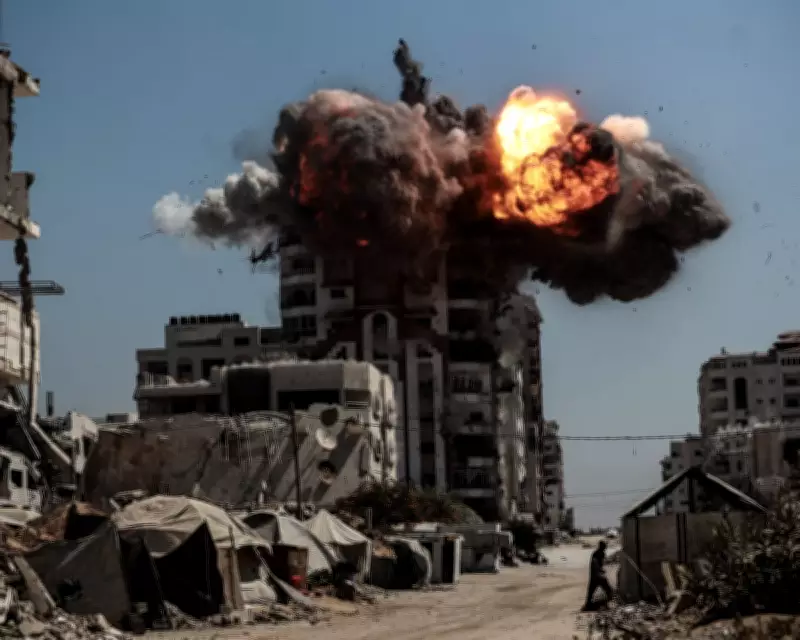
Israel's Military Reverses Stance on Gaza Death Toll Accuracy
In a notable policy shift, Israel's military has accepted that the death toll compiled by health authorities in Gaza is broadly accurate. This marks a dramatic U-turn after years of official attacks on the data, which had previously been dismissed as "Hamas propaganda" and labelled as inaccurate by Israeli officials and media outlets.
First Public Estimate from Israel
For the first time since the conflict began in October 2023, Israel has publicly estimated the war's toll. A senior security official briefed Israeli journalists, stating that approximately 70,000 Palestinians have been killed by Israeli attacks on the territory, excluding those who are missing. This contrasts sharply with previous government and military communications, which only provided figures for militants Israel claimed to have killed.
Gaza health authorities have reported that the direct toll from Israeli attacks has surpassed 71,660 people, with at least 10,000 more presumed buried under the rubble of bombed buildings. The Palestinian database identifies most of the deceased by name, date of birth, and Israeli-issued identity numbers, though it does not provide a breakdown between fighters and non-combatants.
Scrutiny of Civilian Casualties Intensifies
This abrupt change in stance is likely to intensify scrutiny of civilian casualties in Gaza. The Israeli military had previously claimed to have killed 22,000 militants in Gaza, suggesting by its own count that more than two-thirds of the 70,000 dead were non-combatants. This figure is significantly below the 83% civilian toll indicated by a classified Israeli military database but well above the 50% casualty rate previously claimed by Israel's Prime Minister Benjamin Netanyahu.
Israel is still reviewing how many of the dead are civilians, according to the Times of Israel, which noted that the overall toll compiled by Gaza health authorities is "largely accurate". A military spokesperson declined to confirm or deny the figure given at the briefing, stating only that "the details published do not reflect official IDF data".
Broader Implications for Credibility
The reversal raises broader questions about Israel's defence of its campaign in Gaza. A UN commission, rights groups, and scholars have accused Israel of committing genocide in the territory. Haaretz commented after the briefing, "What other accusations could turn out to be true?" The newspaper urged the Israeli public to consider what this belated recognition indicates about the army and government's credibility regarding Israel's conduct in Gaza.
Israeli attacks on Gaza health authorities have ignored a long track record of reliable record-keeping. During past wars in Gaza, the final toll recognised by Israel and observers, including the UN, was broadly in line with Palestinian data.
Limited Media Coverage in Israel
There has been little coverage or discussion of the death toll in Israeli media. Most major outlets attended the briefing, but with the exception of Haaretz, initially ignored the new figure. Yedioth Ahronoth newspaper quoted the figure in a report focused on diplomatic manoeuvring between the US, Qatar, and Israel. The report quoted an official saying, "Our estimate is that roughly 70,000 Gazans were killed in the war, not including missing persons".
The paper's online outlet, Ynet, later published a short piece on the toll late on Thursday evening. It was not featured as a headline on television news shows, indicating a muted response within Israeli media circles.
Rafah Crossing Reopening Announced
In a related development, the Israeli military announced it will open the key Rafah crossing between Gaza and Egypt on Sunday, for the first time since Israeli forces seized control of the border area nearly two years ago, in May 2024. Palestinians who left Gaza can now apply to return for the first time since the war began, a spokesperson said.
A European Union force will supervise the crossing, but Israel will retain full control of everyone who enters and leaves. Reopening Rafah has been presented as a central part of US efforts to push Donald Trump's ceasefire plan for the territory firmly into a second stage. However, it will only be open to pedestrians, so it will not ease shortages of food, shelter aid, medicine, and other basic humanitarian goods in Gaza.
This series of events underscores a significant shift in Israel's public stance on the Gaza conflict, with potential implications for international perceptions and ongoing diplomatic efforts in the region.




