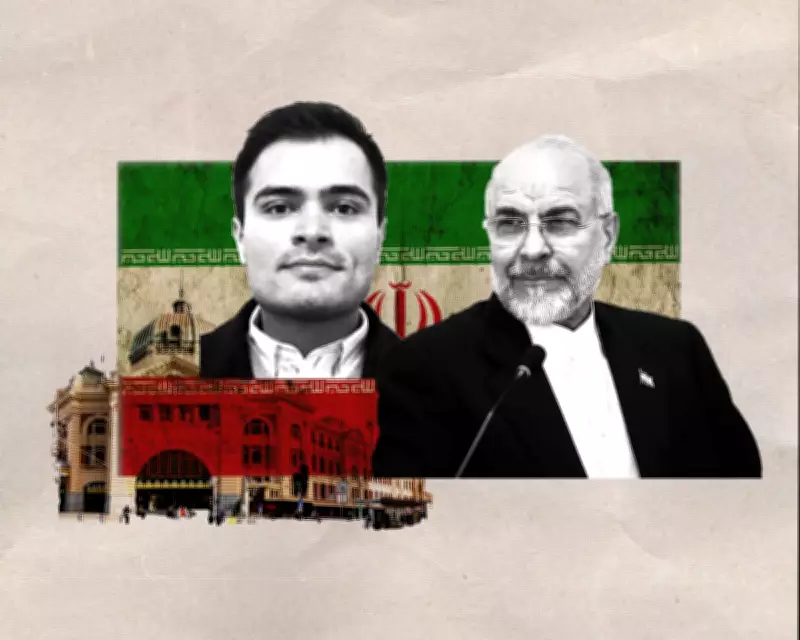
Eshagh Ghalibaf, the 38-year-old son of Mohammad Bagher Ghalibaf, Iran's parliamentary speaker and key figure in peace negotiations with the US, has established extensive ties to Australia over the past decade. These ties include rental income from at least one investment property in Melbourne and a research assistant position at the University of Melbourne, raising questions about national security and Australia's handling of sanctions against Iranian officials.
Background of Mohammad Bagher Ghalibaf
Mohammad Bagher Ghalibaf is a powerful Iranian politician who has served as the head of Iran's Revolutionary Guards' air force, police chief, and mayor of Tehran before becoming parliamentary speaker in 2020. He has boasted about his role in beating student protesters and is currently leading Iran's peace negotiations with the US. Despite his controversial background, Australia has never imposed sanctions on him, unlike Canada.
Eshagh Ghalibaf's Activities in Australia
Eshagh Ghalibaf first arrived in Melbourne in early 2014, studying English and a bridging course before pursuing a master's degree in engineering at the University of Melbourne between 2015 and 2018. During this time, he lived in the inner-city suburb of South Yarra and worked as a research assistant at the university's Centre for Spatial Data Infrastructures and Land Administration (CSDILA) from July 2016 to June 2018, working about seven hours a week during term times.
According to documents filed in Canada's federal court, Eshagh received two monthly payments of $1,353.63 from a Melbourne-based real estate agency in late 2018, described as "rent collected from tenants." The property in question has not been identified, and records from the agency have been removed in accordance with Victorian legislation.
Visa and Residency Issues
Eshagh Ghalibaf secured temporary residency in Australia until September 2022 but did not pursue permanent residency. He also applied for permanent residency in Canada but was refused twice. In 2013, his visa application to study in Ottawa was rejected due to lack of documentation. In February 2024, Canada's immigration minister announced that his permanent residency application was refused, citing the Iranian regime's acts of terrorism and human rights violations.
Security Concerns
British-Australian academic Dr. Kylie Moore-Gilbert, who was detained in Iran for over 800 days on espionage charges, said Eshagh's presence in Australia was another example of the federal government "dropping the ball on vetting and excluding" high-level Iranian officials and their close relatives. She noted that such individuals pose a security threat to the Iranian-Australian community, which is overwhelmingly anti-regime, and to the Jewish community.
NSW Liberal senator Dave Sharma said the revelations showed Australia's sanctions framework was "full of holes" and that actors with close ties to the Iranian regime should not be able to operate with liberty in Australia.
Diplomatic Relations
Australia expelled Iran's ambassador to Canberra in August 2024 after credible information that Iran directed at least two attacks against Australia's Jewish community. Australia's embassy in Iran also suspended operations. In November 2024, the federal government listed Iran's Islamic Revolutionary Guard Corps (IRGC) as a state sponsor of terrorism.
Dr. Rodger Shanahan, a former fellow at the Lowy Institute, said the breakdown in diplomatic relations and the listing of the IRGC meant visa applications by children of Iranian regime officials would now be viewed in a "completely different light."
Financial Resources
When Eshagh first applied for Canadian permanent residency in January 2019, he disclosed access to more than US$148,000 from two Iranian bank accounts and over AU$15,000 from Australian bank accounts. In Iran, he worked for a civil engineering firm owned by Seyyed Abouzar Khazraei Afzali, the son-in-law of Qassem Suleimani, the former head of Iran's Quds Force killed in a US drone strike in 2020.
The Department of Foreign Affairs and Trade declined to comment on sanctions compliance or potential future sanctions measures. Ghalibaf and Eshagh were approached for comment but did not respond.