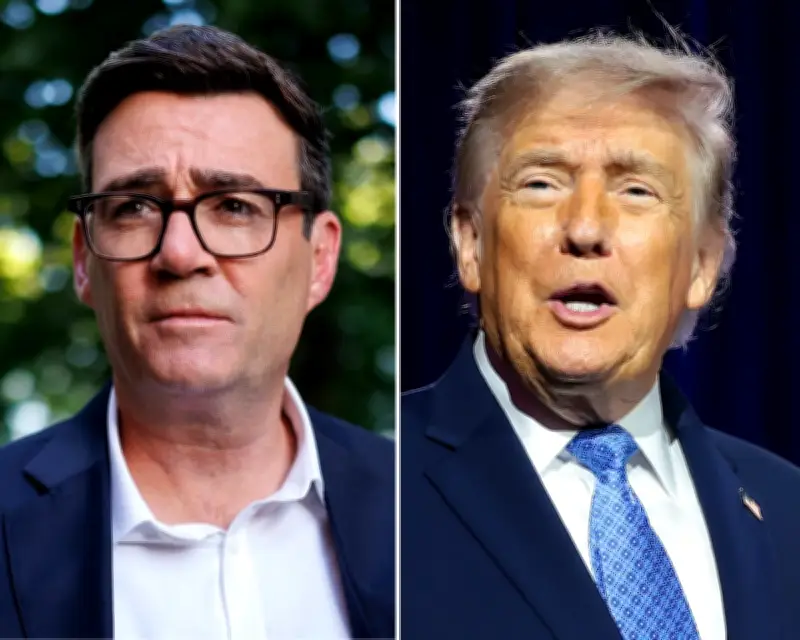
If, as expected, Andy Burnham becomes the British prime minister later this month, one of his first telephone calls is likely to be with Donald Trump. Trump's mother was Scottish and he has a nostalgic fascination with Britain. But managing a relationship with the erratic, transactional and demanding US president has been a diplomatic minefield for Burnham's predecessors.
Burnham's Unknown Status Could Be an Asset
Like most Americans, the US president appears to have never heard of Burnham, who was until recently the mayor of Greater Manchester, a region of 3 million people in north-west England where he has become known as the "king of the north". Asked recently what he knew about the incoming prime minister, Trump replied: "I don't know, I think I see that he was, I guess, the mayor of a town. I hear he's extremely liberal, extremely, so that means he probably won't open up the North Sea."
Burnham has held high office – heading up two big government departments under the Brown government in 2008 and 2009 – but the world has changed dramatically since then. Burnham has previously warned about the "poisonous" nature of US-style politics and said Trump had brought "instability" to the world. Two weeks ago, in his victory speech after winning the election that set him on course for Downing Street, Burnham urged British voters to turn away from the path that "takes us to a divided, dark politics of the kind we see in the United States".
Experts Weigh In on Handling Trump
In Washington, longtime watchers of the alliance do not expect a new face to make any difference. Sidney Blumenthal, a former senior adviser to President Bill Clinton and Hillary Clinton, warned: "Prime Minister Andy Burnham will be treated like other British prime ministers by Donald Trump. The special relationship has been replaced by the abusive relationship. He shouldn't take it personally. Keir Starmer was treated abusively but so was Theresa May. Trump has very low esteem for British prime ministers and extreme deference to the King of England. Trump wishes to be seen as royalty and his idea of an equivalent is a king, not a prime minister."
Burnham has near zero name-recognition in the US – but political strategists and foreign policy experts agreed this clean slate could be an asset. Frank Luntz, a consultant and pollster who spends significant time in Britain, said: "They'll probably think he's a football star. No one in America is going to know who he is. But that's an opportunity to start afresh."
Advice: Treat Trump Like a Poorly Informed Constituent
Larry Jacobs, a professor of political science at the University of Minnesota, added: "Burnham is as unknown a high-level British politician as we've seen in decades. From the man in the street to most people in Congress, he is a nobody." Jacobs said: "The starting point for dealing with Trump is to accept you're dealing with an aberration, a highly unstable, erratic president who has very low self-esteem. If you do anything that kind of disrupts Trump's sense of himself, the relationship is over. My advice to Burnham would be treat Donald Trump like a constituent back home who is poorly informed and quite emotional. How would you deal with that person?"
Nina Sawetz, a communications adviser who worked with Burnham's mayoral team, said the incoming prime minister's instinctive reaction to any Trump provocation would be to focus on "outcomes and interests for the UK, rather than compete on personalities". "My expectation is that Trump will initially interpret Burnham's refusal to engage in a running public battle as a sign that he has the upper hand. I think that would be a misreading," she added.
Potential Common Ground and Pitfalls
One clear commonality between Burnham and the US president is their shared view that for decades mainstream politics has not worked for ordinary people. Trump may find that he admires Burnham's desire to shake up the staid and over-centralised British political establishment. Philippe Dickinson, deputy director of the transatlantic security initiative at the Atlantic Council thinktank in Washington, said: "Mamdani is obviously on a very different side of the political spectrum but his identity isn't 'I'm the anti-Trump guy'. It's about his policy platform domestically in New York. For Andy Burnham, there are potentially some lessons there."
Others believe Burnham should be prepared to cut deals. Joel Rubin, a former deputy assistant secretary of state, advised: "Burnham needs to come in with an agenda of what he needs from the US to advance his domestic goals, and to be ready to offer up tangible goodies to the US that will help Trump and the American people." Conversely, other experts warn that bowing to Trump would be a diplomatic failure and domestic suicide. Brendan Boyle, a Democratic congressman from Pennsylvania, notes that "any leader who takes on Trump benefits domestically from doing so," whereas if Burnham says "absurd, obsequious things in public, he would get absolutely hammered by his electorate".
Richard Stengel, a former undersecretary of state in the Barack Obama administration, urges Burnham to maintain a distance and adopt a "tough love stance". He cautioned: "First of all, I wouldn't wear a red tie under any circumstances. A red tie signals that you're lying down. That universal European response of kowtowing to him and sucking up to him just turns out to be a poor strategy. He turns on everybody so even if he forms an early 'Oh, he's my friend', he'll eventually turn on you. Burnham needs a certain distance." Stengel added: "I would no longer mention the special relationship. That is a dog that doesn't hunt any more and Americans don't get it and I don't know if the Brits do and it also seems to someone like Trump like you're being deferential."