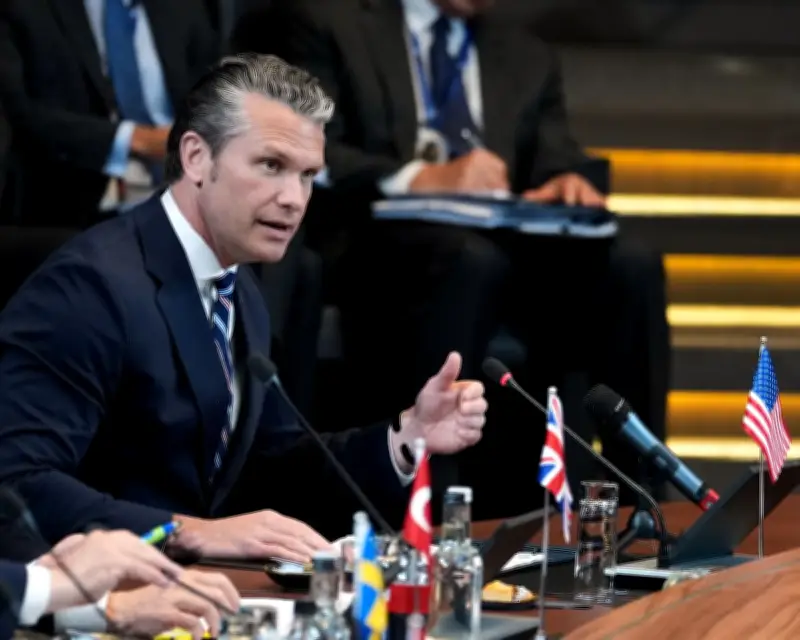
US Defence Secretary Pete Hegseth has announced a review of the US military presence across Europe, delivering a combative address to NATO allies in which he threatened to reduce force numbers in countries that spend the least on defence. Speaking at a meeting of NATO defence ministers in Brussels, Hegseth accused some nations of 'free riding' and criticised others for not allowing their airbases to be used by US jets during bombing operations against Iran in the spring.
Although Hegseth's remarks were made behind closed doors to allies, including the UK's new defence secretary Dan Jarvis, the Pentagon briefed them out as part of its ongoing push for Europe to increase military budgets. Hegseth stated that the review would be 'a real review' where 'our annual NATO dues will be contingent on other countries meeting their defence spending targets,' implying that NATO would become 'a two-way street' from the US perspective.
The Trump administration wants European NATO members to take the lead in defending their continent against Russia and to raise defence spending to 3.5% of GDP by 2035. All members except Spain signed up to this principle at last year's leaders' summit in The Hague. Hegseth added, 'It's a review that some countries will fail and others will pass with flying colours,' suggesting US forces could be withdrawn from lower-spending nations or those struggling to meet the long-term target.
Cuts under consideration include redeploying a third of the 150 US F-16 and F-15 jets designated for NATO, along with refuelling and reconnaissance aircraft, bombers, and drones. Concerns have been raised that these changes could affect NATO's ability to monitor Russian submarines in Europe and its overall deterrence against Moscow.
NATO Secretary General Mark Rutte said Hegseth was trying 'to keep the pressure on' with his outspoken remarks. 'I'm happy he does this, because we need to speak the truth to each other,' added the former Dutch prime minister, who is considered to have a warm relationship with Donald Trump.
Last week, John Healey resigned as UK defence secretary after Keir Starmer would only commit to increasing UK military spending to nearly 2.7% of GDP by 2030. Healey had wanted the UK to reach 3% as a pathway to 3.5%. Arriving at the summit, Jarvis, Healey's replacement, said, 'This is a moment of challenge,' but had nothing new to say on overall defence budgets. Later, the UK announced it would spend £750 million equipping Ukraine with drones and air defence missiles, funded by loans secured against Russian central bank assets.
Hegseth told Jarvis it was unacceptable for NATO allies to be 'standing at the end of a runway with a clipboard to decide what flies,' referring to restrictions placed across Europe on US jets bombing Iran. The UK allowed the US to strike Iranian missile launchers from RAF Fairford in Gloucestershire, but most other European nations did not permit the US air force to fly over their territory or use their bases for bombing or refuelling.
In his speech to peers, Hegseth complained that while the US had 'defended Europe for generations,' it got little in return when Trump wanted to use European bases to attack Iran in the spring. He said: 'Iranian targets threaten European interests even more directly than they threaten us, but too many of our allies said no, or tried to drown us in arcane legal debates, or criticised us publicly for doing what they aren't prepared or able to do themselves. It was shameful.'