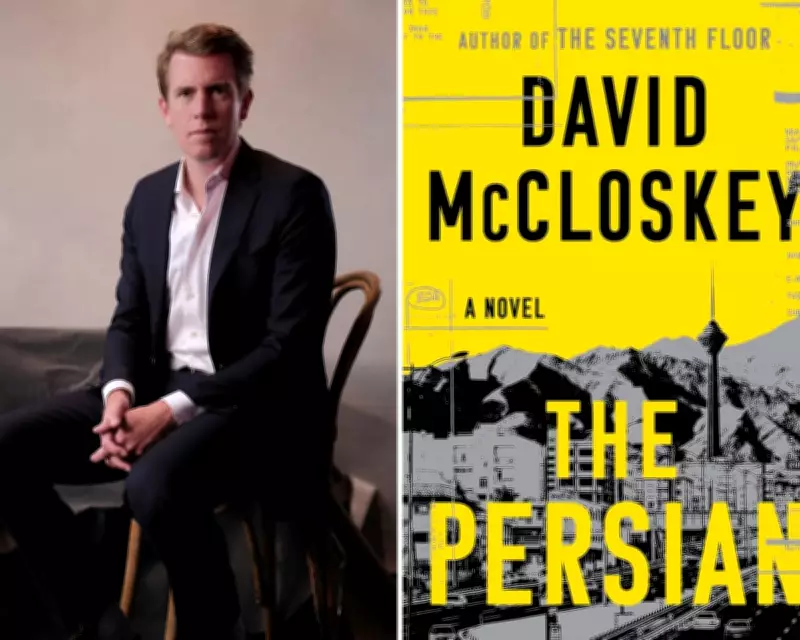
Former CIA Analyst Expresses Surprise at Mossad's Iran Intelligence Capabilities
As the author of a novel depicting Mossad's covert operations inside Iran, David McCloskey was less shocked than most by the stunning assassination of Ayatollah Ali Khamenei, the theocratic regime's most powerful figure, in a precision Israeli strike. What caught him more off guard were reports that the up-to-the-minute, pinpoint accurate intelligence essential for its success was provided by the Central Intelligence Agency.
"I was surprised by that, to be quite honest," McCloskey revealed. "From what I have seen on open-source intelligence, the Israelis had essentially developed a capability to tap existing public CCTV networks in Tehran and then layered on top of that, a bunch of data integration software that enable them to build targeting packages on senior leaders."
Comparing Intelligence Capabilities
McCloskey, a former CIA analyst who now co-presents the espionage podcast The Rest Is Classified with Gordon Corera, the BBC's former security correspondent, means no disrespect to his former employer. He praises analysts on the Iran unit at the CIA's headquarters in Langley for doing sterling work penetrating and understanding a country that the US had no direct access to since the 1979 Islamic revolution.
"There were a lot of people that work on Iran," he said, recalling his days next to the Iran section on the headquarters' seventh floor, where he served as an analyst on the Syria desk. "We have an interest in stealing state secrets from Iran and finding people who will sell us those secrets. Iran is a hard target, but it's also one of our top targets because it's a country that's been in opposition to us since the revolution."
However, McCloskey makes a crucial distinction: "When you compare it to what the Israelis collect and what the Israelis are capable of doing inside Iran, it's not at that level."
Israel's Intense Focus on Iran
This revealing insight says much about Israel's intense focus on Iran's Islamic regime, which has refused to recognize the Jewish state since the revolution that deposed the western-backed former shah, Mohammad Reza Pahlavi – a firm Israeli ally – and stands accused of seeking its destruction.
Israeli strikes, both in the current military campaign and in last June's 12-day war, have decapitated much of Iran's military and political leadership. Apart from Khamenei, who was killed along with his wife and several other family members on February 28th, Israel has exploited a startling level of inside knowledge to eliminate multiple high officials, including:
- Intelligence chiefs
- Senior commanders of the Islamic Revolutionary Guard Corps (IRGC)
- Key scientists working on Iran's nuclear program
Last month's strike also injured Mojtaba Khamenei, Khamenei's son who has been chosen to succeed his father as Iran's supreme leader, making him a potential target of future strikes.
The Persian Novel: Fiction Meets Reality
It is the Israeli fixation with Iran – the driving force behind the current war – that underpins McCloskey's latest novel, The Persian, published last year. The book depicts the tale of an Iranian-born agent, Kamran Esfahani, who is dispatched to Tehran by the Mossad undercover as a dentist.
His mission is to penetrate a Revolutionary Guards unit supposedly dedicated to killing Jews in Israel and elsewhere. Things go disastrously awry, landing Kamran in Tehran's Evin prison, where he undergoes torture and is forced to record his espionage activities in a written confession that serves as the backbone of the novel's narrative.
For McCloskey, fact met fiction when he realized that the book's high-risk operation could only have been run by the Mossad, rather than his former colleagues in the CIA – something he attributes to the Israeli agency's much deeper penetration into Iranian society.
"The Israeli example has shown a committed foreign intelligence service can penetrate Iran and can find plenty of people inside that system who are willing to collaborate with outsiders for quite a variety of motivations," he explained.
Cultural and Linguistic Advantages
Despite the regime's fearsome nature and constant paranoid hunt for foreign spies, Iran's vast size, along with multiple "seams and fissures" in Iranian society, makes it relatively easy prey for intelligence agencies, McCloskey argues.
"It's a huge place with multiple international borders, so getting men and material and technology and stuff in and out of Iran is not very hard for a spy service – even though it's an authoritarian state that ostensibly seemed to have control of its borders," he noted.
The US and Israel are both home to sizable Farsi-speaking populations, the offspring and descendants of Iranians who fled the repressive religious rule imposed after the revolution. But Israel, McCloskey said, has shown the greater motivation to infiltrate Iran, driven by the twin imperatives of shared Middle East geography and a sense of existential threat from Iran's hostile theocratic rulers.
"The Israelis have a large population inside Israel who speak Farsi, are in fact Persian and came out of the Persian Jewish diaspora," he emphasized. "So they've got the linguistic and cultural capabilities to do that kind of work."
Different Approaches to Recruitment
The CIA, by contrast, has shown less inclination to tap into the US's Farsi-speaking population to recruit agents that could be spirited into Iran – deterred in part, McCloskey believes, by the agency's strict security clearance rules.
"I would be willing to bet that if you looked at the Mossad's efforts to integrate Persian speakers and those with Persian backgrounds into its service, and compared that to the CIA's effort... that Mossad's effort is probably very strategically driven and thoughtful, because they view it as an existential problem. Ours is not," he concluded.
McCloskey – who, like most of his former CIA colleagues, has never been to Iran – was forced to lean on friends in the Iranian diaspora in Dallas, where he now lives, for a crash course on the country's often bewildering array of cultural mannerisms to imbue his novel with authenticity, bolstered by watching endless YouTube videos to give him knowledge of Iranian terrain and street scenes.
That lack of first-hand, on-the-ground knowledge has not resulted in him being surprised by the Iranian regime's stubborn resistance in the current conflict. "What surprised me is that the war started, that we did it," he reflected. "I find it surprising that we're what, over a week into this thing, and we still don't have a well-articulated theory of victory. But maybe I shouldn't be surprised by that."