Around 5,500 schoolchildren explored science and technology at New Scientist Live 2026 at ExCeL London earlier this month, with Middlesex University's interactive exhibits among the highlights on October 12. The event showcased the university's expertise in science, technology and healthcare, drawing pupils from North London schools including Barnet and Southgate College, Bishop Douglass Catholic School in East Finchley, and London Design and Engineering UTC in Newham.
Interactive exhibits capture pupils' interest
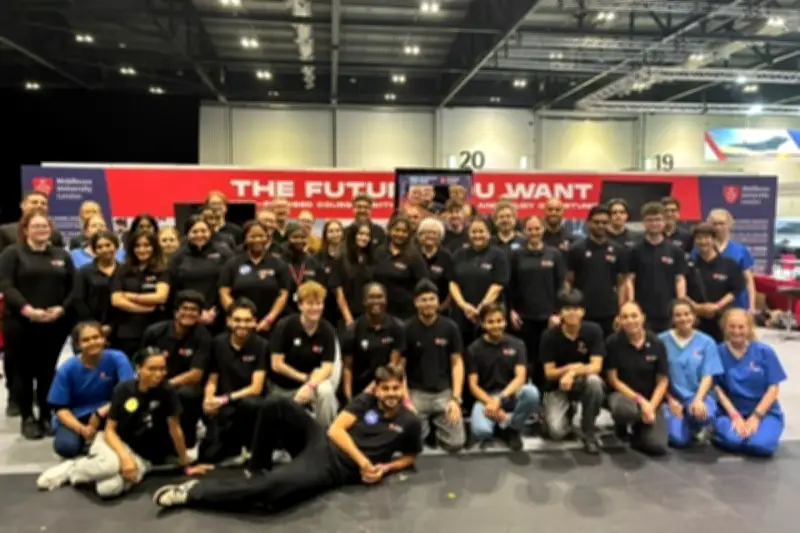
Middlesex University's attractions included a virtual reality rollercoaster, robot demonstrations, brain activity displays, and a molecular model-building competition. Visitors could also take part in strength and jump height tests, with 103 Middlesex students and 59 staff supporting 15 different exhibits.
In the robotics zone, students programmed miniature robots to move cubes using block programming, and could pose for selfies with “Baxter,” a friendly robot. The healthcare stand trained 1,200 people in CPR, while around 1,000 visitors took a “chaotic selfie” at an interactive light display demonstrating the science of chaotic systems.
Students and staff share their experiences
Afsaneh Rasouli, a chemistry lecturer at Barnet and Southgate College, said: "This has increased our students’ knowledge of STEM subjects and given them confidence after trying out the interactive exhibitions put on by Middlesex University. From the robot displays to the VR rollercoaster and CPR demonstrations, our pupils have got a lot out of the day."
Pratham Lohia, a mechatronics and robotics student at Middlesex, said: "Our displays shows visitors that robot technology can have multiple applications and they’re a great way to engage pupils in STEM subjects." Angelo-Reny Baria, a first-year design engineering student, helped run the VR rollercoaster, he said: "I’ve met other Middlesex students and seen all the displays; it’s been great for my personal development."
Impact on pupils and university community
Eric Johnson, a computer science student, supported an exhibit teaching visitors how to train a computer to recognise objects using artificial intelligence, he said: "It’s been a huge opportunity to see the breadth of STEM work across Middlesex University, while my own understanding and confidence has improved." Matilda, 14, from Harpenden, won a prize for quickly building molecular models and said: "All the exhibits have been very hands-on and interactive, helping students to think for themselves."
Professor Mehmet Karamanoglu, Middlesex University's Director of Industry Partnerships and Outreach for the Faculty of Science and Technology, said: "Our students benefit a great deal from involvement in an event like New Scientist Live, developing their confidence in communicating and explaining science and technology to thousands of visitors." The event provided pupils with hands-on STEM experiences, while Middlesex students gained practical skills in public engagement and communication.