Baloch Activist's Prison Dispatch Details Solitary Confinement and Family Harassment
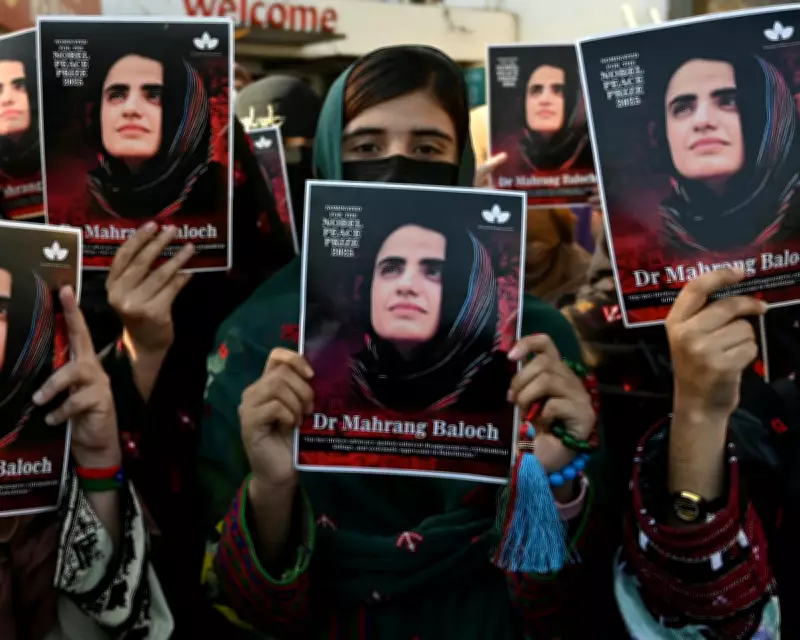
In a powerful dispatch from solitary confinement within a Pakistani women's prison, Dr. Mahrang Baloch, a prominent human rights activist, has detailed her year-long isolation, deteriorating health, and the relentless targeting of her family due to her political activism. The founder of the Baloch Yakjehti Committee (BYC), an organization advocating against human rights violations in Balochistan, writes from Block Nine of Central Jail Huda in Quetta, where she recently turned thirty years old.
Life in Solitary Confinement
Dr. Baloch describes being held separately from other female inmates alongside two fellow BYC defenders, with authorities labeling them as political prisoners who might influence others. "Books and, until last October, exercise have kept me sane," she writes, noting that severe back and joint pain have since prevented physical activity. As a medical doctor, she attempted self-treatment before hospitalization in February revealed diagnoses of a slipped disc and radiculopathy, involving compressed nerve roots in her spine.
Family Under Persistent Pressure
The activist reveals that her family faces continuous harassment linked to her work. Her cousin Salal Baloch was forcibly disappeared, while another nineteen-year-old cousin, Saifullah Baloch, was taken on March 12 and remains missing. Her brother is on Pakistan's fourth schedule, a watch list imposing strict monitoring, travel bans, mandatory police reporting, and financial restrictions for up to three years, with regular harassment from the counter-terrorism department. Her sister faces charges and harassment for speaking out at press conferences demanding their release.
"Since our arrest in March last year, every effort has been made to break us and force us to abandon our political struggle," Dr. Baloch states, citing instances where fellow activist Beebow Baloch was beaten during transfer and Beebarg Zehri developed a urethral stricture due to poor prison conditions.
The Baloch Struggle for Justice
Dr. Baloch frames her imprisonment within broader decades of injustice against the Baloch people, emphasizing that her purpose is to fight for justice and prosperity for Baloch families. She clarifies that while armed groups exist in Balochistan province, conflating them with peaceful political movements constitutes propaganda. The BYC operates firmly within Pakistan's constitution, committed to resisting human rights violations through peaceful means, with Dr. Baloch consistently condemning all violence harming innocent people in the region.
Reflecting on her incarceration, she notes that memory sharpens in prison, with moments from her life returning with clarity centered on Balochistan, her father, and brave Baloch women participating in sit-ins. "These memories carry pain and strength, leaving me with calm certainty: despite state violence and collective punishment, the Baloch continue their peaceful resistance," she concludes.
Global Spotlight on Digital Violence and Artistic Expression
The dispatch coincides with increasing global attention on digital violence facing activists, particularly in Ethiopia where threats against women speaking out have escalated. Meanwhile, Ivorian artist Laetitia Ky highlights the transformative power of art through her sculptural hairstyles, using her work to challenge colonial beauty standards and celebrate natural hair and identity. Her creations, which take up to six hours to craft, convey messages about feminism, identity, and women's experiences, with her recent image featuring her sister symbolizing trust and sisterhood.
Additional developments include author Saara El-Arifi's reimagining of Cleopatra through contemporary experiences of women of color, the Adolescent Girls Summit in Côte d'Ivoire addressing child marriage and sexual violence, and Elinor Cleghorn's exploration of motherhood in her new book A Woman's Work. These stories collectively underscore ongoing global struggles for human rights, gender equality, and cultural representation across diverse contexts.