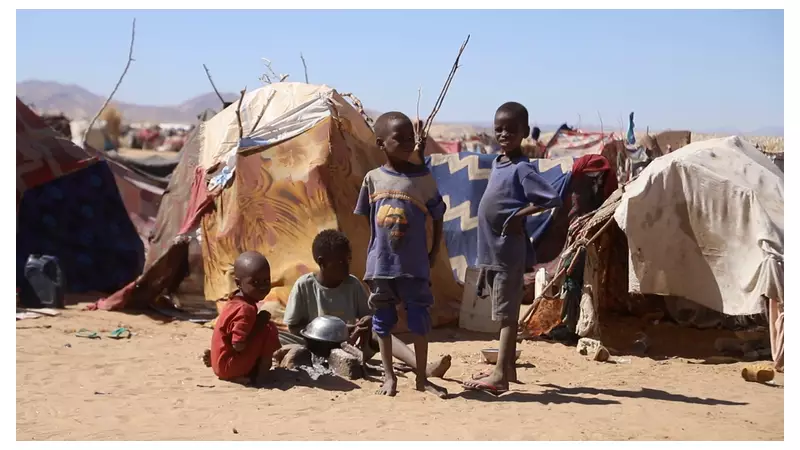
One thousand days of brutal conflict have plunged Sudan into a catastrophic humanitarian disaster, with nearly 30 million people – close to 70% of the population – now reliant on aid for survival.
A City in Ruins: The Fall of Al Fashir
The sheer brutality of this prolonged war is encapsulated by the paramilitary Rapid Support Forces' (RSF) capture of North Darfur's capital, Al Fashir, in late October 2025. Exclusive footage obtained secretly for Sky News paints a picture of utter devastation.
Once a bustling historic capital, Al Fashir is now a hollow shell. Its streets stand empty, and market squares are littered with the twisted metal remnants of munitions. Buildings, pockmarked by bullets and blasted by bombs, barely remain standing.
Civilians who risked returning to search for missing loved ones and salvage valuables have dismissed RSF propaganda videos showing cheering crowds. They describe a barren, abandoned city still haunted by the massacres that accompanied the takeover.
Doctors Held Hostage and a Collapsed Health System
In the aftermath of the city's fall, hundreds of civilians, including doctors, journalists, and politicians, were held for ransom by the RSF. One doctor, using the pseudonym Fatima for her safety, recounted being assaulted by fighters and detained.
"I saw five corpses on the street in our neighbourhood," the 28-year-old Dr Fatima told Sky News. "At the hospital, there were people with maggots in their wounds from how infected they were."
She described a medical system with no capacity to offer proper care, where videos of people being treated were staged for show. Many of the severe injuries stemmed from a relentless barrage of shells dropped by the RSF in the weeks preceding the capture.
Foreign Weapons Flooding the Battlefield
The conflict has been exacerbated by a significant influx of foreign weaponry over its 1,000-day span. Open-source investigators have documented RSF fighters using advanced equipment across the country, including at sites of severe atrocities.
Sky News analysis identified a Panthera T2 armoured vehicle, produced by the UAE-based company Minerva Special Purpose Vehicles (MSPV), being used by the RSF during the capture of Al Fashir in October 2025 and later near Babanusa. The same vehicle model was previously operated by UAE-backed forces in Libya.
Emaddedin Badi, a senior fellow at the Global Initiative Against Transnational Organized Crime, stated that supply lines supported by the United Arab Emirates via networks in Libya or Chad are enabling this flow, contravening arms embargoes.
While the UAE categorically denies supporting either side, further analysis by Sky News' Data and Forensics team has uncovered evidence of RSF using captured Chinese-produced AH-4 Howitzers, which were imported by the UAE in 2019.
The proliferation is so advanced that weapons analysts suspect Sudan's vast warscape is being used to battle-test new equipment. By early November 2025, weapons manufactured in the same year were already being deployed on Sudanese battlefields.
A Nation Scattered and Abandoned
The human cost is immeasurable. Millions have been displaced, forced into camps across the country. Among them are even Sudanese Armed Forces (SAF) soldiers who laid down their arms after the fall of Al Fashir and now live without military support.
One such soldier, Ali Adam, described a doomsday scenario of total collapse. "There were no instructions from the top command. Everyone just scattered. Everyone had to save themselves," he said, his eyes widening at the memory of the chaos. "It was every man for himself."
As large-scale humanitarian funding dwindles and volunteers bear the brunt of supporting devastated communities, the people of Sudan are left deprived, displaced, and longing for a political solution to end the violence tearing their nation apart.