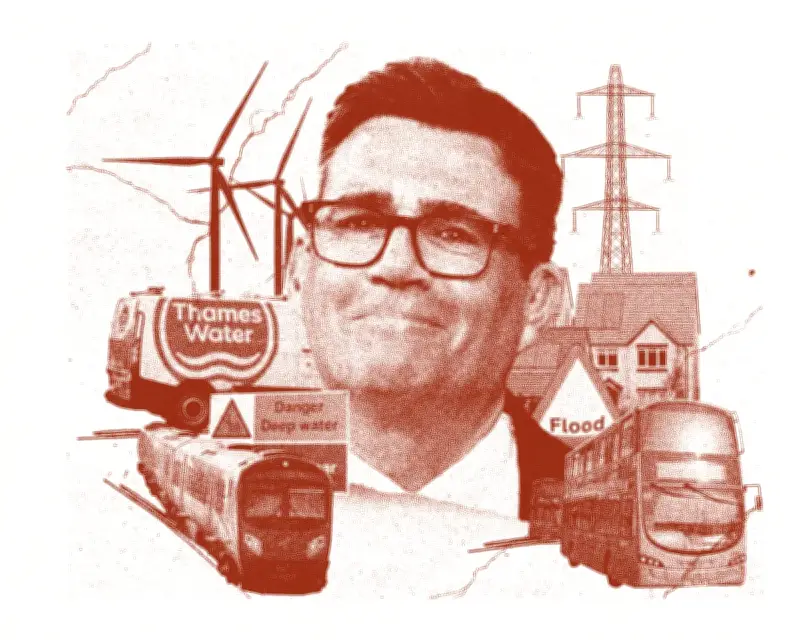
Andy Burnham, the Prime Minister-in-waiting, is set to outline his economic priorities in a speech on Monday, with a focus on expanding public control over essentials like water, energy, transport, and housing. His campaign rhetoric has emphasized running these sectors for the public interest, not private profit.
Choosing a chancellor as a test of radicalism
Burnham's choice of chancellor is seen as a critical indicator of his commitment to nationalisation. Ed Miliband is viewed as a plausible candidate willing to face down industry lobbying, while Wes Streeting, the bookies' favorite, has focused on EU alignment and planning deregulation without mentioning public ownership. Neal Lawson of Compass highlights the distinction between public control and full ownership, noting that evidence suggests utilities are uncontrollable without public ownership.
Thames Water as an early test case
The future of Thames Water presents an early test for Burnham. The heavily indebted company could collapse into the state's special administration regime (SAR), or its bondholders might take over. Advocates of nationalisation argue that ministers could transform Thames into a public corporation. Mat Lawrence of Common Wealth cautions that state capacity must be built slowly, but campaigners like Cat Hobbs of We Own It push for more aggressive use of SAR.

Common Wealth's model of public ownership
Common Wealth's policy paper, "The Productive State," argues that essentials like transport, energy, water, social care, and housing have become too expensive due to shareholder profits, leading to higher inflation and interest rates. The thinktank advocates for public corporations operating with clear mandates, insulated from Treasury short-termism and shareholder extraction, harking back to the Central Electricity Board of 1926. Research by Arthur Downing at LSE shows that regional public generators cut prices by avoiding shareholder payouts.
Fiscal constraints and quick wins
Burnham faces fiscal constraints, with debt-to-GDP at 96% and a £137bn debt interest bill. Lawrence suggests focusing on quick wins like franchising powers for metro mayors to create integrated transport networks, and development corporations to boost housebuilding. Great British Railways could coordinate routes and fares. Great British Energy could be scaled up to enter generation. Labour's 2019 manifesto proposed bonds-for-shares nationalisation, but the Institute for Fiscal Studies estimated upfront costs of "many tens of billions."
Burnham's every word will be watched to see if he is ready to "go big," as Ed Miliband's book title suggests.