
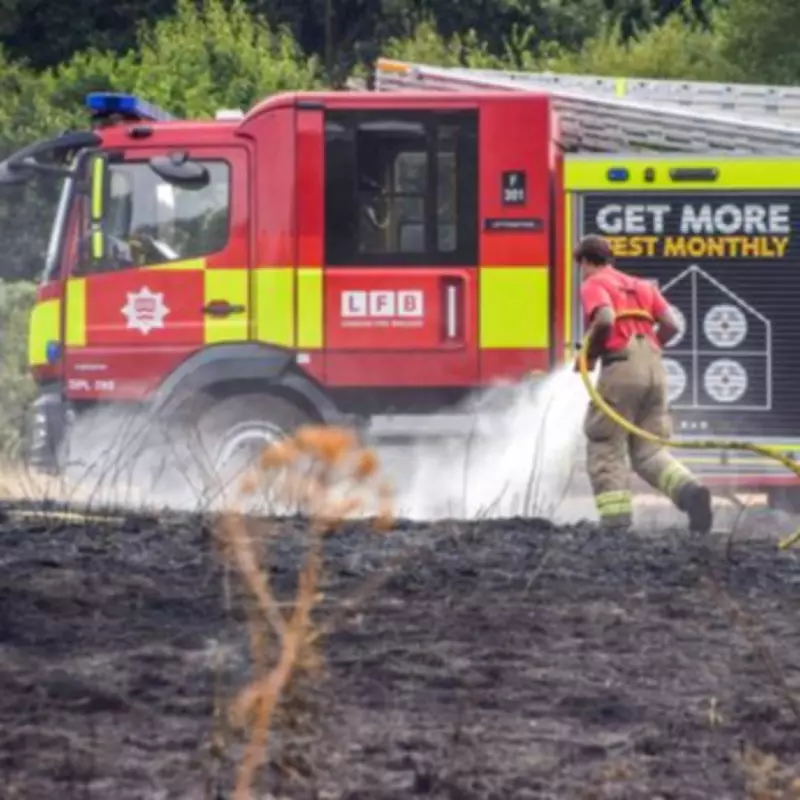
London's fire and rescue service is confronting a perfect storm of emerging threats that will define its challenges for years to come, according to the capital's top fire officer. Fire Commissioner Jonathan Smith has issued a stark warning about the "multiplicity" of risks facing the city, from climate-induced wildfires to the explosive growth of e-bike blazes and the complexities of safeguarding London's ever-growing skyline.
The Changing Landscape of Firefighting
Commissioner Smith, who assumed his role in July last year, told the London Assembly that cultural shifts and climate-related developments over the past decade have fundamentally transformed the firefighting landscape. "When I took over, the first thing we had to do was to make sure the organisation was still postured appropriately to deal with what we knew was going to be a very, very busy wildfire summer period, which has now become the new normal," he explained during Thursday's scrutiny session.
The veteran firefighter emphasised that extreme weather patterns have created year-round challenges, with wildfire seasons extending and autumn flooding becoming increasingly common. "That had always been an issue that we dealt with historically, but the nature of the extreme weather and what we're now seeing on a regular basis throughout, not just the summer period, but then going into flooding in the autumn and winter is now the new normal for London."
The Lithium-Ion Battery Crisis
Perhaps the most dramatic escalation in risk comes from the proliferation of lithium-ion batteries powering personal transport devices. Commissioner Smith revealed alarming statistics showing how e-bike and e-scooter fires have multiplied eightfold in just five years. "When we look at things like e-bikes and e-scooters last year, we had a record number - over 200. Back in 2020, the number was around 25 - this is a risk that continues to develop at pace."
The London Fire Brigade attended 171 e-bike fires in 2025 alone, with the Commissioner drawing a sobering comparison to historical domestic hazards. "Lithium-ion batteries are now the new chip pan in terms of what we're dealing with as an organisation," he stated, referencing the once-common kitchen fires that plagued previous generations of firefighters.
Architectural Challenges and Daily Rescues
London's vertical expansion presents another layer of complexity for fire safety planning. Commissioner Smith pointed to the capital's "complicated built environment" which requires robust regulation to prevent tragedies, noting that this task becomes increasingly difficult as "London continues to build high."
The operational demands on firefighters remain intense, with crews rescuing an average of six Londoners daily from various emergencies and extracting someone from a burning building every three days. "The operational pressure on the organisation is significant because of the variety of incident types that we now expect a modern fire rescue service to deal with, particularly one that's based in a global city, like London," Commissioner Smith explained.
Funding the Fight Against New Threats
To meet these evolving challenges, Commissioner Smith acknowledged that additional funding is essential to maintain London Fire Brigade's effectiveness. "Further funding was needed to ensure London Fire Brigade could be an 'agile' and 'modern' force that can deal with developing and emerging risks going forward," he told Assembly Members.
The financial picture includes a recent budget allocation that will see the average Band D property contributing an extra £20.13 through the Greater London Authority Precept, with £5.13 of this directed specifically to the fire service. This generates an additional £19.3 million towards the Brigade's overall £251.1 million annual budget.
Budget documents highlight that as Britain's largest fire and rescue service operating in an "extremely complex environment," continued investment is crucial. The additional funds will support maintaining operational capabilities and response times while investing in infrastructure, including a new headquarters and the refurbishment of Lambeth Fire Station. The draft budget allocates an extra £16.4 million for "preparedness and response" alongside £5.9 million more for capital financing of major projects.
Cultural Transformation and Health Risks
Deputy Mayor Jules Pipe, who holds responsibility for the fire service, emphasised that ongoing "culture change" within the force remains a priority. Recent staff surveys show reductions in harassment, bullying and discrimination, though safety standard enforcement requires further attention.
A sobering report from the London Assembly Fire Committee this week revealed that firefighters face increased cancer risks from constant exposure to toxins and pollutants. While personal protective equipment shortages contribute to the problem, investigators found safety protocols are sometimes compromised for reputational reasons.
Commissioner Smith reflected on how attitudes have evolved, recalling practices that would now be unthinkable. "As a firefighter myself, you'd often go to a car fire 25 years ago without breathing apparatus and you'd see it as a badge of honour - I look at that now with horror. We have to see that cultural shift...making sure people are showering properly, washing their hands...there's still more work for us to do."
As London continues to evolve, its fire service must adapt simultaneously to technological, environmental and architectural changes while maintaining the cultural transformation needed to protect both the public and firefighters themselves from an increasingly complex array of threats.




