
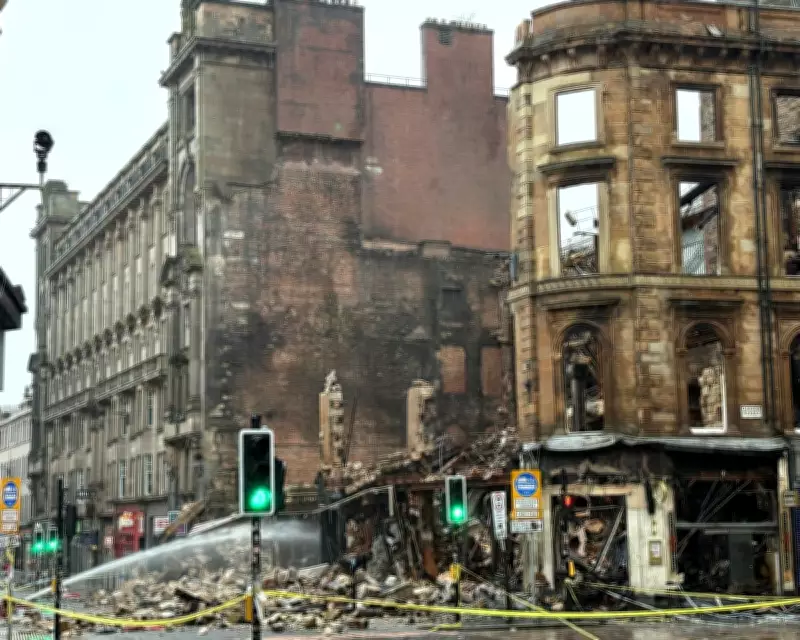
Glasgow Fire Exposes Critical Gaps in Scotland's Emergency Response Capacity
The charred remains of a Victorian office block on Union Street in Glasgow continue to be hosed down by firefighters, following a devastating blaze that erupted on Sunday. This incident has ignited serious concerns about the capacity of Scotland's fire service to handle large-scale emergencies, as it was revealed that Glasgow's sole fire engine equipped with a high-reach ladder was unavailable during the critical hours of the fire.
Delayed High-Reach Response Raises Alarms
The Scottish Fire and Rescue Service confirmed that while standard fire engines arrived at the scene within minutes of the initial 999 call, the nearest available high-reach appliance had to be dispatched from Coatbridge, located 18 kilometers away. In light traffic, this journey took approximately 26 minutes, highlighting a significant delay in deploying essential equipment for tackling such an intense blaze.
This situation underscores the impact of recent cuts implemented in 2023, which reduced the number of high-reach fire engines across Scotland from 26 to just 16. Currently, only one such vehicle is stationed near Glasgow city centre in Maryhill, with another in the nearby town of Johnstone. On the day of the Union Street fire, other major incidents, including fires in Glasgow's east end and Dumfries, as well as a hazardous materials event in Edinburgh, may have further strained resources and diverted available high-reach vehicles.
Political and Union Reactions to Service Cuts
Scottish Labour leader Anas Sarwar confronted First Minister John Swinney during First Minister's Questions, demanding an immediate investigation into how the reduction in fire service capacity might have affected the response to the Glasgow blaze. Sarwar emphasized the need for urgent lessons to be learned, stating, "We don't know right now what difference the reduction in fire service capacity would have made on Sunday."
Colin Brown, executive council member of the Fire Brigades Union Scotland, expressed deep concerns about the broader implications of resource shortages. He noted that Scotland's average response time has increased by about a minute and a half since 2016, and while the initial response at Union Street was swift, with the first pump arriving in six minutes, the availability of high-reach appliances remains a critical issue. Brown pointed out, "The reality is that, as an incident commander, if you make the decision you need additional resources then you need them urgently and you're going to be counting the seconds until they arrive."
Impact of High-Reach Vehicle Unavailability
High-reach fire engines are equipped with a mobile ladder that extends up to 32 meters, compared to the fixed 13.5-meter ladder on standard vehicles. This allows for rapid application of large volumes of water from elevated positions, enhances rescue capabilities, and improves firefighter safety. However, these specialized vehicles are more costly to purchase and maintain, contributing to their limited availability.
During the Union Street incident, standard fire engines were mobilized from multiple stations in and around Glasgow, including Calton, Cowcaddens, and Maryhill, with additional support from outer suburbs and nearby towns. After a request for further assistance, high-reach appliances were called in from locations as far as Greenock, Kilmarnock, Falkirk, and Edinburgh, some over 50 miles away, exacerbating response delays.
Broader Concerns Over Fire Service Sustainability
Brown highlighted a troubling paradox: while First Minister Swinney visited the fire scene on Monday, government discussions were underway regarding potential public sector pay and workforce cuts that could reduce fire and rescue service headcount by an additional 2.5%. This comes amid existing challenges, including fewer firefighters, reduced equipment, longer response times, and station closures.
Sarwar added, "Our fire and rescue service has already faced years of cuts. The tragedy on Sunday must be a wake-up call and a reason to pause." The Scottish Fire and Rescue Service has been approached for further comment on these developments, as the community and policymakers grapple with the urgent need to reassess emergency preparedness and resource allocation in light of this alarming event.




