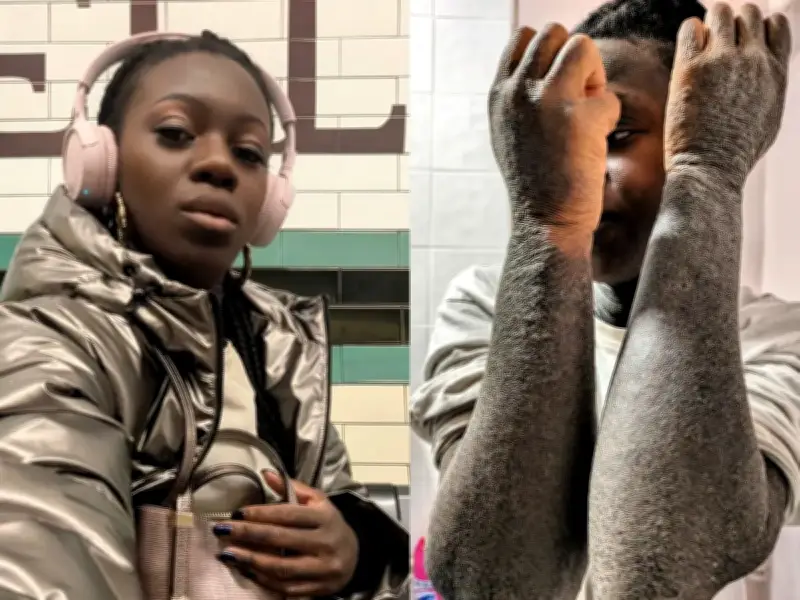
Harriet Williams, a 33-year-old content creator from London, was left completely bald and housebound for seven months after stopping the topical steroid creams she had used for more than two decades to manage her eczema. Williams, who was diagnosed with eczema as a baby, decided to wean herself off the treatment in April 2020, during the first Covid-19 lockdown, after noticing her skin had developed a “paper look” from extended use. By the start of winter that year, she said the symptoms of topical steroid withdrawal (TSW) hit “all at once,” including skin and hair shedding, increased itchiness, an inability to regulate her body temperature, and a “thick layer of skin” that grew over her entire body.
What Is Topical Steroid Withdrawal?
Dr John Akinjolire, an NHS GP working with the travel insurance comparison site PayingTooMuch, told PA Real Life: “Topical steroid withdrawal is a condition that can develop when someone who has been using topical corticosteroids regularly over a prolonged period reduces or stops their use. The timeline for recovery can vary considerably between individuals. Some people may see improvement within months, while for others the process can take significantly longer.”
Williams began using topical steroids at age five, following advice from specialist doctors. Over the years, her prescriptions increased from mild to “highest potency” doses. Despite the treatment, she continued to experience “very aggressive” and “random” eczema flare-ups, triggered by factors such as dust mites, animal dander, seasonal weather changes, food, and stress.
Living with Severe Withdrawal Symptoms
Since giving up topical steroids in April 2020, Williams has experienced several “intense rebounds,” including one that left her housebound for seven months between September 2023 and March 2024. She described the worst flare-up: “A topical steroid withdrawal flare-up can be very debilitating. (At its worst) I couldn't actually move my body and I was in constant pain that I couldn't quite describe. It was very hard to regulate my heat, there was a point where I lost all my hair so I was completely bald and my skin was falling off and I had loads of patches. It was just a really horrendous time for me.”
Reflecting on her childhood, Williams said her eczema was managed by a specialist dermatology team that “tried to keep the flare-ups at bay,” including episodes where she would scratch herself while sleeping until she bled. At school, she was bullied and compared to scaly animals, with children calling her names such as “crocodile” and “tortoise.” Into adulthood, strangers have asked why her skin “looked like that” and if she was a burn victim. “Unfortunately, it is something that I have become accustomed to,” she added.
Decision to Stop Treatment and Its Aftermath
Before giving up steroid treatment at 27, Williams used it every time she had a flare-up, which could be every day for a week if it was particularly bad, or every few months. She tried alternatives like coconut oil and shea butter, but nothing worked as well as the steroid cream. Describing her decision, she said: “I was on the highest potency steroids and it got to a point where there is actually nothing else for doctors to prescribe for me. I hit a glass ceiling with it and there wasn't really a next course of action.” After researching online, she learned about TSW and decided to stop, believing “there had to be more” to her reliance on it.
As a result, her eczema “definitely got worse” before it got better, especially during multiple “rebounds” months after her condition seemed to improve. She said: “It just came back so aggressively and intensely. The rebounds have probably been the most difficult ones to deal with because I thought I was getting over it and I could maybe have clear skin, or even manage eczema, and then I realised that's not the case.”
Impact on Daily Life and Travel
Williams’s eczema flare-ups, which she distinguishes from TSW rebounds, can last longer now that she has stopped topical steroids. She has explored other avenues, including private intolerance tests, and hopes to try allergy tests as well as homoeopathic or neuropathic pathways in the future. “I still experience flare-ups, I still struggle to sleep, and I still have mental battles that I'm dealing with,” she said. “My skin is extremely texturised at the moment, so I want to get to a place where it's more of a calm consistency.”
Everyday activities like going to the gym and travelling abroad can be challenging. On holidays, she packs a full suitcase of products, including emollients, moisturisers, compression gloves, and even her own bedsheets, to manage her condition. On a trip to Barcelona in July 2023, she had not experienced an “intense flare-up” in weeks, so she “packed light,” but then had one during a heatwave and was “close to needing hospital care.” Dr Akinjolire explained: “A sudden change in climate, particularly heat and humidity, increases sweating and can compromise the skin barrier, making it more reactive to irritants it would normally tolerate. Add in new water, different food, unfamiliar fabrics in bedding or upholstery, and disrupted sleep from travel itself, and you have multiple potential triggers converging at once, often in a short space of time.”
Finding Community and Raising Awareness
Williams shares her story on Instagram to her 18,000 followers and is co-founder of EczeMates, a London-based group that hosts social events for people with skin conditions. She emphasised the importance of being open about how eczema and TSW affect Black skin. “As a Black woman, if doctors have even seen topical steroid withdrawal, they're basing symptoms on our white counterparts or people with fairer skin,” she said. “Things like redness of the skin which you wouldn't see in black and brown people. There's this myth that 'Black doesn't crack or Asian doesn't raisin'. But actually, realising there are people outside of my world that are going through this and hearing their journey, I found a community for myself. And I think they found a community too.”