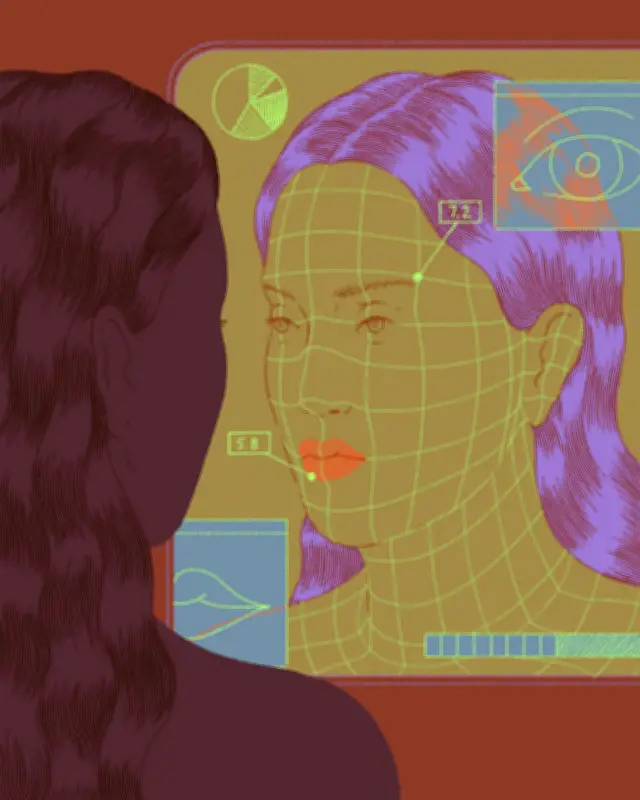
Facial analysis services that charge hundreds of dollars to score facial features and recommend cosmetic procedures are facing criticism from psychologists and researchers who say the services lack scientific validity and can exacerbate mental health issues. These services, including Qoves and Epica, have capitalized on the growing 'looksmaxxing' trend, which treats attractiveness as a quantifiable metric that can be optimized through surgery and injectables.
The lure of 'science-backed' beauty advice
Danielle, a 37-year-old tech worker in Colorado, paid $330 for a 30-page report from Qoves after seeing videos on TikTok. The report scored her features from ear shape to facial femininity and recommended a rhinoplasty, lower blepharoplasty, canthopexy, chin implants, malarplasty, microblading, lash enhancements, and various fillers and Botox. Danielle, who asked to use only her first name for privacy, said she was motivated by the potential career and financial benefits of improved attractiveness, citing the documented 'halo effect' that links looks to better treatment and pay.
Océane, a 25-year-old in France, paid an additional $80 for express delivery of her Qoves report, which she said provided relief because it confirmed her own perceptions of her flaws. She had been bullied at school for her nose and her mother had offered to pay for a nose job when she turned 18.
Scientific foundations questioned
Dr Tracy Vaillancourt, a psychology professor at the University of Ottawa, whose research is cited by Qoves, expressed concern about the negative psychological impact of these services. 'This is what women are most insecure about: their appearance,' she said. 'There are going to be some who are told they look better than they thought and that's great. Is that really going to be sustained over time?' She warned that the services can perpetuate a cycle of self-criticism and are 'so destructive' for people with body dysmorphia, eating disorders, or low self-esteem.
Dr Justin Mogilski, a psychology professor at the University of South Carolina Salkehatchie, co-authored a 2018 study referenced by Qoves on masculine and feminine facial qualities. He said his findings do not generalize to all populations or contexts, noting, 'Would I make suggestions [for facial enhancements] based on our or anyone else's data? I would not.' Dr Mitch Brown, an assistant professor at the University of Arkansas, added, 'I don't think the science is anywhere clear enough to do that. I would caution anyone against that.'
Lack of transparency and potential harm
Epica, which offers AI-based skin and makeup plans, reported a commitment to diversity but did not disclose its algorithmic methods, stating, 'We are unable to disclose proprietary information regarding our algorithmic methodologies, technical frameworks, or internal product development details.' Critics have pointed out that promotional materials often reflect Eurocentric beauty standards, and age restrictions are easily bypassed by minors.
The Guardian's own test of these services found inconsistent results: a skin health score jumped from 61% to 81% simply by changing lighting, and the reports prompted second-guessing of features previously not a concern. Vaillancourt warned of broader mental health implications, including 'social comparison: never feeling good enough, never achieving enough.'
For those affected, support is available: in the US, call or text Mental Health America at 988 or chat 988lifeline.org; Crisis Text Line at 741741. In the UK, Mind at 0300 123 3393 and Childline at 0800 1111. In Australia, Beyond Blue at 1300 22 4636, Lifeline at 13 11 14, and MensLine at 1300 789 978.