
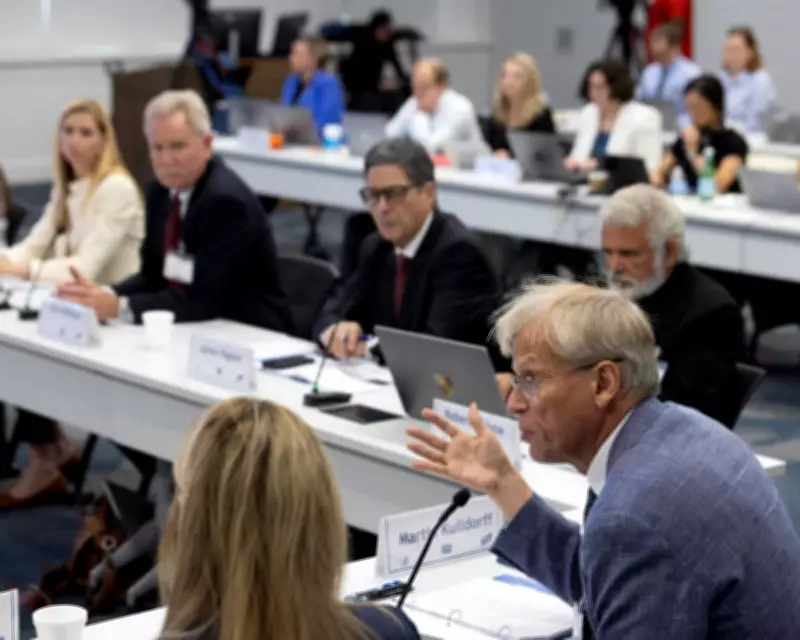
US Vaccine Advisory Committee in Disarray Following Federal Court Ruling
A cloud of uncertainty now hangs over the future of the United States vaccine advisory committee, as former members and health officials issued contradictory statements in the wake of a federal judge essentially invalidating the panel and its recent decisions. The Advisory Committee on Immunization Practices (ACIP), a crucial body for public health guidance, faces an unprecedented crisis that has left its status and operations in question.
Judge's Ruling Creates Immediate Vacuum
On Monday, federal Judge Brian Murphy delivered a stunning blow to the committee by putting on hold the membership of thirteen individuals and all decisions made by ACIP over the past year. The judge determined that these members had not undergone the proper appointment processes required for such positions. This legal action also suspended a major January initiative by US health officials to overhaul the routine childhood immunization schedule, effectively reinstating full recommendations for all seventeen vaccines, including the critical birth dose of the hepatitis B vaccine.
Conflicting Narratives Emerge From Former Members
The immediate aftermath of the ruling revealed deep divisions and confusion among those familiar with the committee's operations. Robert Malone, former co-chair of ACIP, took to social media platform X to declare that the committee had been "disbanded." Malone further asserted that the US government planned to create an entirely new committee rather than pursue a lengthy appeals process against the judge's decision.
However, these claims were swiftly contradicted by other sources. A representative familiar with official thinking pushed back against Malone's statements, indicating that no final decision had been reached regarding how to proceed following the judicial order. The spokesperson emphasized that while the thirteen members specifically challenged in the lawsuit could no longer serve due to the stay, four other recently appointed individuals remained on the committee, which is legally mandated to exist.
Official Response and Backtracking
Andrew Nixon, spokesperson for the US Department of Health and Human Services (HHS), issued a firm statement addressing the speculation. "Unless officially announced by us, any assertions about what we are doing next is baseless speculation," Nixon declared, attempting to quell the growing uncertainty surrounding the committee's fate.
The situation grew more convoluted when Malone initially doubled down on his claims, suggesting officials were attempting to "walk this back while throwing us under the bus." He referenced communications from Kirk Milhoan, the committee chair, as the source of his information. However, Malone later retracted his statements, acknowledging a "miscommunication" and clarifying that dissolving and reforming the committee remained merely one option under consideration, with no final decision yet made.
Internal Communications Reveal Planning
According to a former committee member who requested anonymity to discuss sensitive matters, internal communications revealed that Jay Bhattacharya, acting head of the US Centers for Disease Control and Prevention (CDC), informed Milhoan that officials were considering selecting new committee members. This approach was reportedly being explored because pursuing an appeal against the judge's stay could prove excessively time-consuming. As of Thursday evening, no formal appeal had been filed against the judicial ruling.
Broader Implications for Public Health
The turmoil surrounding ACIP has raised significant concerns about the stability of public health institutions. The former committee member described the situation as emblematic of "chaos and confusion, starting from the top down" that has characterized the panel's recent tenure. They expressed hope that any reconstitution would "follow the law" and result in the appointment of "competent scientists" to guide vaccination policy.
Bruce Mirken, communications co-chair for Defend Public Health, offered a stark assessment of the situation's impact. "This chaos simply adds to the public's declining trust in government health agencies," Mirken stated. He warned that the confusion could have deadly consequences, with people potentially dying "needlessly from diseases that can be prevented by vaccines" due to eroded confidence in vaccination guidance.
Political Dimensions and Calls for Action
The controversy has taken on distinct political dimensions, with Mirken explicitly calling for congressional action against Robert F. Kennedy Jr., whose handpicked committee members were central to the lawsuit. "Congress needs to impeach Kennedy now and put a stop to this grotesque circus," Mirken declared, highlighting how the vaccine advisory committee has become entangled in broader political battles.
As health officials weigh their options—whether to appeal the judge's decision, reconstitute the committee with new members, or pursue alternative paths—the fundamental question remains: How will the United States maintain authoritative, science-based vaccine recommendations during this period of institutional uncertainty? The resolution of this crisis will have profound implications for public health policy and vaccination rates across the nation.




