
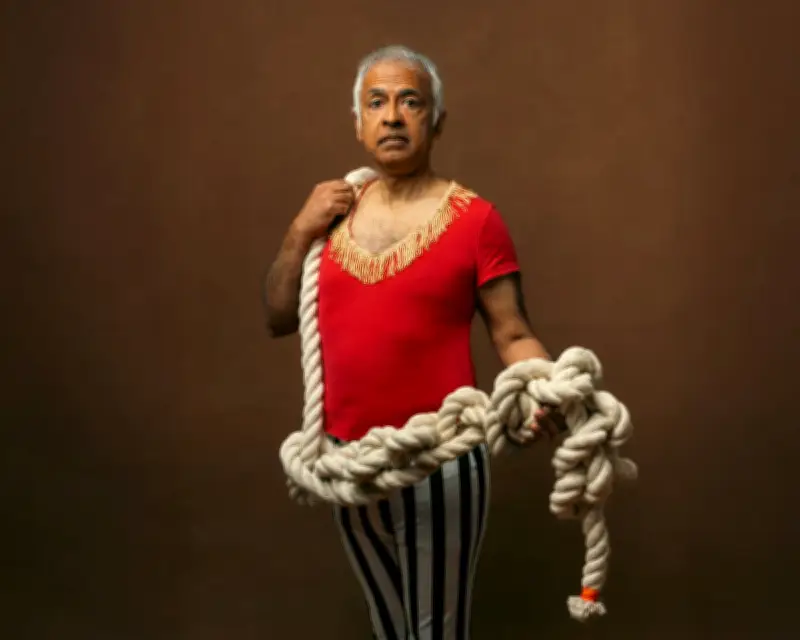
Rumman Talukder, a 60-year-old IT consultant, drives from his home in Stanmore to a circus school in Ware every Sunday to practise the Mermaid trick—hanging from a trapeze by one arm with his back arched. He says it makes him feel “strong and graceful.” “My wife thinks I’m mad but in the run-up to turning 60, I decided I wanted to challenge myself; to find things not normally associated with people my age,” he says.
Rise of Circus for Over-50s
Talukder is part of a growing number of people discovering circus after age 50. In Hertfordshire, Generation Circus has run a pilot project for older adults for the past year and now holds weekly sessions, with its oldest participant nearly 97. In London, the National Centre for Circus Arts in Hoxton has started classes for older people and plans a six-week aerial course later this year. In Eastbourne, Sweet Circus recently launched monthly sessions. All are seeking funding to expand.
Emma Taylor, founder of Generation Circus, says the sessions are transformational. “A lot of our participants signed up for classes simply because it sounded like a fun way to get fit. But circus immediately opens up a whole new world, and suddenly they’re buying hula hoops and rigging up circus equipment in the garden,” she said.
Health Benefits Backed by Research
Evidence on circus is limited, but small studies have found improvements in balance among older adults learning juggling and poi, with some reporting gains in attention and processing speed. Brain-imaging studies show learning to juggle can change brain structure. For Talukder, the attraction is less about neuroscience. “Achieving something this physical at my age makes me feel indomitable,” he said. “I see people in their 70s and 80s, and realise there isn’t an age where you should feel constrained from trying something new.”
Social Connection and Mental Health
The social aspect is crucial. Taylor notes members quickly feel part of a team, which matters given that Age UK estimates about one in 14 people aged 65 and over in the UK are often lonely. “They begin to dress differently: they’re more bright somehow. They look up tricks on YouTube and talk about them and go to see shows together. And it’s all because, every week, they train in a proper little circus school,” she said.
Carol Masson, 70, credits circus school with saving her life. After her daughter died four years ago, she struggled with depression. “I would stay in bed and sometimes even think about suicide. Now I can’t wait for Sundays to arrive. After every class I feel like I’ve had a shot of life in the arm. There’s so much fun and joy. Everything else just disappears,” she said. Masson had a hip replacement in February but returned to class last month, focusing on juggling and hula hoops. “Generation Circus is mental and physical therapy in abundance. I just wish I could do it every day,” she added.
Inclusivity and Transformation
Claire Howard, 54, uses a wheelchair and has had 121 transient ischaemic attacks (TIAs). She never dreamed she could do circus skills. “The first session, I looked at the trapeze and just wanted to turn around and leave,” she said. But she stayed, and a year later she teaches able-bodied participants hula hoop adaptations for her wheelchair. “I’ve gone from having no purpose in life to rediscovering my inner child. Circus has shown me that life can be fun. I’d forgotten that. As a wheelchair user you’re reminded all the time what you can’t do. Here, I have skills that lots of able-bodied people don’t have. I can be useful,” she said.
Corinna Hartwig, who lost her mother at 12 and her father four years ago, found circus helped her reconnect with her inner child. “I was advised to reconnect with my inner child but I didn’t know how until I started going to circus. Now, once a week, I can be playful, happy and creative again,” she said.
Empowerment Beyond Age
Diane Bernier, recreational programme manager at the National Centre for Circus Arts, said circus helps older people “realise their life doesn’t have to go down one path simply because of their age. People discover they can still learn completely new things and that’s such a powerful revelation.”
In Ware, Sarah Hodson, 63, still laughs that she now spends weekends learning circus skills alongside her 96-year-old mother, Jane. “Never in a million years did I think I’d end up doing circus. People of our age often think they’re only good for water aerobics or chair yoga. Then you look around the room and see people older than you hanging upside down from a trapeze, with someone even older swinging from their arms. In some ways it’s better than being young, because we’ve rediscovered that joy, fearlessness and freedom without the self-consciousness of youth,” she said.




