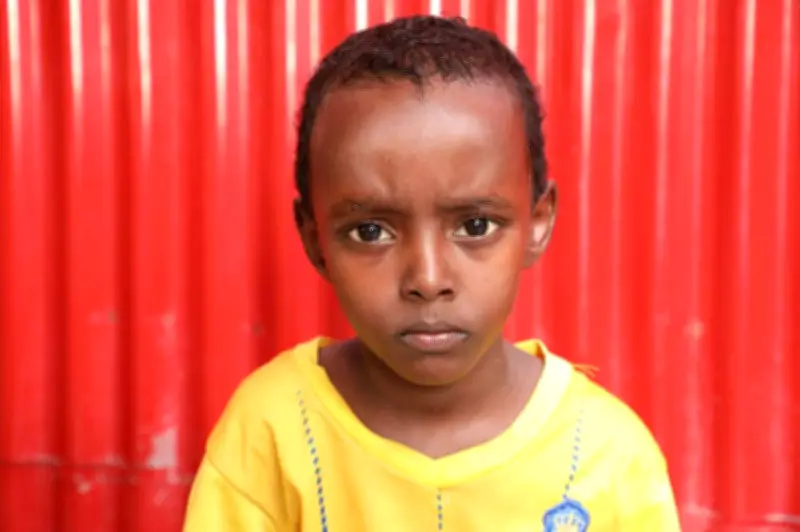
A seven-year-old boy who was riddled with shrapnel during a deadly US airstrike in Somalia faces losing his ability to walk unless he has a £750 emergency operation. But Abdiqadir Salah's family cannot afford the surgery, and the US refuses to admit that any civilians were killed or injured during its attack six months ago.
Shards of shrapnel are lodged in two places in Abdiqadir's back and in his upper thigh after US airstrikes that killed at least 12 civilians, including eight children. It is the deadliest attack on civilians in Somalia during either Trump administration and one of the worst since the botched 1993 US military operation in Mogadishu known as Black Hawk Down.
Deadly airstrike in Jamaame
A Guardian investigation into the strikes in the town of Jamaame raises questions over US intelligence, how the targets were selected, and why children were hit while they were in the open. His mother, Marian Haji Abdi Guled, said Abdiqadir was in the street outside his family home on 15 November 2025 when he was struck by a missile.
“That’s where three of my children got wounded. All three of them were laying on the ground covered in blood,” Guled said. “When I tried to tend to them, shells began falling everywhere. Every step you took, or direction you turned, there were shells and missiles raining everywhere.”
After the attack, Guled took her three injured children into the surrounding countryside to flee the drones. Her eldest, Mohamed, 16, had shrapnel lodged in his fingers, while her daughter Sumaya, 14, had three metal fragments lodged in her head, which have since been removed. Abdiqadir's X-rays show shrapnel still lodged near his hip socket.
Struggle for medical care
The next day Guled travelled 40 miles to Jilib, the de facto capital of al-Shabaab territory, but the hospital could not help. After borrowing money for a two-day journey, she travelled with Abdiqadir and his sister to Mogadishu. “My oldest still has shrapnel lodged in his body but I left him back in Jamaame because I couldn’t afford to take him to Mogadishu,” she said.
Doctors at Kaafi hospital in central Mogadishu told her the shrapnel needed to be urgently removed to avoid life-changing consequences. “They told me if the shrapnel isn’t removed from his body, it could affect his ability to continue walking,” Guled said. “But I don’t have $1,000 needed for the operation.”
Despite being unable to afford the surgery, Guled has stayed in Mogadishu because it is the only place her child can get treatment. However, the cost of renting accommodation – nearly £190 a month – makes it impossible for the family to save enough for the surgery.
US denies responsibility
The US has not paid compensation to any Somali civilians injured or killed in airstrikes. Under the Trump administration, the Pentagon also quietly scrapped a programme requiring it to prevent and respond to civilian deaths. The airstrikes were conducted alongside Somali ground forces, but witnesses describe the casualties being caused by bombs dropped from drones.
Guled has no doubts: “It is the Americans who are responsible for our suffering.” The US Department of War did not respond to questions regarding the airstrikes on Jamaame.