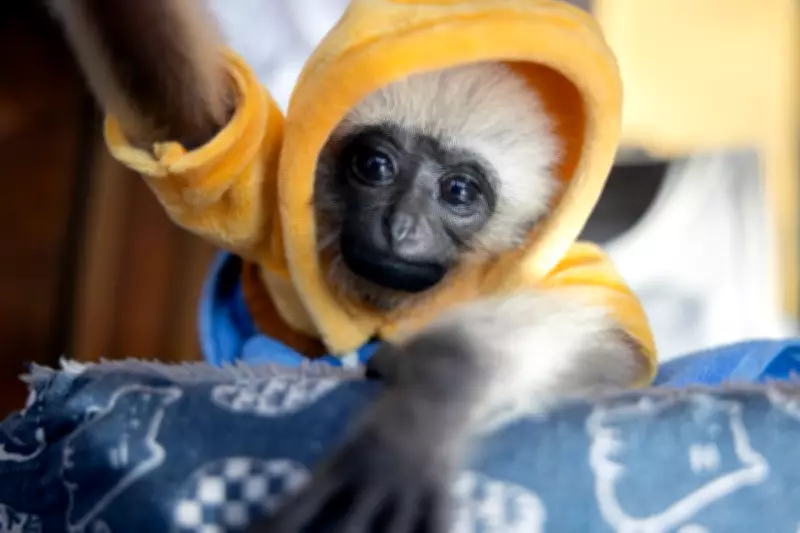
It is a cool morning in Thailand’s hilly north, and a wildlife officer sits on the veranda of Omkoi wildlife sanctuary’s office. On her lap is a wide-eyed infant primate dressed in baby clothes. Not unlike a human baby, he kicks and waves excitedly. Most of his dark skin is covered in dense white fur, except for his face and the palms of his hands.
“We call him Chokdee,” the officer says. “It means ‘good luck’.”
Chokdee is a lar gibbon (Hylobates lar), and in some ways he is lucky. He was a newborn when local people contacted wildlife services, saying they had found him alone in their village.
“I believe someone removed this gibbon from its original habitat,” says Karin Hirankailas, who heads the sanctuary. Chokdee somehow escaped his captors, but for him to have been captured in the first place, his mother was probably killed.
Gibbons Under Threat
Gibbons – small arboreal apes native to the rainforests of south-east Asia – are one of the world’s most threatened primate families, according to the International Union for Conservation of Nature (IUCN). One of the 20 species is classified as vulnerable on the IUCN red list, while all of the rest are endangered and at risk of extinction, and five are critically endangered.
Alongside habitat loss, the main threat to gibbon populations is poaching for the illegal trade in exotic pets, for which there is growing demand. Analysis by the conservation organisation Traffic shows that the number of trafficked gibbons seized by authorities reached an all-time high in 2025, with Thailand among the most affected countries.
Poachers tend to target infants, which are seen as being “cuter” but are also easier to capture, smuggle and domesticate. “About 70% of gibbons in the trade are under two years old,” says Susan Cheyne, vice-chair of the IUCN’s small apes section.
The Devastating Impact on Families
The illegal pet trade increasingly takes place online; in Indonesia alone, more than 800 infant gibbons were advertised for sale on Facebook between 2015 and 2019. But the impact on wild populations far exceeds the number of infants traded. Cheyne’s research suggests that, on average, each individual captured results in the death of three or four other gibbons, with devastating effects on families and populations.
Part of the reason lies in gibbons’ unique traits and behaviours, how they shape their interactions with hunters and their capacity to recover from attacks. Gibbons are particularly vulnerable to the pet trade, says Cheyne, “biologically and ecologically”.
Gibbon Behaviour and Vulnerability
Chanpen Saralamba, a biologist at Mahidol University in Bangkok, has spent more than two decades studying gibbon families in Thailand’s Khao Yai national park. One way researchers – and poachers – track gibbons is by following their loud singing duets, which can be heard from up to 2km away.
“Their duet calls help to maintain the pair bond between male and female and also to announce their territory,” says Chanpen.
Unlike most primates, gibbons are monogamous – often remaining with the same mate for life. They live in small, tightly bonded family groups made up of a pair and their offspring, which may stay with their parents for 10 years. Females and males are fiercely territorial and protective of their group.
While following gibbon families, Chanpen has observed males deliberately distracting researchers as the rest of the family moves away. “The adult male seemed to come close to us, taking the opposite direction to the female,” only to flee once the female was far enough away, she says.
“It’s kind of anecdotal but I never knew about this behaviour in other primates,” says Chanpen.
Reproductive Challenges
Gibbons evolved these behaviours to defend their territory and to protect their young – they are skilled brachiators (swinging from one hold to another by the arms) and can move rapidly through the jungle canopy to evade predators. But against poachers armed with guns, speed offers less protection.
Gibbons remain attached to their mothers for their first two years, so taking an infant requires killing the mother, and possibly other members of the family if they act defensively or get in the way. Hunters sometimes target other family members opportunistically, says Chanpen, to sell their body parts for traditional “medicine”.
The killing of a mother typically causes the rest of the gibbon family to break down. “The juveniles won’t have family or territory to live in,” says Chanpen. While data on this is limited, Cheyne says the impact on the surviving members of the family “is likely to be death”.
For every infant that is successfully sold in the pet trade, others will die in transit. “Imagine how it would affect a human baby to be torn from its mum before weaning,” says Cheyne.
Seized Carcasses and Wider Effects
At Salawin national park headquarters, near the border with Myanmar, a gloved officer carefully removes the rigid corpse of an adult male gibbon from inside a plastic bag and places it on a table. Though the body has been frozen, a pungent smell fills the room. It was seized from poachers just days before, says the officer, alongside several other carcasses of birds and squirrels, probably destined for the wild meat or traditional “medicine” markets.
The hunting of adult males can also have far-reaching effects. When a pair-bonded male is lost, the female may struggle to find another mate. Even if she does, the new male will be unlikely to accept her infants. Gibbons’ reproductive rates are slow, with gaps of at least two years between births. In areas where hunting occurs, this can be too slow to make up for losses.
Hope for Chokdee?
At the sanctuary in Omkoi, Chokdee has fallen asleep under a blanket, thumb in mouth. It is doubtful he can be returned to the wild, says Karin, the sanctuary’s director. Rehabilitating orphaned gibbons is difficult and rarely successful. In cases such as Chokdee’s, where a gibbon is separated from its mother at a young age, it may be nearly impossible to teach it to live in the wild again.
Conservationists warn that without stronger action against poaching, prospects for gibbon conservation are bleak. The traits that define gibbons – strong family bonds, territorial behaviour and high investment in raising young – evolved to help them survive. Faced with the brutality of the illegal trade, those same traits can make them more vulnerable.