
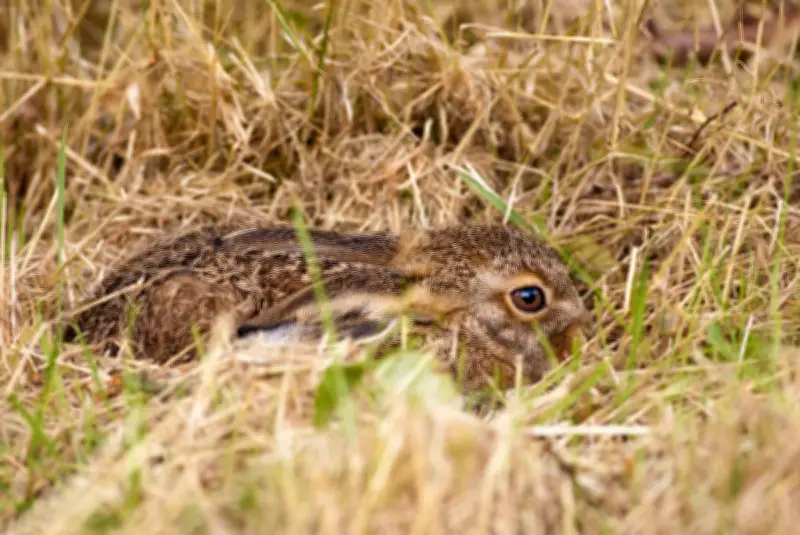
High on Eyam Moor, Derbyshire, the vibrant yellow of meadow vetch and lady's bedstraw lined the trackside, while heath bedstraw glittered white under the sun. Small heath butterflies fluttered restlessly, and a skylark provided a rich, ceaseless accompaniment. As I approached the farmhouse and the stand of sycamores, the saccharine flourish of goldfinches filled the air.
Yet the creature I had come to see was absent. It had recently departed, leaving only the impression of where it had lain. Near the farm, close by a gritstone field wall, long grasses were flattened into a rough circle, or 'form', where a leveret had spent its early weeks. Human neighbours had alerted me, but I had waited too long to visit. Now, like a ghost, the hare had vanished. Despite the disappointment, there was something thought-provoking, even moving, about this fragile refuge.
The secret life of hares
Britain hosts only three lagomorphs: the native mountain hare, with a small colony in the Peak District, and two more recent arrivals, the brown hare and the rabbit. Hares and rabbits have profoundly different reproduction strategies. Rabbit kits arrive naked and blind, needing the security of a burrow to reach maturity. Hares produce fewer offspring, but they are born ready for this perilous world, furred and eyes open. Their irises soon lighten to the sumptuous bronze that, with their rangy bodies and tall ears, characterise these magical creatures.
Subterfuge as survival
Subterfuge is the hare's game—or, more accurately, hiding in plain sight. The mother visits only at dusk to suckle her young, the whole process taking a few minutes. Otherwise, the youngster hunkers down on its own, lest the mother's presence attract the attention of a passing fox or stoat. It will even move away from its form to defecate, so that the odour does not reveal its presence. 'A light touch is the hare's disappearing trick,' the author notes. Away down the track, I saw two black-tipped ears above some thistles, and then they were gone.
This account is from the Guardian's Country Diary series, collected in the book 'Under the Changing Skies: The Best of the Guardian’s Country Diary, 2018-2024', available now at guardianbookshop.com.



