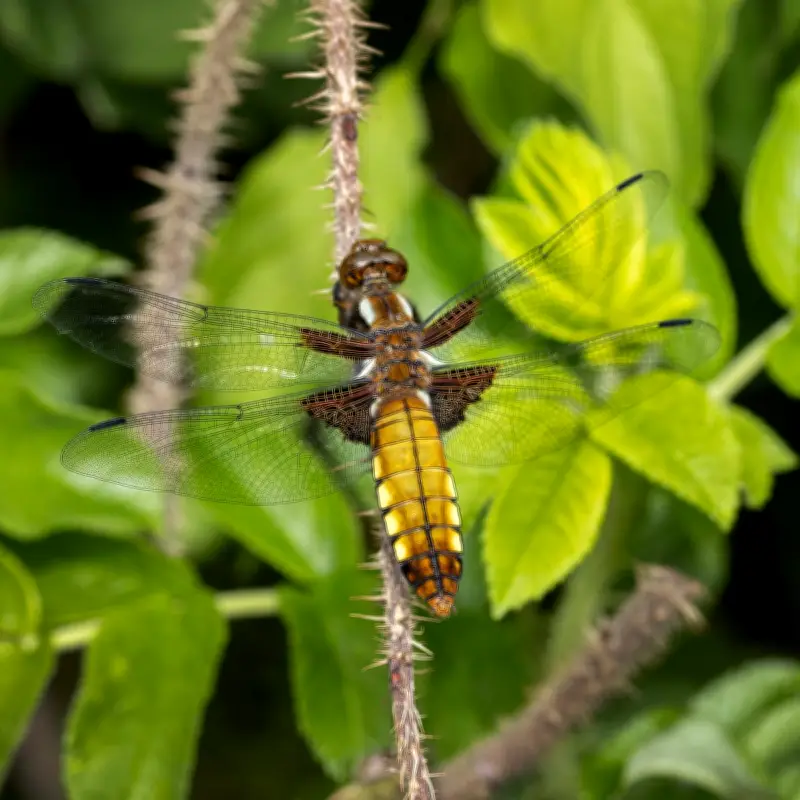
A female broad-bodied chaser dragonfly has been spotted at a newly created pond in Hitchin, Hertfordshire, marking the first emergence of dragonflies since the pond was filled last June. The pond, built to enrich local biodiversity, has already attracted the broad-bodied chaser, a species known to be the first to arrive at new ponds.
Exuviae signal successful emergence
Nic Wilson, the pond's creator and author of Land Beneath the Waves, observed the exuvia—the shed larval casing—of a broad-bodied chaser clinging to a leaf blade of a bur-reed. The hollow legs gripped the plant, and a split in the cuticle showed where the adult dragonfly had pushed through its exoskeleton. Wilson noted several exuviae hoisted up the bur-reeds, indicating that multiple dragonflies had successfully emerged.
When the pond was first filled, a female broad-bodied chaser appeared within a day, flying around the garden like a Golden Snitch. She began ovipositing, tap-tapping her golden-brown abdomen on the water surface, christening the pond with new life.
Nymphs and challenges
Earlier this spring, Wilson removed blanketweed from the pond, rinsing it in a bucket to release pondlife. When the sediment was returned to the water, a procession of dragonfly nymphs emerged—six, seven, eight or more—large and muscular, initially mistaken for froglets. However, a dry spell caused the water level to sink, revealing muddy margins and jagged holes where magpies may have preyed on nymphs preparing to emerge. When rains refilled the pond, the exuviae signaled that the water-dragons had taken to the skies.
Biodiversity and risks
Wilson acknowledged the risks faced by emerging dragonflies, recalling a newly emerged broad-bodied chaser in her parents' garden that was ambushed by a house sparrow after spending hours moulting and hardening its wings. “But if they are, so be it,” she said. “We created the pond to enrich biodiversity, whether that’s from bloodworm to midge to bat, rat-tailed maggot to hoverfly to crab spider—or, from nymph to dragonfly to the insistent gape of a house sparrow chick.”
The pond supports a range of wildlife, and Wilson's observations highlight the interconnectedness of species in a garden ecosystem.