
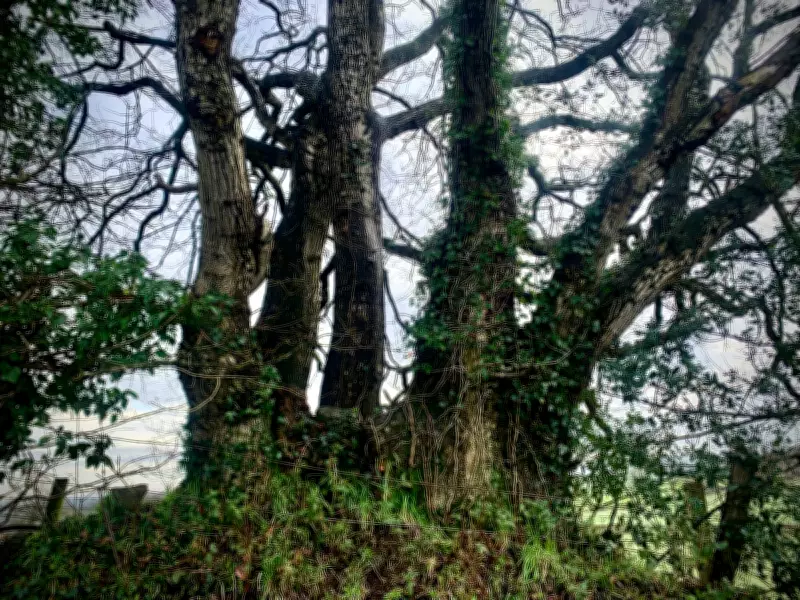
Ancient Coppiced Oak in Shropshire Reveals Human and Natural History
In the Marches of Shropshire, near the historic Old Oswestry hillfort, two ancient oak trees stand as silent witnesses to centuries of human and natural interaction. One is a majestic English oak, Quercus robur, with dark, kinked boughs that frame views across the Shropshire plain, where the Wrekin hill floats above mist on the distant horizon. The air here is damp and hazy, wrapping the earthworks of the iron-age settlement in a mysterious aura, as leaf buds overhead hint at hidden histories of fields and woods.
A Tale of Two Oaks: Standard and Coppiced Forms
Beside this towering oak, poised above a steep holloway bank along the lane, is a coppiced oak of the same species, possibly equal or greater in age. Unlike its neighbor, it features six trunks, each only half the size, sprouting from a central stool where the main trunk was cut down long ago. These coppice stools are places of wonder, with the decaying remains of a trunk cut centuries ago, now hosting dendrothelmata—water-filled cavities that provide a rare and vital habitat for local ecology.
This coppiced oak exemplifies a practice dating back to our ancestors, who observed the magical regrowth of trees after browsing by elk and bison. Humans have since coppiced oaks for timber, charcoal, and tannin, repeatedly cutting and allowing regrowth in a sustainable cycle. Similarly, the hedge it inhabits has been shaped by cutting to break apical dominance, creating an architectural enclosure that echoes with ancestral ghosts and community history.
Ecological Insights and Symbiotic Communities
The more one observes the coppiced oak, the more it evokes comparisons to lichen—a fusion of plant, fungi, algae, and microbes on a different scale, yet embodying its own ambient ecology. Old trees like these are not merely histories of single plants but become ancient places formed by symbiotic communities of life, interconnected across vast landscapes and time. The standard and coppiced oaks may appear as different forms of the same species, but they represent distinct ecological and human narratives.
This exploration into Shropshire's arboreal heritage highlights how coppicing has shaped both the environment and human culture, offering a glimpse into sustainable practices that have endured for generations. The coppiced oak stands as a testament to resilience and adaptation, inviting reflection on our relationship with nature and the enduring legacies of ancient forestry techniques.



