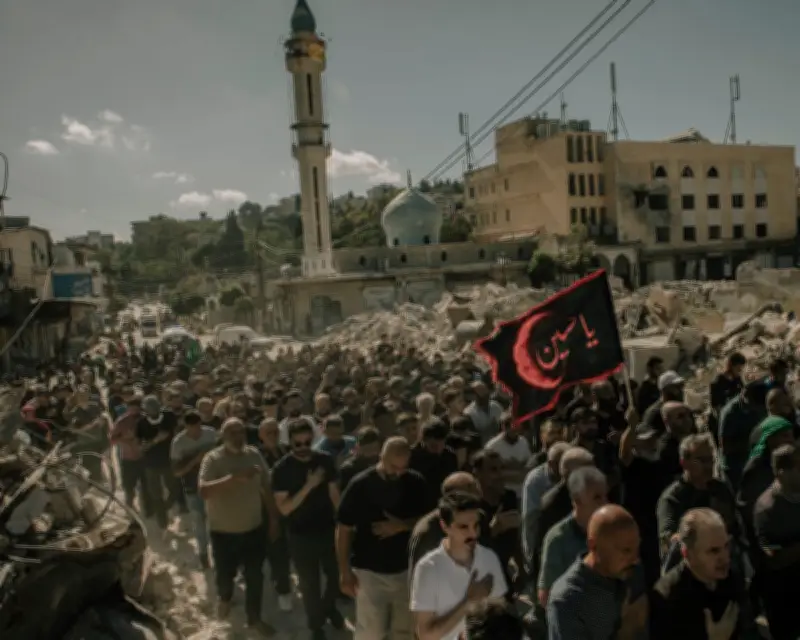
A procession commemorating Ashura in the city of Nabatieh, southern Lebanon, on Thursday wound through mounds of rubble, with the crowd chanting and beating their chests, their lamentations echoed by the dull thud of shelling in the foothills just beyond the city.
Inside the City of Grief
"This is the tragedy of Karbala, O Imam Hussein, look. This is the tragedy of Karbala," the crowd cried in the opening procession of Ashura. The religious ceremony mourns the slaying of the holy figure Imam Hussein in the battle of Karbala in 680; today, it is a symbol for Shia Muslims of resistance against oppression. In normal times, the annual commemoration draws crowds of up to 30,000 people, but this year, the story of Karbala took on renewed meaning due to the Hezbollah-Israel war, which killed more than 3,900 people in Lebanon, most of whom were Shia Muslims.
Nabatieh was one of the hardest-hit cities by bombings during the war, with much of it levelled. On Wednesday, the cries of sorrow were muffled by mounds of earth and snarled metal cleared from roads two days earlier. Only about 200 people attended, unable to fill the silence over the empty streets and shattered buildings after 100 days of war.
Mourning the Recent Dead
Israeli bombings and forced evacuation orders displaced almost all of the city's population of 80,000. Martyr posters dotted the streets, including a 3-metre poster at the entrance to the neighbouring village of Harouf displaying the faces of 50 young Hezbollah fighters killed in that village alone.
"This year Ashura has a special meaning to us. We have lived the battle of Karbala every day during this war," said Ismail Yaghi, a 50-year-old attender. "There is sadness in our hearts and a pride at the same time for our martyrs. But we believe that just because someone died, it doesn't mean that their life has ended. Their eternal life has just begun."
Unexpected Ceasefire and Preparation
Residents had not expected to commemorate Ashura in Nabatieh this year. A ceasefire announced on Monday between the US and Iran unexpectedly stopped the war in Lebanon, halting the advance of Israeli forces on the verge of taking the entire city. Civil defence crews quickly prepared for the ceremony, clearing rubble from the central mosque and hanging black banners to mask gaping holes from an airstrike.
"Usually we take the entire month to prepare for Ashura. This time we just had two days," said Mehdi Sadek, 45, head of the ambulance service, as he stirred a pot of onions and spices. Despite the ceasefire, Israel and Hezbollah continued firing on one another in the "security zone" Israel occupied. On Friday morning, fighting intensified, with Hezbollah killing four Israeli soldiers and Israel carrying out airstrikes around Nabatieh, killing 18 people and wounding 33.
"There were more people here yesterday, but it was a hard night. There was lots of shelling," Sadek said. The Lebanese army blocked off entrances to the upper part of the city after Israel fired on people returning on Tuesday. Families fled the renewed violence, fearful that the ceasefire would collapse.
Return and Resilience
Despite the religious ceremony, not many people had returned to the city. A few drove through to check on their houses and then left again. Hussein Nahleh, a 33-year-old engineer displaced to Beirut, said his home was destroyed but he wanted to return for Ashura. As mourners marched, civil defence crews worked to pull bodies from the rubble, marking airstrike sites from the war to sift through for remains.
"Here in Nabatieh, it still is the same; it's even harder. It's unclear whether there's a ceasefire or not," said Hussein Fakih, regional head of the Nabatieh civil defence. He interrupted the interview to take a phone call and returned teary-eyed: "You will have to excuse me. I just got word from our daughter that our house was destroyed by the Israelis."