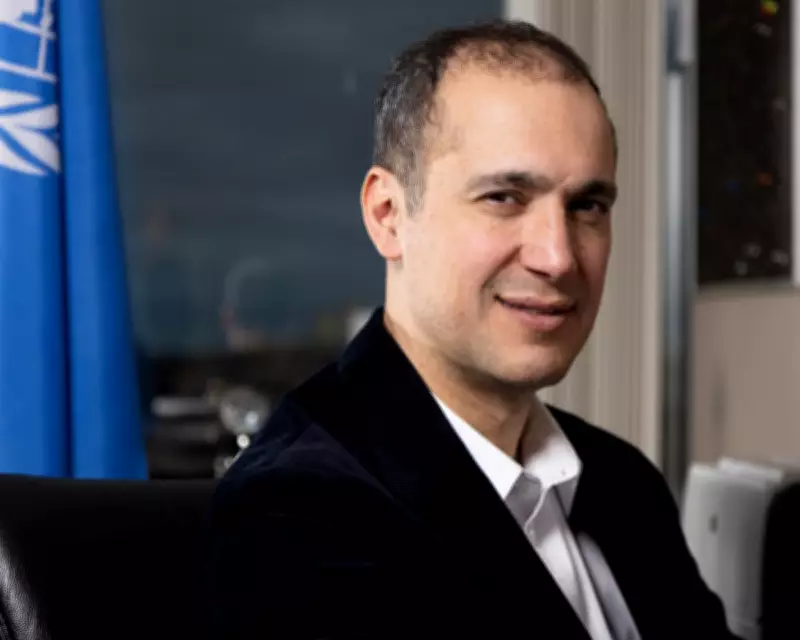
Exiled Iranian Scientist Honored with Prestigious Stockholm Water Prize
Prof Kaveh Madani, an Iranian scientist now in exile, has been awarded the Stockholm Water Prize, the world's most prestigious accolade in water management. The recognition comes after years of personal risk and political complexity, with Madani expressing mixed emotions about the bittersweet moment amid ongoing conflict in Iran.
In an interview, Madani stated he feels "encouraged and humbled" by the prize but lamented that his compatriots in Iran may not be able to celebrate with him due to communication disruptions. "I don't even know if they will hear about this because they're disconnected at the moment," he said, highlighting the isolation faced by many in the region.
Early Encounters with Danger and a Path to Exile
Madani's relationship with peril began in childhood when an Iraqi missile struck near his Tehran home during the Iran-Iraq war. He vividly recalls the explosion that interrupted a television broadcast, describing it as a traumatic event that still haunts his nightmares. After studying civil engineering in Tabriz, he left Iran on a restrictive passport, eventually finding refuge in Sweden, where immigration officials granted him a visa, a decision he credits with shaping his life.
He pursued a PhD at the University of California, Davis, and later built an international reputation at Imperial College London, focusing on modeling water systems. His research applied game theory to water management, challenging conventional models by arguing that human cooperation is not always assured. This work led him to conclude that water crises in Iran and elsewhere stem from mismanagement rather than solely climate breakdown.
Government Invitation and Subsequent Accusations
In 2017, the Iranian government invited Madani to return home for a cabinet-level position as deputy head of the environment department. Hoping to bring hope and reform, he accepted with the sole condition of avoiding imprisonment. However, upon arrival in Tehran, he was arrested at passport control and interrogated by the Revolutionary Guards, who confiscated his devices and accused him of espionage for agencies like the CIA, MI6, or Mossad.
Despite a brief tenure in government, where he appointed women to senior roles and advocated for water policy changes, hardliners escalated accusations against him. They labeled him an "infiltrator," a "water terrorist," and even a "bioterrorist," claiming his work aimed to sabotage Iranian agriculture and promote reliance on genetically modified foods. Madani noted that while the charges seemed laughable initially, repeated interrogations revealed their seriousness.
Survival and Escape to International Work
Using his expertise in game theory, Madani navigated the interrogations by understanding his accusers' logic. In 2018, as the Revolutionary Guards intensified a crackdown on environmental experts, he was arrested multiple times, and several conservationists were jailed, including one who died in custody under disputed circumstances. Fearing for his safety, Madani fled Iran, went into hiding, and eventually resurfaced in the US, taking academic roles at Yale before leading the United Nations University Institute for Water, Environment and Health.
He emphasized that water scarcity is a global issue, citing examples like Cape Town, Chennai, and São Paulo facing "day zero" scenarios, where water supplies nearly run out. Madani argued that political change alone cannot solve these crises, as empty reservoirs render power shifts irrelevant. "If day zero arrives and the reservoirs are empty, it doesn't matter who is in power," he stated.
Current Challenges and Diplomatic Balancing Act
With war in the Middle East displacing millions, Madani pointed out that environmental concerns have been buried, as people prioritize survival over sustainability. He warned that damage from conflicts, such as acid rain from oil facility strikes, will have long-lasting effects on soil and water quality. As a UN official, he must maintain diplomatic impartiality, even when personal ties to Iran weigh heavily on him. "I feel like I'm working with a map of the world in which Iran would be dark because anything I say about it is politicized," he admitted.
In his acceptance statement for the Stockholm Water Prize, Madani wrote that water issues transcend political and military lines, urging recognition of shared vulnerability to achieve peace. His journey from accused saboteur to celebrated scientist underscores the complex interplay of environmental work, personal risk, and global diplomacy in addressing pressing water challenges.