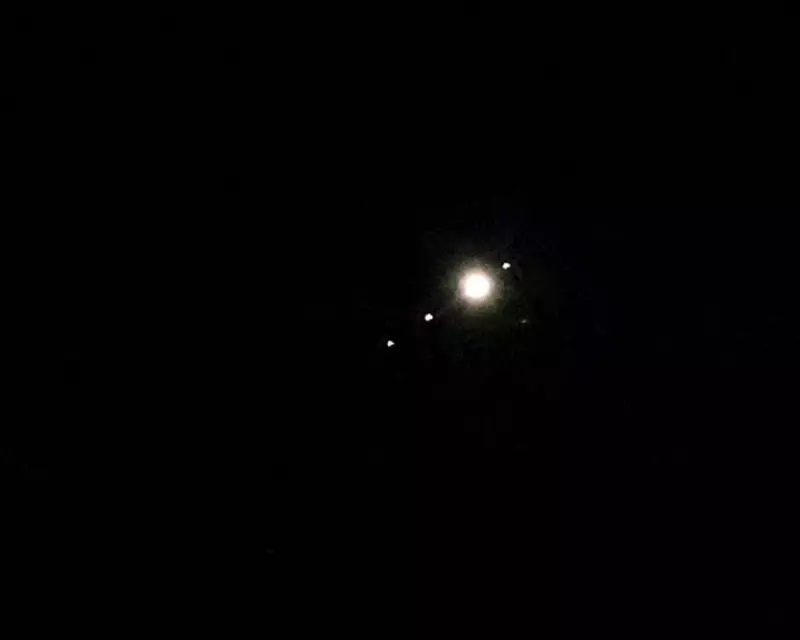
Stargazers across the United Kingdom are in for a spectacular treat tonight, as the largest planet in our solar system puts on a brilliant show. Jupiter will be at its absolute brightest, offering a stunning and easy-to-spot sight for anyone who looks up after sunset.
A Celestial Rarity: Jupiter in Opposition
This exceptional brightness occurs because Jupiter is reaching a specific point in its orbit known as opposition. This means Earth is positioned directly between the gas giant and the Sun. As a result, Jupiter's fully illuminated face is turned towards us, and it is also at its closest approach to Earth for this orbital cycle. The combination of full illumination and proximity makes the planet shine with an intensity that dwarfs the surrounding stars.
The event is perfectly timed for evening viewing. As the Sun sets in the west, Jupiter will rise in the east, becoming visible in the night sky. It will appear as an incredibly bright, steady, non-twinkling point of light, unmistakable to the naked eye. Unlike stars, which scintillate due to atmospheric turbulence, planets like Jupiter shine with a more constant glow.

How and Where to Look for Jupiter Tonight
You won't need any special equipment to enjoy this astronomical highlight. Simply find a location with a relatively clear view of the eastern horizon. Jupiter will be visible throughout the night, climbing higher in the sky and reaching its highest point around midnight, which is the optimal time for viewing as it will be clear of atmospheric haze.
For those with binoculars or a small telescope, the view becomes truly extraordinary. Even basic binoculars held steady will reveal Jupiter as a small disc, not just a point, and you may catch sight of its four largest moons—Io, Europa, Ganymede, and Callisto—appearing as tiny pinpricks of light aligned on either side of the planet. A telescope will provide a more detailed view, potentially showing the planet's distinctive cloud bands.
The best viewing will be away from the light pollution of city centres, but even from suburban gardens or parks, Jupiter will be a prominent and captivating sight. The planet is currently located in the constellation of Gemini, but its sheer brightness makes it simple to locate without knowing specific constellations.
Why This Planetary Display Matters
Events like Jupiter's opposition serve as a powerful reminder of our place in the cosmos. They provide a direct, tangible connection to the wider solar system that is accessible to everyone. For amateur astronomers, it's a prime observing opportunity. For families, it's a chance to step outside and share a moment of wonder, pointing out the king of the planets to children and sparking an interest in science and nature.
Such clear, bright planetary appearances are not nightly occurrences. While Jupiter is often visible, its peak brilliance at opposition is a special occasion that won't be repeated for another 13 months, which is the time it takes for Earth to lap Jupiter in their respective orbits around the Sun. So, if clouds obscure the view tonight, try again over the coming evenings, as it will remain exceptionally bright for several weeks.
So, wrap up warm, step outside after dark, and cast your eyes eastward. One of the brightest objects in the night sky won't be a star or a plane—it will be Jupiter, a world hundreds of millions of miles away, putting on a free, unforgettable show for the UK.