
On a fine May morning in Willington, County Durham, the world of pollination reveals its stunning diversity. Along a former railway line, thousands of newly opened flowers laden with nectar and pollen vie for the attention of foraging bumblebees. Among them, broom (Cytisus scoparius) delivers its pollen with deception and violence.
The Explosive Mechanism of Broom
A large bumblebee lands on a broom flower, finds no nectar, and departs, leaving a deranged tangle of stamens protruding from the petals. What happened? When an insect or a probing finger triggers the flower, 10 stamens and a coiled stigma, confined in the boat-shaped keel petal, break free with an explosion of pollen. This simultaneous delivery and collection of pollen delivers a gut-punch to the insect's furry abdomen. Bumblebees seem unfazed; almost every flower on the bush has been tripped.
Gentle Precision of White Dead-Nettle
Nearby, white dead-nettle (Lamium album) achieves the same ends with gentle precision. A common carder bee settles on a landing platform, reaches deep into the flower's throat for nectar, then leaves with a dab of white pollen on its thorax. The pollen is applied by stamens hidden inside the flower's hooded standard petal. The visitors, exploited but rewarded, feel nothing and deposit the pollen in the next flower, where a stigma inside the hood—fork-tipped like a serpent's tongue—collects the delivery.
The Free Lunch of Dandelions
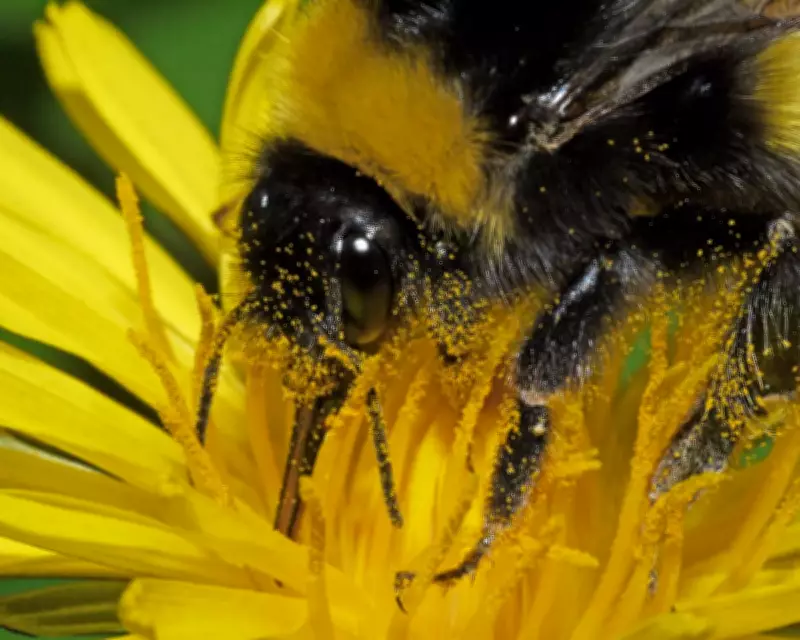
Meanwhile, dandelions (Taraxacum officinale) in the grassy verge offer easily accessible nectar and pollen. They are never in want of a pollinator, but from the plant's perspective, it's squandered wealth. Dandelions are apomictic, always setting seeds without needing fertilization via pollen. Bumblebees crawling over them, probing the inflorescences' florets for nectar, become smothered with pollen and periodically pause to brush it from their eyes. In the dandelion's world, pollinators are redundant, but its largesse is the bumblebee's equivalent of an all-you-can-eat free lunch—an invaluable energy supply in spring.
Conclusion
One of the universally acknowledged truths of natural history is that it often confounds assumptions and delivers endless surprises. From explosive violence to gentle precision and generous free lunches, the weird world of pollination is a testament to the intricate co-evolution of bees and flowers.



