
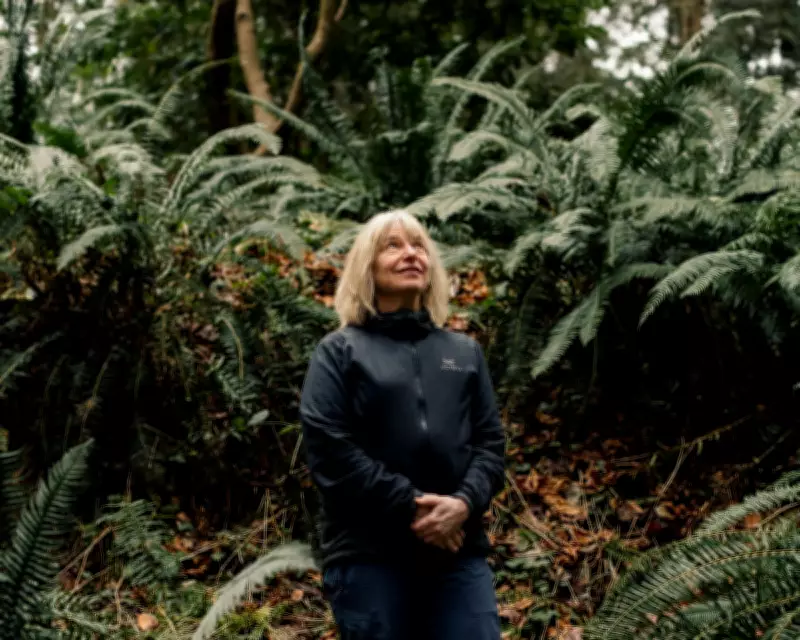
Suzanne Simard: A Revolutionary Voice in Forest Ecology
In 2018, ecologist Suzanne Simard found herself in a life-threatening situation while conducting research in the Caribou Mountains of western Canada. A sudden thunderstorm ignited a wildfire, forcing Simard, her two teenage daughters, and colleague Jean Roach to flee as flames engulfed the forest. Animals, including a deer, rabbit, and grey wolf, burst from the trees in a chaotic scramble for survival. They barely reached their truck in time, covered in soot as helicopters circled overhead, battling the inferno.
This harrowing experience underscores a growing crisis in Canada, where wildfires have escalated dramatically. The 2018 fires were the largest in British Columbia's history, a record shattered in 2021 and again in 2023, when blazes consumed an area triple the size of Nova Scotia, with smoke reaching as far as New York City. Global heating, combined with logging practices that replace diverse native forests with flammable conifers, has turned Canada's woodlands into a tinderbox.
The Carbon Sink Turned Emitter
For decades, policymakers assumed Canada's vast forests were resilient to human impact, but Simard's research reveals a stark reality. Since 2001, due to logging, wildfires, and pine beetle outbreaks, these forests have shifted from being a carbon sink to a net emitter of carbon. "What we're doing by taking down forests is we're undercutting our ability to solve climate change," Simard explains. She criticizes the billions invested in carbon capture technology, arguing that trees and plants are far more effective at this task, yet they are being destroyed.
Simard's work, detailed in her bestselling 2021 book Finding the Mother Tree, challenges traditional views of forests as collections of competing individuals. Instead, she proposes they are complex, interdependent communities connected by an underground fungal network called mycorrhiza. This "wood wide web" allows trees to communicate, share nutrients, and recognize kin, with older "mother trees" playing a nurturing role.
From Logging to Academia
Growing up in British Columbia's Monashee Mountains, where her family worked as loggers, Simard initially entered the forestry industry. As the only woman on staff at a logging company in the 1980s, she observed that replanted forests often struggled. Her curiosity led her to pursue a master's and PhD in forest ecology, culminating in a landmark 1997 paper in Nature that introduced the concept of the wood wide web. This research garnered international attention, suggesting trees are intelligent, perceptive beings.
Simard's ideas, which she describes as bringing a "feminine perspective" to a field dominated by masculine notions of competition, resonate with indigenous wisdom and public intuition. Her 2016 TED Talk, "How trees talk to each other," has been viewed over 8 million times, and her work inspired characters in literature like Richard Powers' The Overstory.
Facing Scientific Backlash
Despite her popularity, Simard faced brutal criticism after publishing The Mother Tree. Critics accused her of lacking scientific integrity, with some even writing to her university and media outlets to discredit her. "When you have an idea that is a little revolutionary, that threatens the structure of the scientific method, backlashes happen," Simard reflects, comparing her experience to that of Jane Goodall and James Lovelock.
The backlash took a personal toll, leading Simard to retreat and keep her camera off during Zoom calls. "It's so hurtful because it's your peers – it's a rejection," she admits. Critics argue there isn't enough evidence for her assertions, but Simard counters that science moves too slowly for the urgency of the climate crisis. She advocates for a more holistic approach, inspired by indigenous practices that emphasize interconnectedness.
Ongoing Research and Personal Reflections
Since 2015, Simard has led the Mother Tree Project, a national study exploring sustainable logging methods, such as leaving behind mother trees to aid regeneration. Her new book, When the Forest Breathes, blends science with memoir, touching on her recovery from breast cancer and personal losses, including her mother's assisted death. "There is no way to understand how something grows without also understanding how it dies," she writes.
Simard remains hopeful, buoyed by public pressure on the Canadian government to improve forestry practices. However, she notes geopolitical tensions with the US may hinder progress. While climate change denial persists in some quarters, she believes Canadians, directly affected by wildfires, are more receptive to science. "I hope when people read this book, they come to feel agency in motivating change," she says.
As she prepares for a sabbatical to reconnect with the forests of Nelson, British Columbia, Simard reflects on the warmth of this year's winter and the looming threat of more wildfires. Her journey continues, driven by a passion to reimagine humanity's relationship with nature.



