
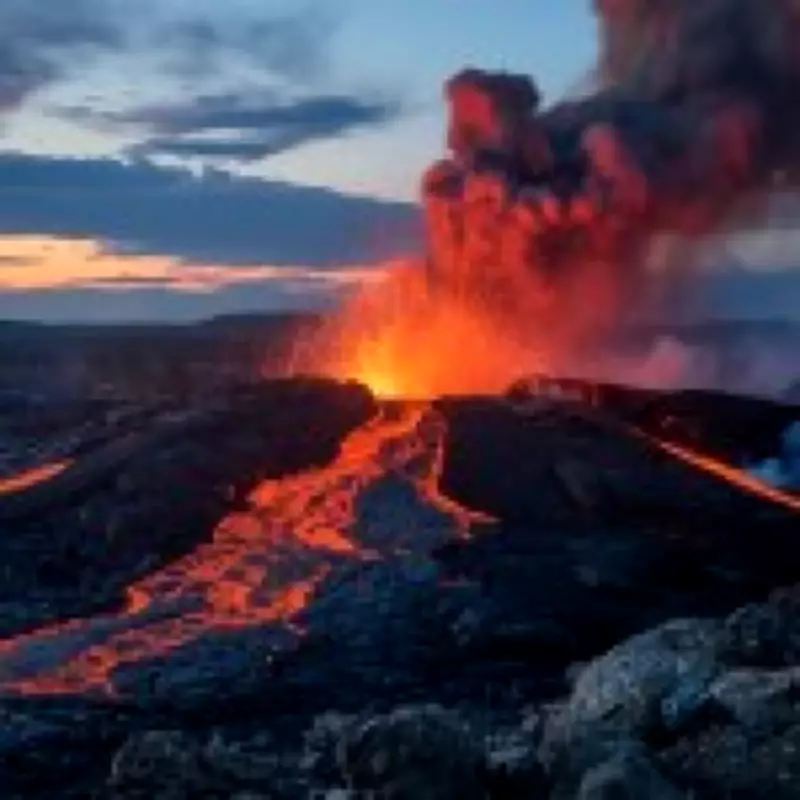
The Catastrophic Eruption That Changed the World
Following recent unpredictable and sometimes wintry weather, the idea of snow in May, sunless skies in June, and a pandemic by July seems unimaginable. Yet, two centuries ago, a similar scenario unfolded, triggered by a volcanic eruption on the other side of the globe. This event caused a climate catastrophe, three years of disruption, and millions of deaths, reshaping history in profound ways.
The Eruption of Mount Tambora
On April 10, 1815, the Indonesian island of Sumbawa experienced one of the most powerful volcanic eruptions ever recorded. Mount Tambora's explosion measured seven out of eight on the Volcano Explosivity Index, ejecting an astonishing 24 cubic miles of gases, dust, and rock into the atmosphere. For context, Mount Vesuvius, which killed around 2,000 people in 79 AD, was a magnitude five event. The last known level-eight eruption occurred approximately 26,000 years ago.
Meteorological expert Nathan Yao explains: 'The eruption of Tambora was a catastrophic event and one of the biggest volcanic eruptions in 10,000 years. It propelled a massive plume of volcanic material high beyond the troposphere, where we live, into the stratosphere. There, aerosols reflected sunlight, causing temperatures to drop for three years. It was 1819 before they recovered. This had a huge impact on climate, affecting everything from temperature and wind patterns to global ecosystems.'
Immediate and Global Consequences
The explosion instantly killed about 10,000 people and destroyed all vegetation on Sumbawa. Uprooted trees mixed with pumice ash washed into the sea, forming rafts up to three miles wide. Meanwhile, 100 megatons of sulphur aerosols created a deadly haze that blocked sunlight, cooling the Earth by an estimated 0.5°C.
Nathan elaborates: 'That might not seem like much, but over a sustained period, very small changes in the atmospheric balance can have huge repercussions. It severely impacted crops, leading to famine and disease outbreaks worldwide.'
The 'Year Without Summer'
The following summer was recorded as the coldest ever in the UK, with snow falling in the Midlands in May due to freezing overnight temperatures. This grim weather inspired literary works: Mary Shelley, confined indoors by the cold, wrote Frankenstein, while Lord Byron penned the poem Darkness, imagining a sunless world collapsing into chaos.
Gloomy, cold rains persisted across Europe and the United States, earning the period the nickname 'the year without summer.' As temperature changes disrupted rain and snowfall, and sunlight remained scarce, harvests failed globally. This led to poverty, starvation, and food riots across Europe.
- In Ireland, wheat, oat, and potato crops failed, resulting in famine and a typhus outbreak that claimed many lives.
- In the UK, soldiers returning from the Napoleonic Wars faced low wages, scarce jobs, and stagnant industry. Farmers watched fields rot, while food prices soared in towns, leaving families unable to afford basic necessities.
- Asia suffered even more severely, with famine and cholera spreading across India and rice paddies destroyed in China.
The eruption is estimated to have cost millions of lives. Most frighteningly, those affected had no scientific understanding of the events, often attributing the death, disease, and destruction—along with the beautiful fiery sunsets caused by volcanic ash—to divine punishment.
Nathan notes: 'They had no technology, no internet, no Met Office, so they wouldn't have known what was happening. People would have made superstitions about God or strange forces. Seeing crops fail and people suffer without explanation would have been terrifying, akin to viewing comets as omens.'
Could It Happen Again?
While such events are rare and modern civilization is better equipped to handle natural disasters, there is no guarantee against another 'year without summer.' Nathan, who has covered volcano stories, emphasizes their unpredictability.
He adds: 'You don't get many warnings with earthquakes and volcanoes. Look at the 2004 Tsunami—no one saw that coming. If it's happened once, it can happen again. The eruption of Mount Tambora was rare, but theoretically, another volcanic eruption could occur somewhere in the world. Today, we have more information and communication, so we'd handle it better, but it could still be catastrophic.'
This historical event serves as a stark reminder of nature's power and the interconnectedness of global climate systems, urging preparedness and resilience in the face of potential future disasters.



