
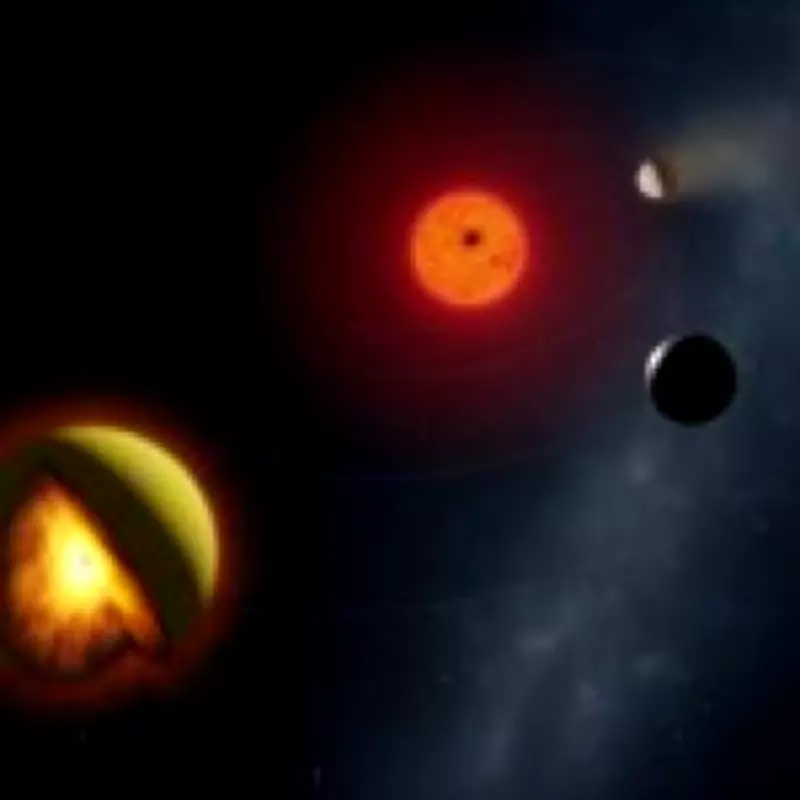
Hellish Mystery Planet Covered in Molten Rock Ocean Identified
In a groundbreaking discovery, scientists have identified a previously unknown type of planet beyond our solar system, characterized by a permanent ocean of molten rock and the ability to store vast quantities of sulphur deep within its interior. The study, led by researchers at the University of Oxford and published in Nature Astronomy, focuses on the distant world L 98-59 d, located approximately 35 light years from Earth.
Unusual Characteristics of L 98-59 d
Observations utilizing the James Webb Space Telescope (JWST) and ground-based observatories revealed that L 98-59 d, which orbits a small red dwarf star, exhibits an unexpectedly low density despite being about 1.6 times the size of Earth. Its atmosphere contains significant amounts of hydrogen sulphide, a gas typically associated with rotten eggs, challenging conventional planetary categories.
Traditionally, astronomers classify planets of this size into two groups: rocky 'gas dwarfs' with hydrogen atmospheres or water-rich worlds covered by deep oceans and ice. However, L 98-59 d fits neither description, suggesting it represents an entirely different class dominated by heavy sulphur compounds.
Advanced Simulations Reveal Planetary History
Using sophisticated computer simulations, an international team from the University of Oxford, University of Groningen, University of Leeds, and ETH Zurich reconstructed the planet's evolution over nearly five billion years. By integrating telescope data with detailed models of planetary interiors and atmospheres, the researchers uncovered the hidden dynamics of this alien world.
The findings indicate that the mantle of L 98-59 d is likely composed of molten silicate, similar to lava on Earth, forming a global magma ocean extending thousands of kilometres below the surface. This immense reservoir of molten rock enables the planet to retain substantial sulphur over geological timescales and maintain a thick hydrogen-rich atmosphere containing sulphur-bearing gases like hydrogen sulphide.
Implications for Planetary Diversity
Dr. Harrison Nicholls, lead author from the University of Oxford's Department of Physics, emphasized the significance of this discovery: "This suggests that the categories astronomers currently use to describe small planets may be too simple. While this molten planet is unlikely to support life, it reflects the wide diversity of worlds beyond our Solar System."
Observations from the James Webb Space Telescope in 2024 detected sulphur dioxide and other sulphur gases in the planet's upper atmosphere, likely formed by ultraviolet light from its host star triggering chemical reactions. The magma ocean acts as a vast reservoir, storing and gradually releasing these volatile gases over billions of years, explaining the planet's unique characteristics.
Future Research and Exploration
Co-author Professor Raymond Pierrehumbert highlighted the power of computer models: "We can uncover the hidden interior of a planet we will never visit. This research shows it's possible to reconstruct the deep past of alien worlds and discover types with no equivalent in our Solar System."
As data from the James Webb Space Telescope continues to stream in, upcoming missions like the Ariel exoplanet mission and PLATO mission will provide further insights. The team plans to apply machine-learning techniques to these observations, aiming to map planetary diversity and better understand formation and evolution processes.
Dr. Richard Chatterjee from the University of Leeds and University of Oxford concluded: "Our simulations enable us to turn back the clock and understand how L 98-59 d evolved. Hydrogen sulphide plays a starring role, but more observations are needed. Further investigation may reveal that such pungent planets are surprisingly common in our galaxy."



