
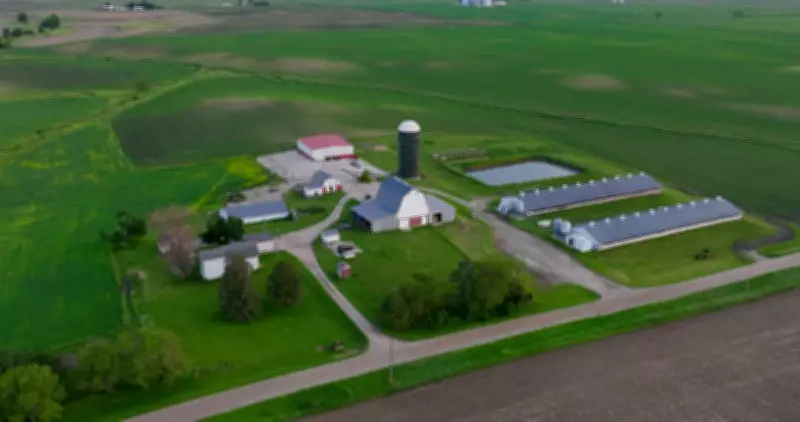
From Hog Barns to Mushroom Haven: An Iowa Farm's Sustainable Revolution
As a sixth-generation Iowa farmer, Tanner Faaborg understood deeply that agricultural traditions are profoundly difficult to break. When he initiated plans to transform his family's farm from a livestock operation that housed over 8,000 pigs annually into a venture focused on cultivating lion's mane and oyster mushrooms, he anticipated some skepticism from his peers. What he did not necessarily foresee was that his older brother would become one of the most vocal doubters initially.
"My older brother has dedicated his entire adult life to working with pigs, managing approximately 70,000 of them across five counties," Faaborg explains. "But we reached a pivotal moment where he transitioned from laughing at my idea to declaring: well, I suppose I might quit my job and assist you."
Katherine Jernigan, director of the Transfarmation Project at Mercy for Animals, a non-profit organization that facilitated the Faaborgs' transition and helped establish their new business, 1100 Farm, notes the remarkable change. "Now he's the most dedicated," Jernigan says. "He's the most attuned to which mushrooms are thriving."
The Transfarmation Project: Guiding Farms Toward Independence
Established in 2019, the Transfarmation Project collaborates with farms across the United States that aim to abandon industrial animal agriculture, typically conducted as contract work for major meat corporations, and shift toward a sustainable, fully independent business model. The project offers comprehensive guidance on repurposing existing infrastructure for different crops, alongside crucial business advice on market identification, website development, brand establishment, and direct-to-consumer sales strategies.
Additionally, the project provides research and innovation grants to alleviate the financial burdens associated with such transitions. The Faaborgs now utilize their functional mushroom crops to produce products like tinctures and salts, which are sold directly to consumers through online platforms.
Escaping the Detrimental CAFO Model
The initiative seeks to move beyond intensive farming practices that exert a severely harmful impact on the environment, while also safeguarding farmers themselves. Many individuals find that the concentrated animal-feeding operation (CAFO) model exacts a heavy toll on their mental health. In this context, the Faaborgs' narrative is emblematic of a sector where agricultural consolidation has adversely affected both individuals and communities.
"We previously had numerous independent farms," Faaborg reflects, "but affluent entities deemed it crucial to control every aspect of the operation. Own the pigs, own the feed, own the distribution channels, yet contract out the labor."
He reminisces about his family's former lifestyle: "Our family once embraced a homesteading existence with chickens and a large orchard, where we would gather eggs in the morning, truly living off the land... every animal had a name, we relished the chores, harvesting, and weeding."
The Cost of Industrialization: Financial and Emotional Burdens
This idyllic scenario shifted for the Faaborgs approximately three decades ago when a representative from a major meat company approached them. They were offered loans to construct several large hog barns and adopt the CAFO model. The plan involved repaying the debt over a decade to achieve a higher household income. However, it incurred a significant non-financial cost.
"It evolved into a scenario where we had an employer, a job, and obligations to perform tasks to receive a paycheck, settle bills, and repay loans," Faaborg states. "That strains your mental health. It alters your emotional state. It erodes your sense of pride and self-worth."
Government data indicate that around a decade ago, the population of rural, small-town America began to decline, with younger generations increasingly migrating to urban areas for economic prospects. Many farmers engaging with the Transfarmation Project grapple with substantial debts accumulated under the CAFO model, which can become unmanageable. A core aspect of the project's work involves demonstrating that an alternative model, reminiscent of the autonomy of bygone eras, is feasible.
Demonstrating a Viable Alternative System
"The broader objective is not merely to transition individual farms but to illustrate that a different system is attainable," Jernigan emphasizes. "We encounter farmers in despair: they believe they are inadequate farmers or have committed errors. Yet, aiding them in recognizing they are part of a system where success is nearly impossible... I cannot overstate how profoundly this helps them comprehend that solutions exist."
For the Faaborgs, the transformation has reignited their enthusiasm for their work and its connection to nature. They aspire to convey to others that a different future is achievable.
"Our family does not fit the typical profile for this narrative and its success," Faaborg asserts. "We are not a hippie family, nor a wealthy family with disposable income who thought: 'Yes, this will be enjoyable.' My father worked as a welder for about forty years. We maintained the hog barns for over thirty years. My parents resisted change. Yet, if our family can accomplish this, any family can."



