
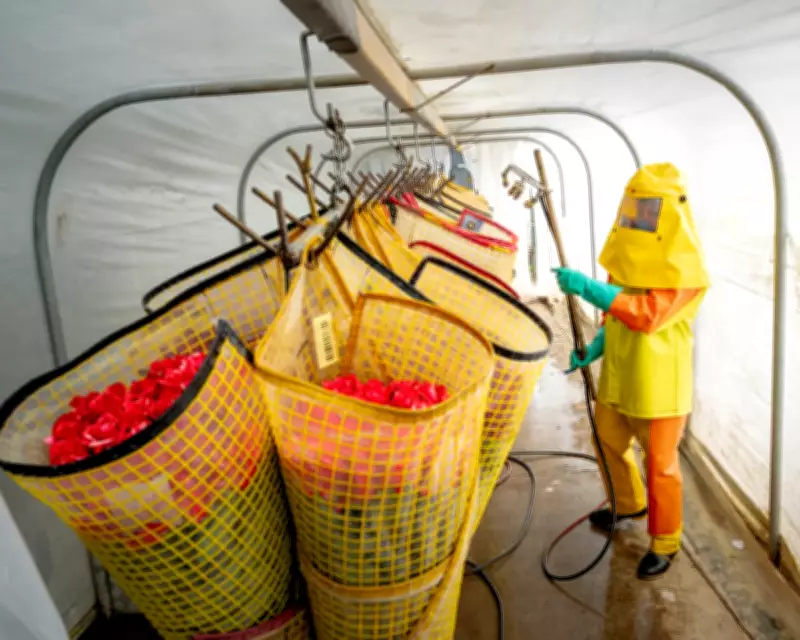
The Hidden Dangers Behind Ecuador's Blooming Rose Trade
In the fertile high valleys of Cayambe, Ecuador, where rainbows arch over white plastic greenhouses, a global industry thrives on beauty cultivated at a steep human cost. As the world's third-largest exporter of roses, Ecuador sells over 2 billion stems annually, trailing only the Netherlands and Colombia. This economic success story, however, masks a troubling reality of pesticide exposure, health hazards, and environmental strain that disproportionately affects Indigenous workers and local communities.
A Fragile Economy Built on Flowers
The Cayambe region, situated at altitudes reaching 3,300 meters with its thin, sharp air, has become the epicenter of Ecuador's floriculture industry. Here, three-quarters of the nation's rose production occurs, accounting for 66% of total flower output. For smallholders like Patricia Catucuamba and her husband Milton Navas, who transitioned from dairy farming to rose cultivation five years ago, diversification represents survival rather than strategy.
"Diversification isn't just a strategy, it's survival here," Catucuamba explains at their family ranch, gesturing toward their 4,500-square-meter greenhouse containing five rose varieties. Their story mirrors that of many in Cayambe, where nearly half of the region's 100,000 residents participate in the flower sector. Indigenous women like Catucuamba play crucial roles throughout the production chain, from planting to harvesting, often serving as primary family earners.
Global Demand Drives Local ConsequencesEcuador's roses have gained international recognition for their quality, generating more revenue than traditional exports like coffee and bananas. The region's high altitude, fertile volcanic soil, and intense sunlight produce stems of exceptional length and blooms of remarkable size. From an economic perspective, equally advantageous are the low wages paid to Indigenous workers and limited enforcement of labor rights.
Through flower exports, Cayambe connects to global markets, with large-scale producers and cooperatives shipping to the United States, European Union, and Kazakhstan—the latter serving as a proxy supply hub for Russia during its conflict with Ukraine. Yet for small businesses, survival remains precarious despite the industry's overall economic boost.
The Chemical Burden of Perfect Blooms
To meet international demand for flawless roses year-round, Ecuadorian growers intensively treat flowers with chemicals. Unlike agricultural production, pesticide use in cut-flower cultivation operates with indistinct limits, and existing environmental standards receive minimal monitoring. This lax regulation results in severe short- and long-term health problems for workers and nearby residents.
A revealing study by Austrian environmental organization Global 2000 examined 16 bouquets and detected traces of 79 different pesticides—49 of which can affect hormones, are carcinogenic, damaging to fertility, or classified by the World Health Organization as hazardous to human health. On average, each bouquet contained residues of 14 pesticides, with one sample contaminated by 32 different chemicals. Alarmingly, three-quarters carried substances long banned in the European Union for extreme toxicity.
"It's an uphill battle," states Dr. Jose Suarez of University of California, San Diego. "Many pesticides that have been discontinued or banned in Europe continue to be heavily used in the US. Ecuadorian agriculture seems to mirror what the US does—and for the rural communities encircled by the flower plantations, that is bad news."A 2024 study of Ecuadorian floriculture workers found that 61% exhibited symptoms consistent with pneumonitis attributed to pesticide exposure. Skin complaints like rashes and eczema are common from contact with chemicals and plants, with some research reporting pesticide poisoning rates reaching 60% among flower workers.
Beyond Workers: Community-Wide ImpactsThe risks extend far beyond plantation employees. Dr. Suarez's research program, studying over 500 adolescents in Cayambe's flower-producing areas since 2008, discovered that intense pesticide use correlates with increased inflammation among children. This inflammation directly links to worse neurobehavioral performance, affecting how children think, learn, remember, and socialize.
"After the Mother's Day harvest, we found that children had way higher pesticide exposure and lower neurocognitive performance than those examined later in the season," Suarez explains. His team also identified higher depression scores among participants with greater pesticide exposure, particularly among women, alongside reports of increased leukemia cases, miscarriages, chronic diseases, and neurological damage including memory problems and fatigue.
Inside the Production Facilities
At a large Cayambe plantation employing approximately 500 workers, an acrid chemical smell permeates the cultivation area, which is protected by armed guards. Workers typically earn Ecuador's minimum wage of $482 monthly (approximately £350) and frequently work unpaid overtime under productivity pressure. Several employees reported facing fines for missed shifts.
Despite strong chemical fumes in poorly ventilated halls, workers often operate without protective equipment. The agricultural engineer managing the site, while showcasing bestselling varieties like Pink Amaretto and Violet Hill, defends year-round production as more carbon-friendly than energy-intensive Dutch greenhouse cultivation during cold seasons.
"Any agricultural activity leaves an environmental footprint," the manager acknowledges, noting that spraying teams rotate every three months and certain chemicals are prohibited due to carcinogenic properties or harm to pollinators. Outside production sites, toxic waste containers are frequently discarded casually, while pesticide spraying areas remain restricted from external verification.
Certification Challenges and Water Scarcity
Only about 0.1% of roses exported from Ecuador carry Fairtrade certification, reflecting the industry's limited adoption of ethical standards. While certification schemes aim to ensure safer working practices, compliance and enforcement vary significantly. New labor rights projects attempting to improve fair pay, workplace safety, and legal protection for agricultural workers face challenges from lobbyists, policymakers, and government resistance.
For small growers like Catucuamba and Navas, water access presents a more immediate concern than broader issues of crime and political unrest. As water trickles from their taps, Navas counts hours until irrigation cuts off again—for three 12-hour periods weekly—to sustain their roses, while large plantations downstream draw from the same diminishing canals.
"Water defines everything," Navas reflects. "How long the crops will last, how many animals survive, how entire communities endure on the slopes below." Catucuamba places their latest export invoice on the kitchen table, with pesticide costs circled in red, highlighting the economic pressures driving chemical dependence.
As rainbows fade over Cayambe's greenhouses, Catucuamba arranges a bunch of roses on their kitchen table. These blooms, bearing slight imperfections on some petals, represent an alternative approach—grown without chemical treatments. Their presence serves as a quiet testament to the possibility of different cultivation methods, even as the broader industry continues prioritizing perfection over protection.



