
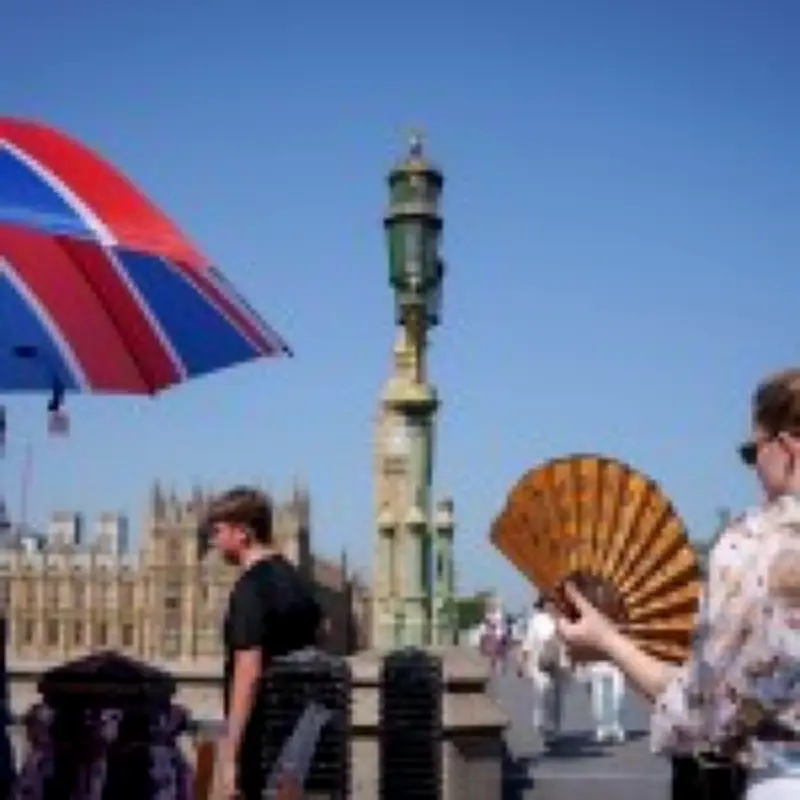
The UK is facing one of the longest heatwaves in nearly 50 years, a weather expert has told Metro. Temperatures peaked yesterday at 30.4°C at Heathrow in London, the 10th day in a row when the thermometers have risen to 30°C or above.
Heatwave could last until July 26
Jim Dale, a meteorologist with the British Weather Services, says that the third heatwave of the year likely won’t ease until July 26. This could make it longer than the sweaty summer of 1976, which brought 15 days of temperatures above 32°C, peaking at 35.9°C. ‘We live in extraordinarily self-inflicted and dangerous times, with much more to come,’ Dale says, referring to the outsized role climate change is playing in the recent hot and dry weather.
‘This particular 30°C run will probably end this weekend, though for most southern areas of England, official heatwave territory is likely to remain. Over the weekend, temperatures will be a few degrees lower than during the week. It will however still be a bright and sunny couple of days. It’ll then become progressively hotter again during next week, again more especially across southern counties of the UK.’
London experiences longest heatwave in 23 years
Greater London is in the throes of one of the longest heatwaves the capital has seen in 23 years, the Met Office told Metro. The temperature in London has barely sunk below 28°C in the past 11 days. The Met Office says the last time temperatures in London exceeded the heatwave threshold for this many days straight was 2003, with 13 days. ‘The record we have for the longest heatwave across Greater London was back in 1976 with 16 days,’ the national weather service said. ‘But it’s important to note that the heatwave criteria did not exist then and has been updated since it was introduced.’
What defines a heatwave?
A heatwave isn’t just any old time it’s warm. It’s when it’s hotter than a specific temperature set by the Met Office for three straight days. In London, for example, the threshold is about 28°C. Yet in Cornwall, the minimum temperature is 25°C. The Met Office has adjusted this threshold over the years to account for climate change, which is making heatwaves hotter, more frequent and longer lasting.
This year’s three hot spells – in May, June and July – have all seen temperatures rivalling or beating the peak temperature of 1976’s sizzler, and have led to numerous fires. In May, the mercury rose to 34.8°C in Kew Gardens, west London. While last month saw Lingwood, Norfolk, baked by 37.7°C. This year is also the first to have recorded temperatures of 35°C or higher on six separate days and has seen a record nine days above 34°C.
Climate change and El Niño fuel extreme heat
The reason this year is so much hotter than 1976 is simple, Dale says: climate change. ‘That year was a thorn ahead of a bunch of burgeoning nettles, which are now stinging us and others regularly,’ the climate expert adds. The main culprit behind all the record-breaking scorchers is a sprawling, stubborn high-pressure system called a heat dome. If the jet stream – a fast-moving ribbon of air that circles the globe from west to east – slows down long enough, high pressure can get stuck. All this pressure squeezes the air so it can’t flow. With nowhere to go but down, the air is cooked, kind of like a lid on a pot that holds in steam.
The past 11 years have been the hottest on record as humans continue to burn fossil fuels, spewing planet-warming gases into the skies. Aimee Mook, a curator at the National Maritime Museum, says this is all on top of El Niño, the name given to powerful shifts in Pacific Ocean winds and water temperatures. ‘These warmer waters transfer heat to the atmosphere, increasing temperatures across the globe,’ Mook says. ‘The warmer atmosphere over the Pacific Ocean can lead to more rainfall in some regions near the Americas and less rainfall in places such as Australia, depending on local weather conditions.’ Scientists believe that this year’s ‘super El Niño’ could be one of the strongest on record. ‘When El Niño occurs in a world that is already warming because of climate change, its impacts can be more noticeable,’ Mook adds.



