
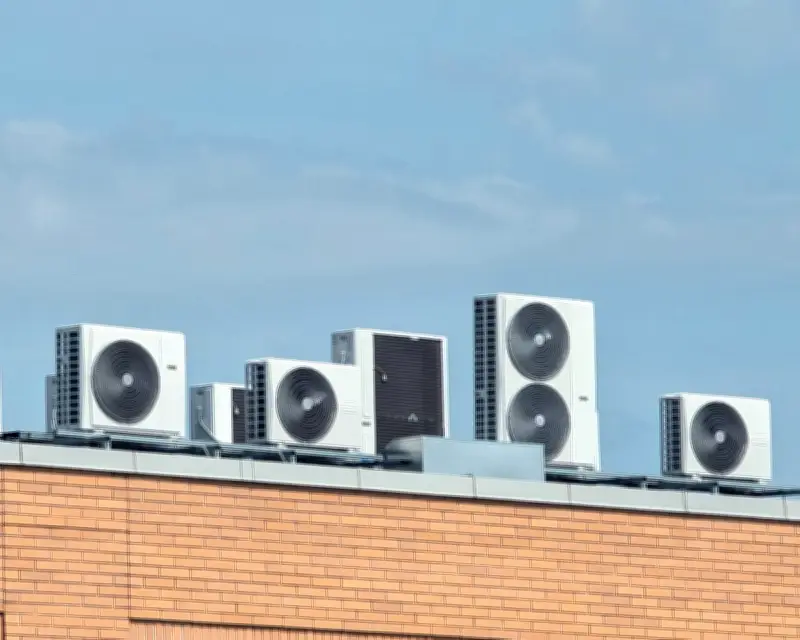
As Britain reels from Europe's worst ever heatwave, many households are seriously considering air conditioning for the first time. Leftists have often criticized AC, citing cheaper, more ecological alternatives. However, with decades of underinvestment leaving the UK unprepared for further heatwaves, it is time to rethink the progressive position on air conditioning.
Phineas Harper argues that air conditioning can bring significant benefits but also real harms, contributing to external air temperatures and global emissions. Dogmatically denying these harms is unhelpful, but refusing to explore how mechanical air-cooling systems could play a productive role in progressive climate adaptation is equally blinkered.
Efficiency and Strategic Installation
Fundamental to any leftwing air-conditioning policy must be efficiency. Currently, AC in Britain is installed inefficiently, household-by-household with no economies of scale or strategic vision. Much of the technology is ingenious, but used in isolation it becomes wasteful. Cooling the air inside a building without also stopping that air from heating up again is like running a bath with the plug out.
Many British homes overheat simply because they lack good insulation and outside shading. Harper's neighbor recorded a 17.8C difference between internal temperatures of unshaded and shaded windows—the equivalent of multiple 400W radiators on full blast. Without first cooling down windows, installing AC would be throwing money down the drain, and units are prone to malfunction during prolonged heatwaves.
Complementary Cooling Measures
There are specific situations where external awnings, shutters, or louvres, common in southern France and Spain, might still not be enough during the hottest peaks. In those cases, using a moderate amount of AC is sensible, provided it is in addition to, rather than a substitute for, lower-emissions cooling methods.
Smith Mordak, former CEO of the UK Green Building Council, says: "Individual air-con units are the bottled water of urban cooling. What we need instead are the equivalent of mains water solutions: shared, available for all, and transformative for public health." For Mordak, installation should center on increasing public health rather than private luxury.
Strategic Use in Public Transport
Public transport is a perfect example of good strategic AC use. It is not possible to clamp awnings or thick insulation to trains or buses, but without reliably comfortable public transit, whole cities suffer. Everyone on the left should call for more AC on public transport. The fact that the vast majority of London buses still lack air-cooling systems while almost all private taxis have them is a severe misallocation of resources.
Deployed well with appropriate licensing and regulation, and in concert with other transit forms, cars are brilliant. Unleashed wholesale without oversight, they degrade cities and cause pollution. Similarly, AC used strategically could be emancipatory. Only if we continue today's purely market-led AC bonanza, with no serious plan for expanding less energy-intensive cooling measures or ensuring equitable distribution, will the technology exacerbate inequality and climate breakdown.
Economic Opportunities and Public Ownership
Dealing with extreme heat represents a huge engine for new skilled jobs and profitable state enterprise. The French government holds major stakes in critical industries including energy, transport, and communications. As temperatures rise, cooling systems will become as fundamental as other essential infrastructure. Leftists should demand public ownership of the cooling sector, bringing democratic accountability while preventing corporate profiteering.
Licensing also has a role. There are currently no serious restrictions on where or how AC can be installed, other than who can afford it. Rich households can install whatever tech they want and run it without regard for neighbors or the climate. At the very least, simple rules should require implementation of lower-emissions cooling strategies before a building can be granted an AC permit.
A Comprehensive Approach
The solution to overheating is not air conditioning alone, as there is no single solution to climate adaptation. Instead, a mix of tactics is needed: more tree planting for urban cooling, European-style external shading such as awnings and shutters, insulation upgrades, ambient loop heat networks, and more cross-ventilation. Deploying AC alone would be disastrous, exacerbating the problem it purports to address. However, alongside other cooling measures, it has a key role to play. The progressive position should not be whether to use AC outright, but where, how, and alongside which other infrastructure upgrades will make the most positive impact.



