
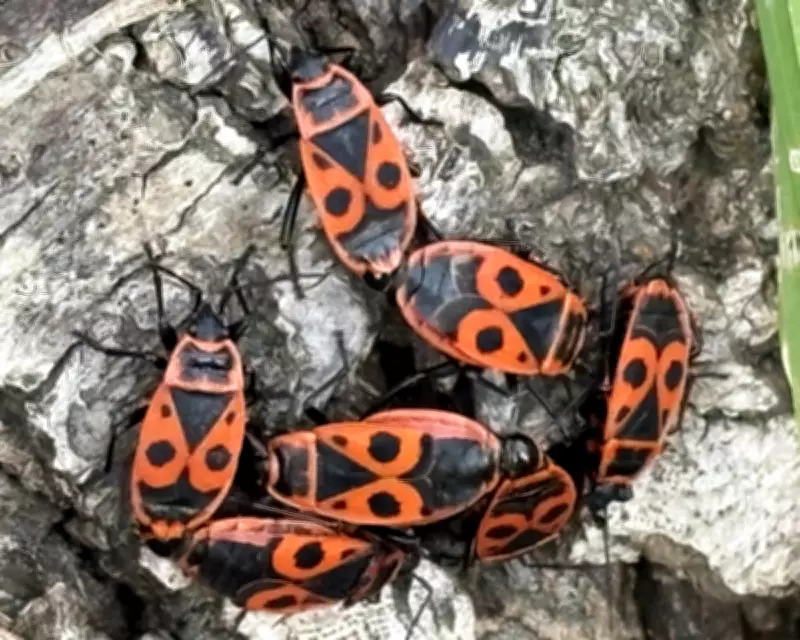
Firebugs, once a rare sight in the UK, have now established themselves across most of southern England, with their range expanding northwards. A recent sighting on a farm in Caistor St Edmund, Norfolk, highlights their growing presence. The bugs were discovered congregating on the sunny side of an old lime tree, forming a cluster of about 50 individuals that resemble flickering flames.
Firebug Characteristics
Each firebug is nearly a centimeter long, with bright red backs marked by bold, symmetrical black shapes. They gather on trees like lime or mallow for mating and feeding. Their diet includes seeds, aphids, and even dead relatives, from which they suck moisture using a proboscis. At first glance, they can be mistaken for cinnamon bugs, but firebugs have geometric patterns, while cinnamon bugs have softer, painterly markings.
Expansion and Impact
Firebugs were once limited to a single population in Devon, but rising temperatures have allowed them to spread. Despite their dramatic appearance, they are harmless to humans, trees, and gardens. Birds and amphibians sometimes ignore their warning colors and eat them. Firebugs produce only one generation per year, and nymphs often remain at the hatching site as they mature.
The sighting was reported by Laura, a regular dog walker and photographer, who shared the discovery with the farm. The farm, which offers public access, benefits from the extra pairs of eyes that notice wildlife and maintenance issues. The firebugs' behavior is influenced by sunlight: they move upward in warmth and descend to leaf litter in shade.
As spring progresses, swallows perform acrobatics over meadows, while swifts are expected to arrive soon. The observation underscores the subtle shifts in wildlife distribution driven by climate change.



