
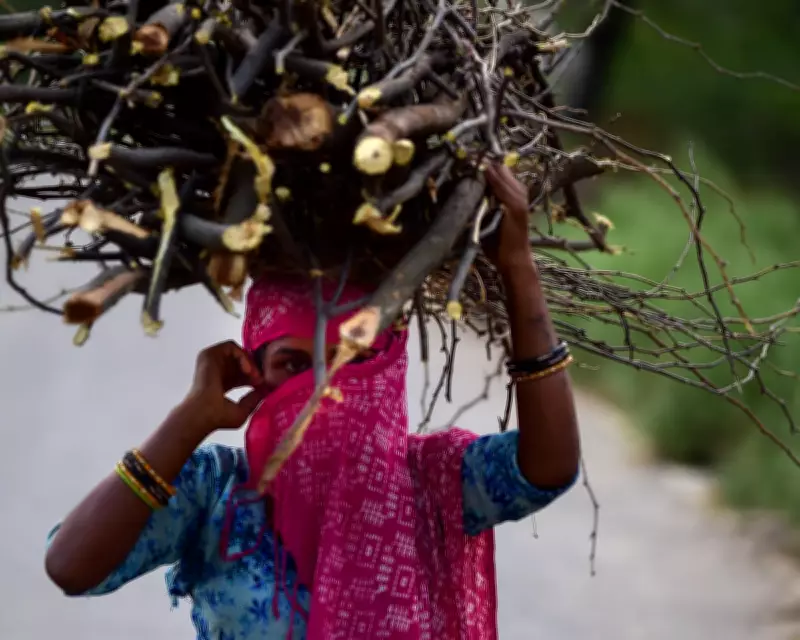
In the ramshackle lanes of a south Delhi slum, Afshana Khatoon crouched wearily on her haunches and began lighting a small pile of firewood. She had only just returned from six hours spent trudging through urban forests and dry parks looking for kindling. As the summer heat soared above 40C, she walked for miles, piling sticks and fallen branches on her head while sweat ran down her face.
Just weeks ago, the 35-year-old prepared meals for her four children on a small gas stove with little fuss. But as the crisis in the Middle East has choked India's vital supplies of imported liquefied petroleum gas (LPG) – used by over 60% of the population for cooking – refills have become scarce and prices have risen far beyond what is widely affordable.
Khatoon, like growing numbers across Asia, has been forced to cook with crude fuels such as firewood and coal to survive. "It already feels like hell," she said, filling a pot with water. "I'm not eating properly, and I have to work much more than before. My whole day now is about collecting firewood and cooking."
Public Health and Environmental Risks
The return to fuels like firewood and coal is deepening the economic strain of the war on ordinary civilians across Asia, raising concerns about public health, air pollution, and the fragility of the energy transition. India imports about 60% of its LPG needs, with roughly 90% passing through the Strait of Hormuz, a critical shipping route blockaded amid the Iran-US conflict. Official data shows India's LPG consumption fell by 2.2 million tonnes in April, the sharpest decline in years.
In informal markets, cooking gas prices have surged. In Khatoon's dimly lit shanty, her 5kg gas canister sat empty. She said LPG had become prohibitively expensive, rising to more than four times what she used to pay. "My husband earns 400 to 500 rupees a day. We can't spend 1,000 rupees just on gas for a week," she said.
Health Impacts of Biomass Burning
Once Khatoon's fire stove is lit, thick smoke rises, stinging eyes and throat. She has no option but to breathe it in while cooking. "We just want to cook as quickly as possible," she said, admitting exhaustion. The return to biomass is raising alarms about air quality. Solid fuels like wood and charcoal emit dangerous pollutants linked to respiratory problems, chronic obstructive pulmonary disease, lung cancer, strokes, and heart disease. The World Health Organization associates ambient and household air pollution with 6.7 million premature deaths annually. Women and children, responsible for cooking and collecting firewood, are the most vulnerable.
Delhi already ranks among the world's most polluted cities. Years of policy focused on promoting cleaner fuels like LPG and compressed natural gas to reduce emissions. Environmental activists fear progress toward widespread use of cleaner fuels is being reversed as the war drags on. With shortages deepening, authorities in Delhi have temporarily relaxed restrictions on coal and firewood use.
"When prices rise, it's the poorest who are forced to switch back to biomass," said Harjeet Singh, a climate activist and founding director of the Satat Sampada Climate Foundation. "Biomass burning is a major source of fine particulate pollution. In dense urban areas, the impact is even more severe because of how closely people live and how poorly ventilated these spaces are."
Over the past decade, the Indian government distributed over 100 million subsidised cooking gas canisters. But the crisis exposes a deeper fault line: access did not guarantee affordability, with families now forced to choose between food and fuel. For many, the gas cylinder has become "a symbol of a transition they can no longer afford to sustain," Singh said.
Similar Crisis in the Philippines
Thousands of miles away in the Philippines, where 90% of LPG needs depend on supplies through the Strait of Hormuz, a similar crisis unfolds. In Manila, Josephine Songalia sat by a charcoal-lit stove, fanning it until a flame appeared. Months ago, she would have turned a knob to light the LPG. But gas has become unaffordable; prices for a small tank have tripled to about Php600 (around $9.80). Charcoal, though far dirtier, costs just Php10, allowing her to cook rice and boil water. At dinnertime, she tells her children to keep a distance, fearful of toxic fumes. "I worry the smoke could harm my lungs and make me sick, but I push those thoughts aside because I have to do this so my kids can eat," said Songalia, 25, who lives with her husband and three children in Aroma, Tondo, one of Manila's poorest neighbourhoods.
Compounding the crisis, food costs have also increased due to the war's ripple effects, forcing her family to skip meals. "In the morning, my kids say: 'Mama, we're hungry.' I tell them we don't have food – just drink coffee," she said. LPG consumption in the Philippines has dropped 30% compared to the same period last year, as people switch to charcoal. To ease the burden, the government suspended the excise tax on LPG and paraffin for three months.
"At stake right now is the health of families … air pollution indoors will be proliferating," said Mylene G Cayetano, a professor of environmental science and meteorology at the University of the Philippines, Diliman. She noted that charcoal production is a "very dirty process," mostly carried out in seaside or riverside areas, filling the air with ash and smoke and causing environmental devastation.
Elderly Particularly at Risk
Back in the Delhi slum, as evening fell and firewood stoves were lit for dinner, Shanti, 75, struggled for breath. Diagnosed with a chronic lung condition, she has been forced to cook on firewood for the past two months. "A doctor told me to stay away from smoke," she said, coughing. "But what choice do I have? My health is getting worse but I need to eat."



