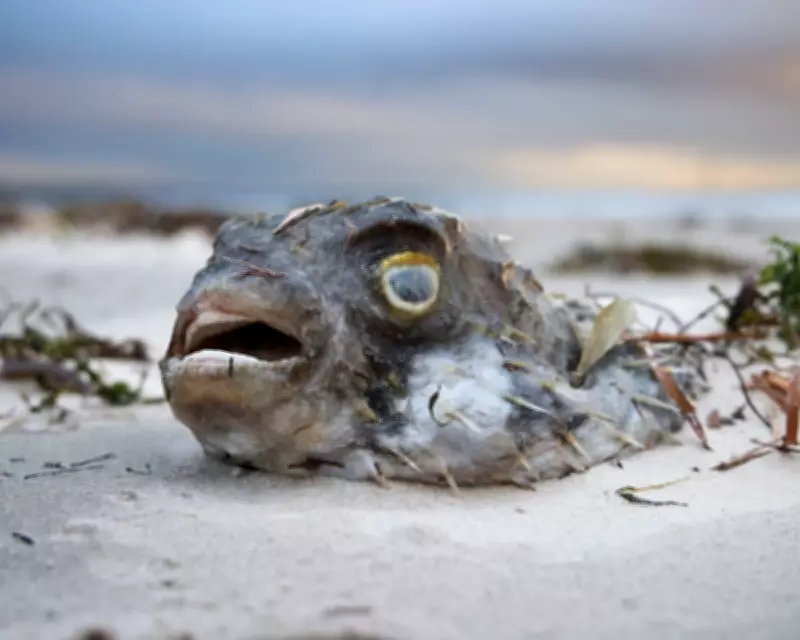
An ocean scientist has warned that a “second wave” of South Australia’s toxic algal bloom could be imminent, as algae levels skyrocket near the southern tip of the Eyre Peninsula.
At the end of April, Australia’s largest and most destructive algal bloom appeared to be dissipating, with low or zero levels of the toxic Karenia cristata algae recorded almost everywhere in the state – except for Bickers Island at the bottom of Spencer Gulf, west of Adelaide, where the algae was recorded at concentrations of 16,490 cells per litre.
The state’s premier, Peter Malinauskas, said “the algal bloom is clear and really has been for many months”.

Now, only four weeks on, testing results show levels at Bickers Island have climbed to 348,080 cells per litre, and the problem has spread with elevated concentrations across six out of 32 testing sites on the Eyre Peninsula. According to the government, Karenia levels above 10,000 per litre are considered elevated, with higher counts suggesting a bloom could be under way.
Dr Jochen Kaempf, an independent oceanographer who has modelled the movement of the bloom using data on ocean currents, said algae levels had gone from small to “fully infrared” in a matter of weeks, and could herald a “second wave” of the bloom, which devastated coastlines throughout 2025.
In March last year the algal bloom kicked off in similar circumstances, he said, starting just outside the Gulf St Vincent, then moving into the gulf and spreading clockwise. The species – Karenia cristata, a rare and toxic type of algae – unexpectedly thrived in colder months, with the worst effects lasting from July to September.
“We are at the autumn period again, at the south of the gulf,” Kaempf said. “The general currents are actually very similar between these two regions, so we can expect a very similar movement of the algae, a similar timescale too.”
Kaempf’s modelling anticipated the algae would spread northwards towards Whyalla over the coming months.
Stefan Andrews, a marine biologist, said the elevated algae concentrations were “particularly concerning”. “There’s so many species that could be impacted if it really does ramp up again.”
Even in areas where the bloom had subsided, there was a “long tail” of impacts, he said, with many ecosystems yet to recover. Rocky reefs and kelp forests have been really stripped back and degraded, he said.
This week the charity OzFish launched a community seagrass planting project, to restore habitat for bloom-affected recreational fish species – such as squid, garfish and blue swimmer crabs – along the Adelaide coastline.
But in the north Spencer Gulf, it would also be a “nervous wait” as giant Australian cuttlefish began arriving for their annual congregation near Point Lowly, Andrews said. Cephalopods had been heavily impacted by the bloom in the Gulf St Vincent, with widespread mortality.
Each year, the spectacular cuttlefish meetup takes place in a kaleidoscope of colour between late May to August, attracting thousands of tourists from Australia and overseas. Kaempf expected the bloom would arrive at the site later, but could overlap with eggs hatching between September and November.
Manny Katz, from the Whyalla Dive Shop, said the giant cuttlefish – some nearly a metre – had started arriving this week, in what was a later than usual start to the season. The cuttlefish were “absolutely gorgeous”, he said, with the ability to create contrasting patterns by changing the colours and textures of their bodies.
So far, the upper Spencer Gulf – where the cuttlefish gathered – had avoided the worst effects of the bloom, Katz said, but it was too early in the season to know whether the bloom had affected the population as a whole.
“It is a very uncertain time, I think everyone’s a bit nervous,” he said. “But I’m feeling pretty optimistic. We’re right at the beginning of the season. The water temperature just dipped below 18 degrees. And as the temperature continues to drop, we expect to see an exponential increase in the amount of cuttlefish that are arriving.”