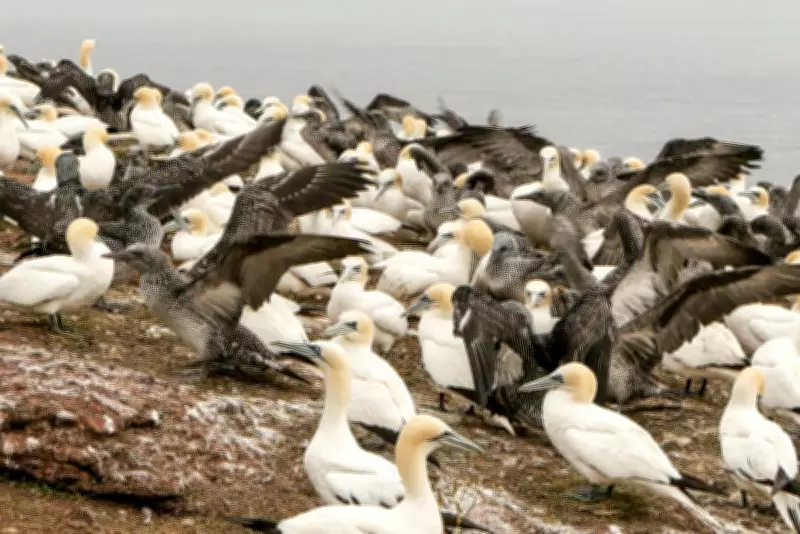
Levels of some of the most dangerous PFAS compounds have dramatically fallen in Canadian seabird eggs, according to a new peer-reviewed study. The authors say this illustrates how regulations can be effective in reducing environmental contamination.
Study Details
Researchers examined PFAS levels in the eggs of northern gannets in the St Lawrence Seaway basin over a 55-year period. PFAS levels shot up from the 1960s through the peak of the chemicals' use in the late 1990s and early 2000s, then fell sharply.
The decline coincides with several regulatory developments. Facing scrutiny, chemical giant 3M, one of the largest PFAS producers, began moving away from PFOS, among its most common and toxic compounds. By 2015, major chemical makers reached an agreement with the US Environmental Protection Agency to phase out PFOS and PFOA, another problematic compound.

Good News for Wildlife
Raphael Lavoie, a co-author and ecotoxicologist with Environment and Climate Change Canada, called the findings "good news."
"We see this incredible rise to a peak where concentrations seem to be higher than toxicological threshold for those birds, then it really decreases in a nice way," Lavoie said. "The regulations are having a good effect."
PFAS are a class of at least 16,000 chemicals commonly used to make products resist water, stains, and heat. They are called "forever chemicals" because they do not naturally break down, and they are linked to health issues such as cancer, thyroid disease, kidney problems, and decreased immunity.
Data from Bonaventure Island
The eggs were collected from the remote Bonaventure Island, which holds North America's largest northern gannet colony. Data shows that levels of PFOS fell from a peak of 100 parts per billion (ppb) to 26 ppb by 2024, a 74% drop. Levels of PFOA are down about 40% over this time, though they ticked back up in recent years. Meanwhile, PFHxS, another common toxic PFAS compound, fell from 0.69 to 0.19 ppb, a drop of about 72%.
Historical Context
The paper details how PFAS production increased sharply between 1969 and the mid-1990s, driven by widespread applications from firefighting foams to stain guards and various manufacturing processes. With virtually no regulatory oversight, the chemicals rapidly accumulated in the environment, exposing wildlife like the northern gannet. The birds faced high risk as the St Lawrence received water pollution from manufacturing centers around the Great Lakes.
As the dangers of the most commonly used PFAS came into focus, the US, Europe, and Canada each ratcheted up regulatory pressure. The United Nations targeted PFOS, and the compound was listed in the 2009 Stockholm Convention, requiring signatory countries to restrict its production and use. In recent decades, militaries and other users of firefighting foam switched to PFAS-free products or stopped using the chemicals during training exercises, significantly reducing water pollution.
Not All Good News
However, the chemical makers moved to a newer generation of smaller PFAS, which also present risks to the environment and wildlife. The levels of those compounds have probably grown, and the study found one example of a shift, but the new PFAS are more difficult to measure in bird eggs because they do not accumulate in wildlife as much, Lavoie said.
Moreover, compounds such as PFOS stay in the environment or animals' bodies for decades, so the birds and environment will remain contaminated for the foreseeable future. The authors wrote that this "emphasizes the importance of maintaining scientific and regulatory vigilance."