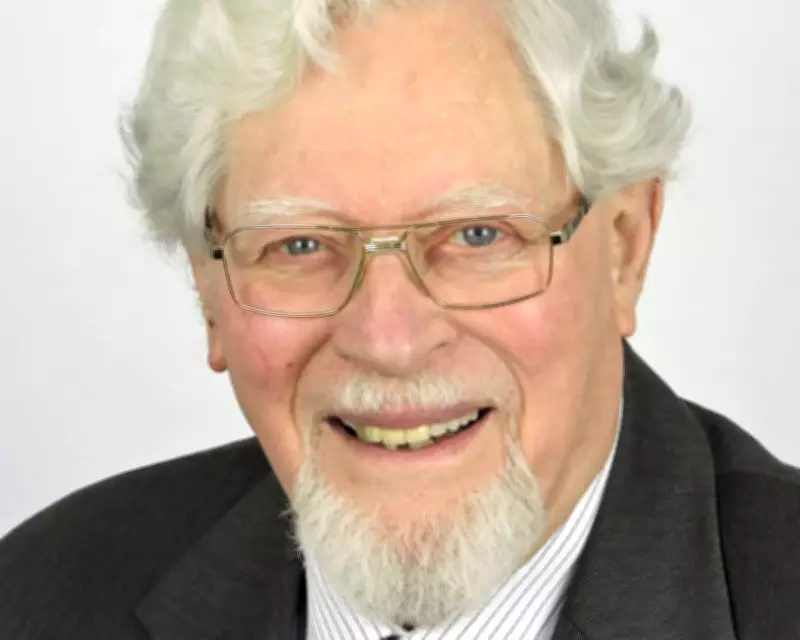
Desmond McConnell: A Life Dedicated to Mineralogy and Scientific Inspiration
Desmond McConnell, a distinguished mineralogist whose career spanned both Cambridge and Oxford universities, has passed away at the age of 95. His contributions to the field of mineralogy have inspired scientists globally, with his work on crystal structures and lunar samples marking significant advancements in earth sciences.
Groundbreaking Research at Cambridge University
During the 1960s and 1970s, Desmond McConnell utilized the advanced X-ray diffraction facilities in the Mineralogy Department at Cambridge University. He built upon research initially published by his colleagues, Peter Gay and Mike Bown, focusing on the incommensurate behavior of crystal structures—phenomena that fall outside conventional scientific rules. His studies led to important insights into plagioclase feldspars, a group of minerals critical to geological understanding.
In 1969, following the Apollo 11 moon landing, McConnell was among the select scientists to analyze lunar dust samples brought back by astronauts. His son, then 10 years old, recalls being amazed when shown the moon sand in a test tube, highlighting the personal impact of his father's work.

Career Spanning Academia and Industry
McConnell's professional journey included a pivotal period in industry from 1983 to 1986, where he served as head of the Department of Rock Physics at Schlumberger Cambridge Research. During the early design stages of a new Schlumberger building, he proposed a flexible, large space with an adaptable central area, including potential drilling test sites. This innovative suggestion was incorporated by the architect, resulting in a structure famously resembling a large tent.
In 1986, he was appointed professor of the physics and chemistry of minerals at Oxford University, a newly created chair, and later became head of the Department of Earth Sciences until his retirement in 1995. His academic affiliations included being a founder fellow at Churchill College, Cambridge in 1962 and a fellow of St Hugh's College, Oxford upon his move. He was elected a fellow of the Royal Society in 1987, cementing his status in the scientific community.
International Recognition and Personal Passions
McConnell lectured extensively in the United States, China, Italy, and Japan. In 1996, he received the Humboldt prize, leading to a year of collaboration with other scientists at the Geoinstitut in Bayreuth, Germany. Beyond his scientific pursuits, he was a keen singer with perfect pitch and a deep contrabass voice, as well as an accomplished watercolour painter specializing in architectural subjects.
Early Life and Family
Born in Lisburn, Northern Ireland, Desmond was the eldest of four children to Samuel McConnell, a local primary school headteacher, and Cathleen (nee Coulter), a secretary. Inspired by the rocky landscapes of his youth, he studied geology at Queen's University Belfast before pursuing a PhD at Cambridge University in 1952. His research focused on rare minerals and the thermal metamorphism of sedimentary rocks in Ballycraigy, north of Larne.
He married Jean Ironside in 1956, and they had three children: Craig, Elspeth, and the author of this obituary. Jean passed away in 2014, and Desmond was predeceased by his two sisters, Margaret and Irene. He is survived by his children, four grandchildren—Patrick, Jessica, Leon, and Alexandra—six great-grandchildren, and his brother John.