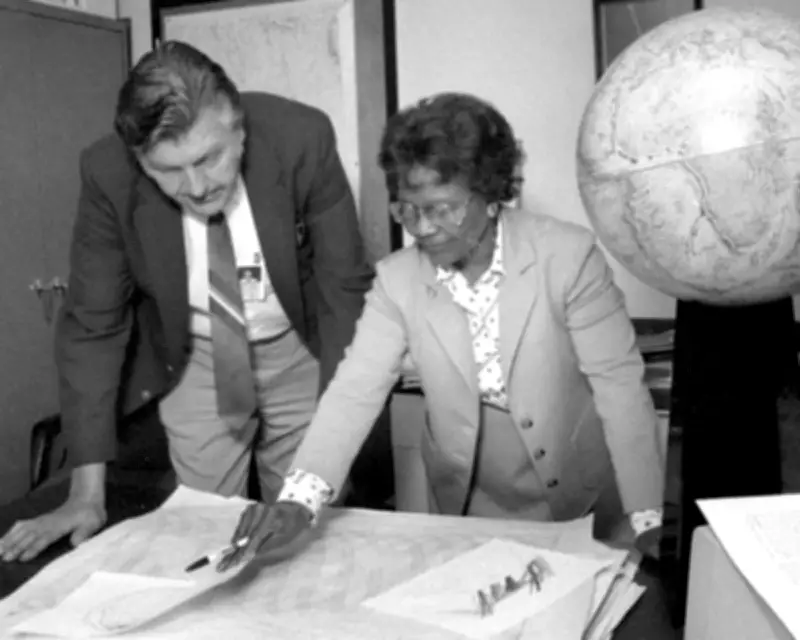
Gladys West: The Hidden Figure Who Mapped the World for GPS
Gladys West, a pioneering mathematician whose groundbreaking work in satellite geodesy was instrumental in the development of the Global Positioning System (GPS), has passed away. Her contributions, though long overlooked, fundamentally shaped modern navigation and technology, earning her recognition as a key figure in scientific history.
Early Life and Career
Born in 1930 in Dinwiddie County, Virginia, Gladys West overcame significant racial and gender barriers to pursue a career in mathematics. She earned a bachelor's degree in mathematics from Virginia State College in 1952 and later a master's degree, demonstrating early on her exceptional talent and determination in a field dominated by men.
In 1956, she joined the Naval Surface Warfare Center in Dahlgren, Virginia, as a mathematician. At a time when opportunities for African American women in science were severely limited, West's role involved complex calculations and data analysis, setting the stage for her later, more influential work.

Pioneering Work in Satellite Geodesy
During the 1960s and 1970s, Gladys West was deeply involved in satellite geodesy, the science of measuring the Earth's shape and gravitational field using satellites. She worked on the analysis of data from the Navy's Transit satellite system, an early precursor to GPS.
Her meticulous calculations helped create detailed models of the Earth's geoid—the shape of the planet's gravitational field—which were crucial for improving the accuracy of satellite-based navigation. This work involved processing vast amounts of data by hand and with early computers, a testament to her precision and dedication.
West's contributions were essential in refining the mathematical foundations that allowed GPS to become a reliable and precise tool. Without her efforts, the development of modern GPS technology, which now underpins everything from smartphone apps to military operations, would have been significantly delayed or less accurate.
Recognition and Legacy
For decades, Gladys West's role remained largely unrecognised, overshadowed by the more visible figures in the GPS project. However, in recent years, her achievements have gained wider acknowledgment. In 2018, she was inducted into the United States Air Force Space and Missile Pioneers Hall of Fame, a rare honour that highlighted her critical impact.
Her story has been celebrated as part of the broader narrative of "hidden figures" in science—women and minorities whose contributions were vital yet often ignored. West's legacy extends beyond GPS; she inspired future generations of scientists and mathematicians, particularly from underrepresented groups, to pursue careers in STEM fields.
Gladys West's passing marks the loss of a true pioneer. Her work not only revolutionised navigation but also demonstrated the profound importance of diversity and inclusion in scientific advancement. As GPS continues to evolve, her foundational contributions will remain a cornerstone of this transformative technology.