Student's Breakthrough Solves Cosmic 'Snowmen' Enigma
An American graduate student has unraveled the enduring mystery of one of our solar system's most peculiar phenomena—cosmic 'snowmen' drifting in its distant outer regions. Astronomers have long puzzled over why these icy globular objects exhibit such distinctive shapes, but new research from Michigan State University provides compelling evidence that a surprisingly straightforward process is responsible for their formation.
The Kuiper Belt's Ancient Relics
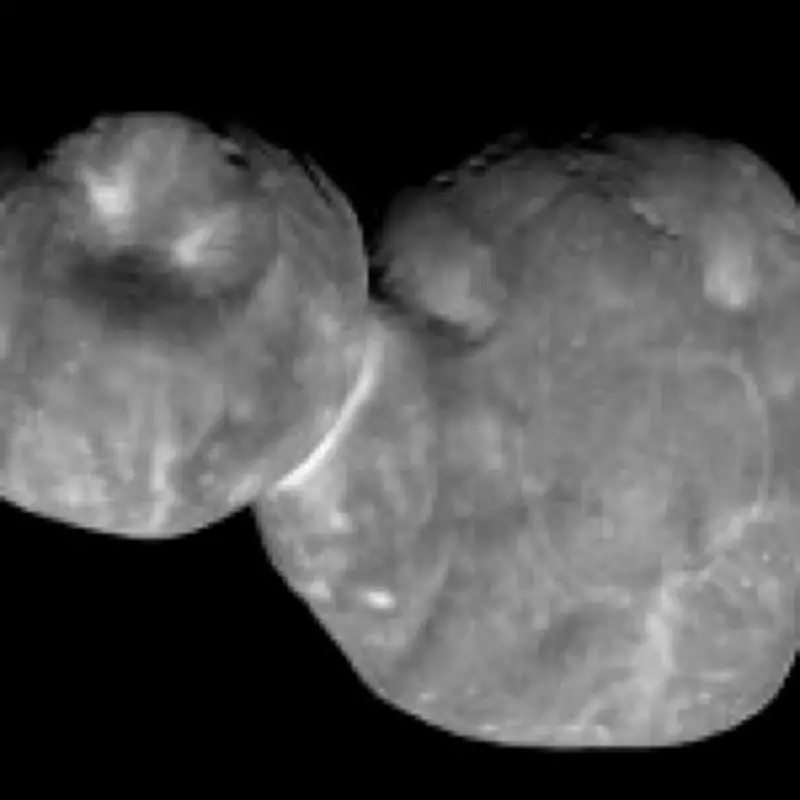
Beyond the chaotic asteroid belt situated between Mars and Jupiter lies the Kuiper Belt, an expansive area past Neptune teeming with icy remnants from the solar system's infancy. These primordial building blocks, known as planetesimals, have remained largely unaltered for billions of years. Approximately one in ten of these objects are classified as "contact binaries," consisting of two connected spheres that bear a striking resemblance to snowmen. The question of how they formed without being shattered by violent collisions has remained unresolved until now.
Jackson Barnes, a graduate student at the university, has pioneered the first computer simulation demonstrating how such two-lobed shapes can emerge naturally through gravitational collapse. This process involves matter contracting under its own gravitational force, overcoming other forces that would typically pull it apart. The findings have been published in the prestigious Monthly Notices of the Royal Astronomical Society.

Revolutionizing Simulation Techniques
Previous computer models treated colliding objects as fluid-like blobs that rapidly merged into single spheres, making it impossible to replicate contact binaries. However, by leveraging high-performance computing facilities, Barnes' simulations enable objects to maintain their structural integrity and gently settle against one another. Other theories had proposed that rare events or exotic conditions might be necessary to produce these shapes, but researchers argue such explanations are unlikely to account for their apparent abundance.
'If we estimate that 10% of planetesimal objects are contact binaries, the mechanism forming them cannot be rare,' stated Seth Jacobson, an assistant professor of earth and environmental science and the study's senior author. 'Gravitational collapse aligns perfectly with our observational data.'
Historical Context and Future Implications
Contact binaries were first observed in detail in January 2019 when NASA's New Horizons spacecraft flew past a Kuiper Belt object later named Ultima Thule. These images prompted scientists to re-examine other distant bodies, revealing that about 10% of planetesimals share this unique snowman-like shape. In the sparsely populated Kuiper Belt, these objects drift largely undisturbed, with collisions being exceptionally rare.
During the early history of the Milky Way, the galaxy consisted of a disc of gas and dust. Remnants from that era persist in the Kuiper Belt today, including dwarf planets like Pluto, along with comets and planetesimals. Planetesimals are among the first solid bodies to form as dust and pebble-sized material clumps together under gravity, akin to snowflakes compressing into a snowball.
Barnes' simulation illustrates that as one of these clouds rotates, it can collapse inward and split into two separate bodies that begin orbiting each other. Such binary planetesimals are commonly observed in the Kuiper Belt. Over time, their orbits spiral closer until the pair gently touch and fuse, preserving their rounded forms. Barnes explains that the survival of these fragile-looking structures for billions of years is due to simple chance; in such a remote region, collisions are infrequent, and without major impacts, there is little to pull the two bodies apart.

Advancing Astronomical Understanding
Scientists have long suspected gravitational collapse was the underlying mechanism, but until now, they lacked models capable of adequately testing the hypothesis. 'We are now able to test this hypothesis for the first time in a legitimate manner,' Barnes remarked. 'That's what makes this paper so exhilarating.' He believes the model could also aid researchers in understanding more complex systems involving three or more bodies. The team is already developing simulations that more accurately capture the nuances of the collapse process.
As future space missions venture deeper into the outer solar system, researchers anticipate that the familiar snowman shape may prove to be far more common than previously imagined. This breakthrough not only resolves a long-standing cosmic mystery but also opens new avenues for exploring the formation and evolution of celestial bodies in our solar system and beyond.