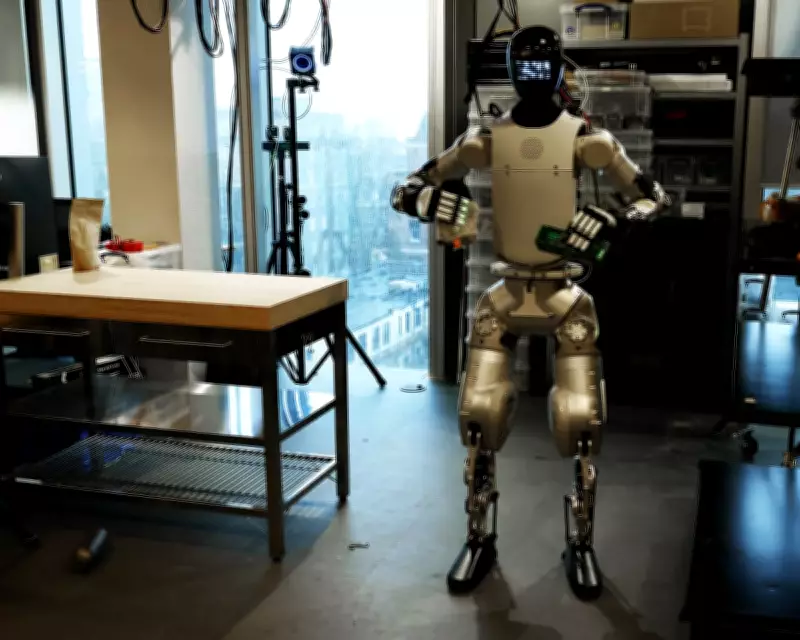
An AI system will collaborate with humans to make a Nobel prize-winning discovery within the next 12 months, and tradespeople will receive assistance from bipedal robots within two years, according to Jack Clark, co-founder of Anthropic. Clark, speaking at a lecture at Oxford University, described a “vertiginous sense of progress” in AI technology and outlined a series of bold predictions, including that companies operated solely by AI would generate millions of dollars in revenue within 18 months, and that by the end of 2028, AI systems would be capable of designing their own successors.
Risks and Progress
Clark also highlighted the potential dangers of AI, stating that there remain plausible scenarios where the technology could pose “a non-zero chance of killing everyone on the planet.” He emphasized that it is “important to clearly state that that risk hasn’t gone away.” Anthropic’s most popular model, Claude, has been followed by a version called Mythos, which demonstrated alarming capabilities in exploiting cybersecurity weaknesses.
Call for Slower Development
Clark suggested that it would be beneficial if humans could slow the pace of AI development “to give ourselves more time as a species” to address the implications of its power. However, he acknowledged that this is unlikely due to the competitive landscape involving “a variety of actors and a variety of countries, locked in a competition with one another, where commercial and geopolitical rivalries are often drowning out the larger existential-to-the-species aspects of the technology being built.” He described this situation as “not ideal.”

Anthropic’s Position
Clark is one of the most senior figures at Anthropic, a company founded by AI researchers who left OpenAI due to safety disagreements. The $900 billion company has faced accusations from Donald Trump’s White House and other AI accelerationists of “fear-mongering” to encourage regulation that could strengthen its competitive position. Anthropic disputes these claims, and Clark argued that many people are in denial about AI’s progress. He urged humanity to prepare for a technology that would “soon be more capable than all of us collectively.”
Comparison to Pandemics
Comparing the failure to prepare for AI to the lack of preparedness for pandemics such as COVID-19, Clark warned: “If we stand by and let synthetic intelligence multiply, then we’ll eventually be forced into reactivity.” Critics of frontier AI companies, including Anthropic, OpenAI, and Google, fear that over-reliance on their few AI models—backed by significant profit-seeking capital—could create a “single point of failure” in global systems.
Concerns Over Cognitive Atrophy
Professor Edward Harcourt, director of the Institute for Ethics in AI, which co-hosted Clark’s lecture, separately cautioned that the rise of AIs performing more tasks for humans could lead to “cognitive atrophy,” weakening human decision-making and judgment. He advocated for alternative AI models that encourage human thinking, sometimes referred to as “Socratic” AI.
Profound Changes Ahead
Clark described his most conservative prediction as “vast swathes of the economy and society will go through profound changes.” These changes could include a machine economy decoupling from the human economy, robots gaining brains, science progressing without human involvement, and the emergence of scientific equipment that people had not previously conceived of but which works. He admitted that some of these ideas sound “crazy.”