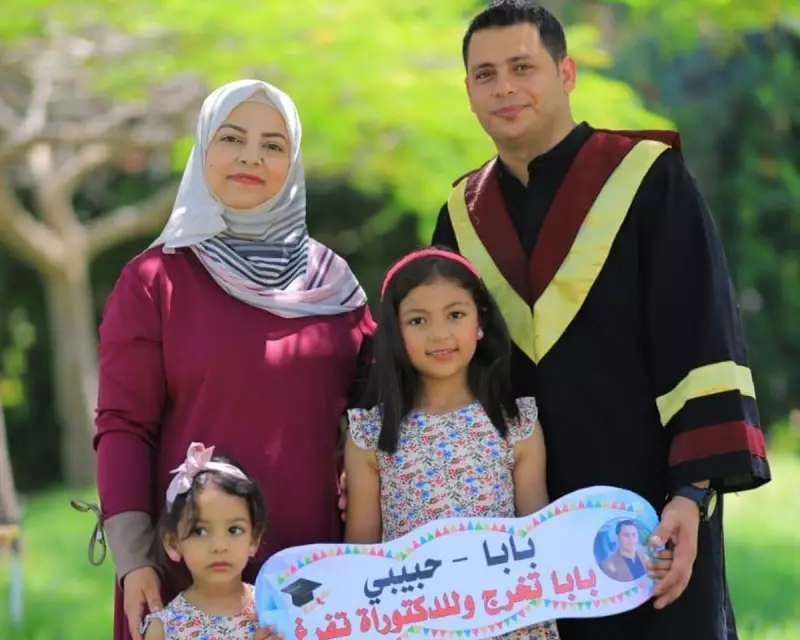
The UK government has facilitated the evacuation of a Gaza PhD student and her family after reversing a contentious immigration policy, but the scheme continues to leave dozens of other scholars and their loved ones in peril.
A Long-Awaited Journey to Safety
Manar al-Houbi, who holds a fully funded scholarship for a PhD at the University of Glasgow, has finally reached Jordan with her family and is set to travel to the UK imminently. Her case, first highlighted by the Guardian in October, exposed a critical flaw in the UK's approach. Despite her visa permitting dependants, her family was initially barred from joining her due to a government crackdown preventing most international students from bringing relatives.
The publicity surrounding her situation prompted a Foreign, Commonwealth and Development Office (FCDO) U-turn. Officials stated they would now consider evacuating dependants from Gaza on a "case-by-case basis." Houbi's family are reportedly the only group the British government has helped to evacuate together from the territory under this revised stance.
A Scheme Beset by Delays and Heartbreak
However, for other students offered places at UK universities, the evacuation process remains fraught with uncertainty and emotional turmoil. The UK's Gaza evacuation scheme, set to expire on 31 December 2025, has been criticised for poor communication and extensive delays, leaving applicants stranded as conditions in Gaza worsen.
Many report feeling pressured to travel alone, despite the stated policy change. Wahhaj Muhammad, 32, now studying for his PhD in Glasgow, was advised by the FCDO to evacuate without his wife and two children two months ago, with assurances they would follow. They remain trapped in Gaza with no clear timeline for evacuation, leaving Muhammad consumed by guilt and unable to focus on his studies.
"The uncertainty affects every aspect of my life here," he said. "It's difficult to settle, to feel present or to engage academically when the people you love most remain living under constant threat."
Impossible Choices for Trapped Families
Other students have refused to leave their families behind, risking their academic futures. Amany Shaher, a 34-year-old mother of three with a place for a Master of Research at the University of Bristol, says the idea of travelling alone made her feel nauseous.
"How can I even consider leaving my children behind in Gaza?" she asked. "It's dehumanising. We have a right to stick together as a family and not be forced to separate." With the scheme's expiry date looming, she and others do not know if they will have to defer their studies or lose their places entirely.
The bureaucratic struggle has been described as "almost as traumatic as the war itself" by Mohammed Aldalou, who has a scholarship for the London School of Economics. His five-year-old son is severely autistic and has been without treatment for two years, yet the FCDO has suggested Aldalou evacuate alone. He has refused, stating there will be no departure without a guarantee his family can leave together.
While there have been internal discussions about allowing online study or extending the evacuation scheme, sources indicate the FCDO is unlikely to extend it without Home Office approval. Both the FCDO and the Department for Education declined to provide further comment on the scheme's future or the cases of those still stranded.