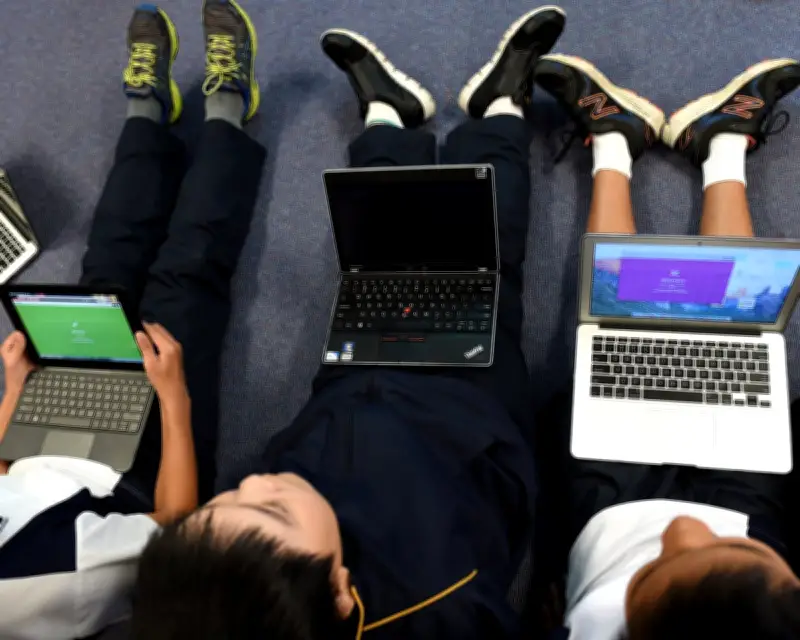
Secondary schools in Victoria will limit device screen time to two hours a day, after an announcement from the state education minister. Photograph: Paul Miller/AAP
‘Eyes up, screens down’: Victoria restricts tech in high school classrooms to two hours a day in national first
Academic says laptops have ‘completely overtaken’ traditional note-taking and research and other states should ‘absolutely’ follow the state’s lead Follow our Australia news live blog for latest updates Get our breaking news email, free app or daily news podcast
Victorian secondary school students will spend less time on screens and more time using pen and paper under a national-first plan to limit classroom device use to two hours a day.

The Victorian government on Monday announced that all state secondary schools will be required to incorporate planned device-free learning time in their teaching programs from term 1, 2027. This could include “using whiteboards or paper, group debates, practical experiments or performances instead”, the government said.
It follows the announcement in October of mandatory screen-time limits for primary school students, which will take effect at the same time. Under the plan, students in years 3 to 6 will be restricted to a maximum of 90 minutes of classroom device use a day, while those in prep to year 2 will have only “minimal” use of screens.
The education minister and deputy premier, Ben Carroll, said final guidelines for teachers would be released in the coming months after consultation with schools, but he expected device use would be limited to no more than two hours a day in public secondary classrooms.
Sign up for the Breaking News Australia email
“There shouldn’t be any more than two hours. We want eyes up, screens down,” Carroll said.
“A full reset in the classroom is so important – for behaviour, for calmness, for the students’ own mental health – the focus needs to be on the most important adult in the classroom, and that’s the teacher, and that’s why we are moving down this [path] with a relentless focus on excellence inside every classroom.”
Melinda Davis, a senior lecturer in education at Swinburne University of Technology and former secondary school teacher, welcomed the announcement, saying technology is being used in schools “in a way that it was never intended.”
She said laptops have “completely overtaken” traditional note-taking and research in classrooms, with students even using their screens during breaks.
“It’s a social issue as much as an education issue … many young people use screens to avoid social interaction,” Davis said.
But given this reliance, she questioned how a two-hour limit would be implemented.
“Taking screens away is good, but how will teachers actually manage that?” she said “It puts an incredible onus on them to manage students who suddenly don’t have devices. We know about the impact of screen time on the brain. If you take that away from someone very quickly, there are going to be negative responses.”
Despite these concerns, Davis said other states should “absolutely” follow Victoria’s lead.
Carroll said exceptions would exist for students with a disability or neurodiversity who rely on technology, as well as for those studying specialist subjects.
Smartphones have been banned in Victorian state schools since 2020. The policy was later adopted across non-government schools and then rolled out across the rest of Australia, with the Australian Capital Territory, Northern Territory and Queensland the last jurisdictions to introduce phone bans in term one, 2024.
From 2027, Victoria will expand the ban to include smartwatches and headphones, further limiting students’ access to personal technology during the school day.
Carroll said the measures follow “world best practice” recommended by international experts.
He said “tech giants” and their algorithms “do not have these young people’s best interests at heart.”
“They’re focused on eyeballs. We’re focused on their minds and their hearts for the future,” Carroll said.

Joining Carroll and the premier, Jacinta Allan, at the announcement was Anthony Oldmeadow, the principal of Ngayuk college in Kalkallo, in Melbourne’s outer north, who described the screen limit as a “really positive step”.
“We know what technology brings is great opportunity, great ability to connect, to be global citizens, but what we do know is that there’s a side of technology that is distracting for students,” Oldmeadow said.
He said the government’s approach would “limit that distraction” while still allowing technology when “used purposefully.”