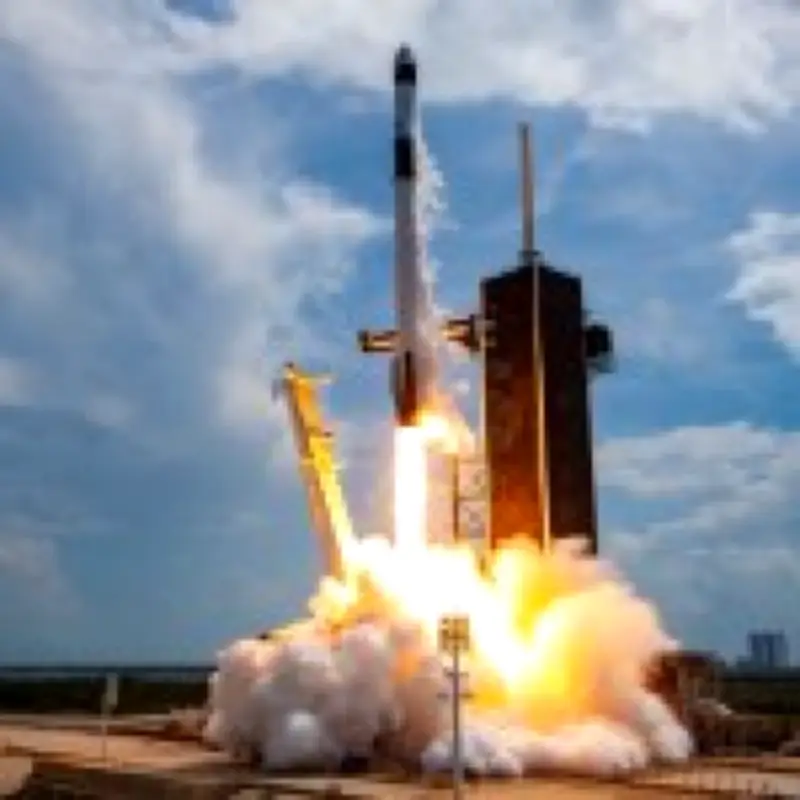
A 4,900kg piece of a SpaceX Falcon 9 rocket is on course to slam into the Moon on Wednesday at 7.35am. The spent upper stage – roughly the height of a five-storey building – is travelling at 5,400mph, seven times the speed of sound, and will strike the sunlit face of the Moon that points towards Earth. The force of the impact is expected to be equivalent to the blast of three tons of TNT.
Space debris analyst Bill Gray, who runs the Project Pluto tracking software, forecasts that the collision will create a crater about 17 metres in diameter. He was quick to reassure that there is no danger to Earth. "It doesn't present any danger to anyone," Gray said. He added that the upcoming crash "does highlight a certain carelessness about how leftover space hardware (space junk) is disposed of."
How did a rocket end up on a lunar collision course?
The incoming object is the upper stage of a Falcon 9 rocket that blasted off in January 2025 with two lunar landers and a package of scientific instruments bound for the Moon. That mission was a one-way trip, meaning the 45-foot-tall upper half of the rocket was never designed to return or be deorbited. Instead, it was left adrift in space and eventually captured by the Moon's gravity. According to the Associated Press, SpaceX did not plan for this piece of hardware to hit the lunar surface. Metro has contacted SpaceX for comment, but no response has been received yet.

What happens when it hits the Moon?
The Moon is used to being battered. Unlike Earth, it lacks tectonic plates to recycle its crust and an atmosphere to wear away impact scars. As a result, it keeps the marks from every collision, big or small. Dr Ed Bloomer, an astronomer at the Royal Observatory Greenwich in London, told Metro that Wednesday's impact will be a non-event for the Moon and for everyone on Earth. "While the rocket part colliding with the lunar surface is quite a large piece of kit, and it is moving at a fairly impressive speed, it is certainly not going to cause any problems," Bloomer said. "After all, the moon is pretty large and desolate, and we know precisely where and when the collision will occur."
Can we watch the crash from Earth?
Don't count on seeing it with the naked eye, or even with a backyard telescope. Gray suspects that the impact will be invisible to most viewers because it happens near the Moon's limb – the apparent edge – on the sunlit side. That region is only occasionally in view owing to the Moon's slight wobble, known as libration. Even with professional equipment, any flash from the explosion will likely be dim. What might be visible through a sensitive telescope is an ejecta plume: a cloud of lunar dust blasted into the vacuum above the surface.
The best observing locations are in eastern parts of the United States and Canada, as well as much of South America. Observers in the UK might miss the event entirely but could later catch a glimpse of the newly formed crater, which Bloomer says will be located in the Moon's northwestern area, close to the Einstein Crater.
NASA's Lunar Reconnaissance Orbiter (LRO) is expected to pass over the crash site in the aftermath. Project scientist Brent Garry said in June: "We can do some additional targeting about a week after the impact and get some targeting over where the site is."
What exactly is space junk?
The Falcon 9 stage is far from the only piece of space junk orbiting the Earth or Moon. Dean Sladen, an aerospace engineer at Accu Components, defines space junk as "any human-made object in orbit, or falling back to Earth, that no longer serves a purpose." This includes spent rocket stages, dead satellites, bolts, paint flecks, and fragments from past collisions. Sladen notes that "there are tens of thousands of trackable objects up there right now, and many more too small to track." The debris population is expanding as launch activity increases, and SpaceX is a major contributor given that it conducts roughly half of all launches worldwide, according to Accu Components' space race report.

This upcoming impact will be the second known accidental crash of a rocket body into the Moon. In 2022, a Chinese rocket segment dug out a pair of craters on the far side of the Moon, and NASA's Lunar Crater Observation and Sensing Satellite (LCROSS) was deliberately crashed into the same region in 2009. The growing trend highlights the need for better management of space hardware.
Dr Bloomer says the incident should serve as a reminder that Earth's orbital environment is becoming a "stellar dumping ground." He warned: "Although we generally track manmade debris with high precision, even for tiny objects, we continue to add to the swarm of material in the local neighbourhood, astronomically speaking. Avoiding further pollution and reducing existing material is a phenomenal technical challenge, but of increasing importance for future spaceflight operations." Whether or not anyone catches sight of the crash, it will leave a permanent scar on the Moon and a lasting lesson about the price of space exploration.