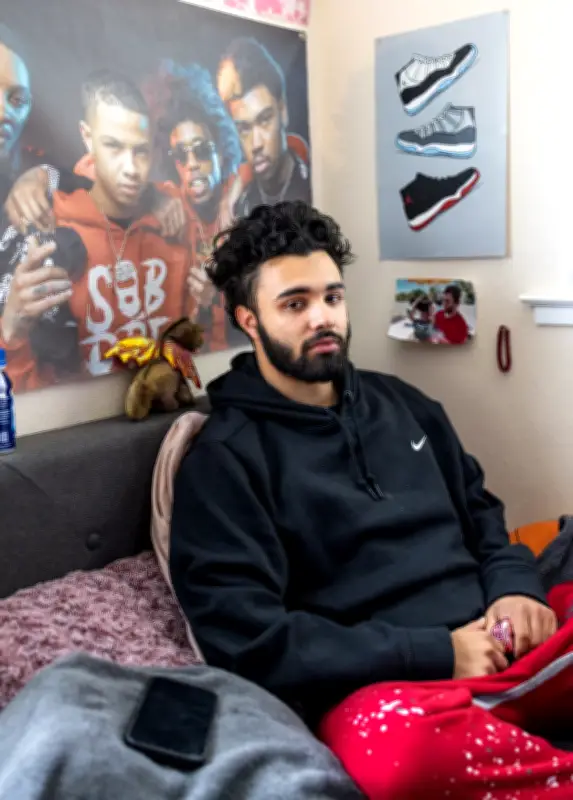
Aaron in his bedroom with posters reflecting his musical tastes and a photo of himself with his father. He lives with roommates in the large house in Santa Cruz his parents vacated when they could no longer afford it. It is one of the most expensive housing markets in the country. Photograph: Rachel Bujalski
Some college, no degree: the Americans who find it impossible to graduate. They all begin college with hope, and leave without the credential they believed would shape the rest of their lives due to financial instability, family, illness.
Story and photographs by Rachel Bujalski

Everyone knows the feeling of leaving something unfinished. A half-written novel. A business idea scribbled into a notebook. A hobby abandoned after the excitement fades. In my own life as a documentary photographer, I have started countless projects that never fully materialized. Some stories lose momentum. Others wait years before revealing what they are really about.
Long before I understood the scale of it, I kept meeting people who had left college without a degree. I kept hearing versions of the same story: people would explain where they had landed in life by tracing it back to the moment college became impossible to finish. Some had left school only a semester short of graduating. Others had dropped out years earlier after financial instability, family responsibilities, illness, addiction, or burnout interrupted their plans. What struck me most was how common the experience was – and how rarely it was talked about openly because of the shame attached to not finishing.
I met Aaron while on assignment at a homeless shelter in Santa Cruz, California, where he worked security at the front check-in desk. I met Alina while visiting my old boxing gym in Chicago. Dupree came through a mutual friend in Florida. And Sylvie responded to a Reddit post I made late one night asking strangers to share their experiences leaving college before graduating.
Today, 43.1 million people fall into the “some college, no credential” category, according to the National Student Clearinghouse Research Center. The people in this project are different in age, geography and circumstance, but they share a common experience that has become increasingly American: beginning college with hope, and leaving without the credential they believed would shape the rest of their lives.
Aaron, 20, Santa Cruz, California
Aaron was 19 when I met him working security at a homeless shelter in Santa Cruz, California – one of the most expensive housing markets in the country. During a slow moment at the front check-in desk, we talked about work, school and the version of adulthood he imagined for himself.
Growing up, Aaron often felt out of place in school. He struggled socially and academically, describing himself as “a brown kid in rapper clothes” surrounded by wealthier white classmates. He fought often, spent time in the principal’s office and almost gave up during Covid. Still, despite the instability and isolation he felt growing up, college represented something larger to him: proof that his life could move in a different direction.
Aaron enrolled at Cabrillo Community College with plans to transfer to a four-year university and study construction management. In his first year, he was diagnosed with bipolar disorder. He began failing classes and eventually lost the financial aid he depended on to stay enrolled. Aaron’s parents had been forced to leave the area because they could no longer afford housing, leaving him to navigate adulthood on his own. Without support from family or a financial safety net, continuing school no longer felt possible.
On weekends, Aaron retreats into music. He has produced two autobiographical rap albums filled with lyrics about mental health, pressure and disappointment. He now shares a large rental house with roommates and has enrolled in barber school in San Jose. He continues to work overnight security but now at a bus yard while building his skills as a barber, balancing school, cutting hair, and late-night shifts. “My schedule is barber, work, gym and that is it,” he said, describing the routine that helps him stay focused on his goals.

Aaron struggled academically at Redwood City high school and had a rough few years at Scott Valley high school, where he felt out of place as a brown kid in rapper’s clothing among a sea of white faces and mainstream styles. He fought, spent time in the principal’s office, and during Covid nearly gave up. ‘I didn’t give a shit about school,’ he said. Yet he was determined to go to college.
Aaron takes a break in a roadside pull-out. He keeps a tight and busy schedule, working as a security guard and intake officer for a string of homeless shelters from 10am until 10pm, often staying up until 2am listening to music and playing video games.
Aaron raps in his room on the weekend. He has produced two albums of rap music with autobiographical lyrics that can be dark. In his first year at Cabrillo Community College, he was diagnosed with bipolar disorder. He started failing classes, struggling in particular with math, and lost his crucial financial aid. He stopped out after one year.
Aaron hangs out in his bedroom with his friends after work late one night.
Aaron talks with a longtime friend on FaceTime in his bedroom in Santa Cruz, California. After leaving college, Aaron relied heavily on a close circle of friends for emotional support while navigating financial pressures, mental health challenges and the demands of full-time work. He says those friendships have become one of the most important sources of stability in his life.
Aaron’s schedule leaves him little time for cooking, so he relies on frozen dinners.
Aaron sits outside at a lookout point in Santa Cruz. He has looked into finishing college but decided he couldn’t manage without the forfeited financial aid. He has applied to a trade school that offers a certificate program in construction management that will let him pick up where he left off.
Aaron looks at a photo of himself with his dad on his wall in his bedroom.
Aaron dresses for a long day as a security guard.
Alina, 26, Chicago, Illinois
When I met Alina in Chicago, she was balancing far more than most people her age. At 26, her days revolved around work, childcare schedules and long trips across the city with her daughter, Aliana. Much of her time was spent moving between responsibilities: training young boxers at the Chicago Youth Boxing Club, working part-time at her daughter’s school and coordinating rides, train schedules and family obligations. A life built around persistence and careful planning.
As a teenager, Alina imagined something different. Growing up in a neighborhood marked by gang violence and drugs, she saw college as a pathway to a new environment and a new future. She had planned to attend Hawaii Pacific University, drawn to the possibility of distance and peace. But shortly before leaving, she learned she was pregnant. Instead, she enrolled at National Louis University in Chicago so she could stay close to home and raise her daughter.
Alina, 26 was ready to attend Honolulu Pacific University when she found herself pregnant. Changing plans, she enrolled at National Louis University in Chicago, but by then she had a three-month-old baby, postpartum depression and a 30-hour-a-week job. Stymied by Covid and poor internet connections, she left after one year.
For a time, she tried to make both worlds work. Between classes, a newborn baby, postpartum depression and a job that required nearly 30 hours a week, college became increasingly difficult to sustain. When the Covid-19 pandemic arrived, bringing further disruptions and unreliable internet access, the situation became impossible. After just one year, Alina left school.
Alina has channeled a lot of her energy into mentoring young people who remind her of herself. She began boxing in middle school after her immigrant mother encouraged her to learn self-discipline and self-defense, and coached young athletes facing their own challenges. She hopes to see more girls enter the sport, believing boxing can build confidence as much as physical strength. Because her childcare arrangement ended shortly after the school day, she often had to bring Aliana with her to boxing matches and training sessions across Chicago, weaving motherhood into nearly every part of her work.
Since photographing Alina, she has left both of the jobs she held at the time. She no longer works at the Chicago Youth Boxing Club and lost her part-time position at her daughter’s school due to budget cuts. Three months ago, she started a full-time job at a Chevrolet dealership, where she was able to purchase a car for $1,500 from a coworker. The car has helped her with her transportation challenges but her daughter told her: “Mom, I love our car but I do miss our walks in the city and all the adventures we used to go on together.”
A devout Catholic and proud daughter of Mexican immigrants, she starts most mornings with prayer and still speaks about finishing school and becoming a teacher someday. Like many people who leave college before graduating, Alina’s story is not one of giving up. The path she imagined for herself changed, but the desire to build a better future – for herself, her daughter and the young people she has mentored – remains very much intact.
Alina gets Aliana ready for school in the Chicago apartment she rents from her grandmother. Her days are long, and her childcare routine is carefully choreographed. She is determined to go back to school, but multiple responsibilities are keeping her from finishing her degree today just as they had before.
Alina mentors and trains 10 young people at the Chicago Youth Boxing Club, which works with at-risk and other youth. Alina herself started boxing in middle school, at the urging of her working immigrant mother, to learn self-discipline and self-defense. She also works part-time at her daughter’s school.
Alina and many of the girls she trains wear necklaces like these as a symbol of their Mexican heritage and a testament to their Catholic faith. Alina attends mass regularly and starts every morning with prayers. Showing her care, she takes the girls’ necklaces off before bouts.
A single working mother, Alina must bring her daughter to the boxing club after school every day, and to matches around the city, because her childcare ends after the school day and a few hours of an after-school program. She must constantly keep an eye on Aliana while getting her trainees ready for the ring.
A mural of the Mexican artist Frida Kahlo brightens up a gritty corner of south side Chicago in the shadow of the elevated subway, which Alina relies on for transportation.
Alina and Aliani spend much of their day in transit, as here on the elevated subway, known as the “L.” Every day is a time-consuming transportation challenge, especially when their unreliable car is in the shop.
Alina applies her lipstick standing on the platform of Chicago’s elevated subway, known as the “L.” Much of her day is spent in transit between work, childcare responsibilities, and the youth boxing program where she mentors young people.
Alina presents Aliani with a spring blossom as they walk to the after-school care center. Urban flowers are a joy to Aliana and a comfort to Alina, who grew up in a neighborhood plagued by drugs and gang violence. Of her original plan to go to college in Hawaii, she says, “I just wanted a place where I could find peace.”
Dupree, 42, Delray Beach, Florida
By the time I traveled to Florida to photograph Dupree, I knew he was running his own nonprofit, helping young people avoid the kinds of mistakes that can alter the course of a life. What I didn’t know was how closely their stories mirrored his.
Growing up, Dupree had few examples of academic success around him. Some family members dealt drugs, police regularly raided his mother’s house, and much of his childhood was shaped by instability. As a teenager, he attended Boca Raton high school and spent more time focused on having fun than thinking about college. Football eventually became his pathway to higher education, earning him an opportunity to play at a community college in Minnesota.
Like many young athletes, Dupree was focused on staying eligible to play rather than earning a degree. When his grades slipped and financial aid disappeared, he left school and returned to Florida. He drifted back into dealing drugs before eventually finding his way back to school and transferring to the University of Minnesota Duluth, hoping football might open even bigger doors.
Then life intervened again. The cousin he had helped raise was beginning to head down a dangerous path, and Dupree felt pulled back to his family and community. With only 18 credits remaining before graduation, he made the difficult decision to leave school and return home.
Today, Dupree channels those experiences into the EJS Youth Center, named after his father. He spends his days mentoring young people, supporting families and creating opportunities for youth growing up amid circumstances similar to those he faced. Looking back, he wishes he had finished his degree. But his story is also a reminder that lives rarely unfold according to plan. The education he never completed remains an unfinished chapter, yet the lessons he learned along the way became the foundation for the work he does today.
As much as he enjoys the one-on-one time with young people in the program, Dupree spends much of his day at his desk, doing administrative chores and talking to parents anxious to enroll their children. When he started the program, Dupree was also concerned about the dangerous path ahead for a young nephew in his care.
Dupree picks up several kids after school to take them to the youth center. His route to founding the youth center was a long one, as well. He transferred between three different colleges, where he played football, doing only the work necessary to stay eligible. Back home in between, he averaged $2,000 a week selling cocaine and marijuana. He dropped out of the University of Minnesota at Duluth with just 18 credits to go. ‘I wasn’t hungry enough to get to the goal,’ he says.
Dupree and his family make regular visits to his father’s grave in Sneads, Florida. He credits his father with imposing discipline and modeling good morals, serving as a counterweight to other relatives who dealt drugs and served time in prison. With him are his partner, Janay, and their two daughters.
Dupree’s youngest daughter plays with ropes of Spanish moss in the cemetery where her grandfather is buried. The birth of his first daughter, along with the death of his father and his own extended hospital stay, Dupree says, convinced him to go straight and to serve as a better role model for his daughter than his family did for him.
Dupree sits with his daughter in their Delray Beach, Florida home while ordering breakfast before taking her to school. Raising his daughters is at the center of Dupree’s life. He sees fatherhood as both a responsibility and an opportunity to provide the support, encouragement, and example that helped him change the course of his own life.
Dupree lives in the back unit of this ageing house in a Delray Beach neighborhood that is rapidly gentrifying. He and his family recently began building a new home just around the corner from the apartment where they currently live and hope to move in by October. Remaining in the neighborhood was especially important to him. ‘That has always been the dream – to own a home in my community,’ he said. “We were almost priced out.”
Dupree waves to a neighbor driving by his home. Deeply rooted in his community, he knows many of the people on his block and values the relationships that have shaped both his personal life and his work mentoring local youth.
Camouflaged and ready to hunt some white-tailed deer, Dupree pays a visit to his late father’s cherished horse, Cotton, with his friend Noy and young daughter. Although he lives in coastal Delray, Sneads, a Panhandle town near the Georgia border, is his ‘happy place’.
Sylvie, 43, Charlottesville, Virginia
I met Sylvie after she responded to a Reddit post I made asking people to share their experiences leaving college before earning a degree. While many people described financial setbacks or family responsibilities, Sylvie’s story was shaped by years of addiction, mental health struggles and repeated attempts to start over.
When I traveled to Charlottesville, Virginia to photograph her, I found someone who still loved learning despite her setbacks. Books filled the basement apartment she shares with her partner, who works as a carpenter, and their son beneath her mother’s home.
Sylvie, 42, sits in a tree by her backyard creek in Charlottesville, Virginia, lives with her partner Ryan and their son in the one-bedroom basement apartment of her mother’s home. Her life has been upended by drug addiction, and she is currently serving a 15-month suspended sentence and five years’ probation for illegal possession of narcotics.
A self-described “artsy type”, Sylvie once imagined becoming a teacher or professor. But that path began to unravel after her parents divorced and the family moved from Arizona to Virginia during her teenage years. Struggling to adjust, she began drinking, smoking and acting out before eventually transferring to an alternative high school with only a dozen students in her graduating class. There, she excelled academically even as her life outside the classroom became increasingly turbulent.
After high school, Sylvie enrolled at Virginia Commonwealth University, where she admits she was often more interested in partying than studying. Then tragedy struck. One of her friends died by suicide, and Sylvie was among those who found him. Already battling anxiety and depression, she spiraled and eventually dropped out.
Hoping for a fresh start, she later enrolled at Arizona State University, pursuing a double major in English and women’s studies. She dreamed of becoming a teacher, perhaps even a professor. But a serious motorcycle accident led to surgery and an opioid addiction that would alter the course of her life. Around the same time, she became immersed in the punk music scene, married young and left school for a second time.
The years that followed were marked by instability and reinvention. She moved back to Virginia, worked in restaurants and bars, earned a welding certificate and became a mother. Today, much of Sylvie’s energy is focused on maintaining sobriety and creating stability for her family. Recently, she applied for a union apprenticeship with an elevator mechanics local in Virginia, completed the aptitude test and interview process, and was ranked 70th out of roughly 200 applicants. As positions become available, the union contacts candidates based on their ranking. While there is no guarantee of when an opening may come, the apprenticeship offers the possibility of stable, skilled work and a new direction for her future.
What struck me most about Sylvie was not how many times she had fallen off course, but her willingness to keep imagining a different future. She still talks passionately about books, ideas and learning. She still wonders whether she will ever finish her degree. But like many people in this project, she is learning that unfinished does not necessarily mean over.
Sylvie gets her eight-year-old son Gus ready for school. She has a welding certificate and occasional work, but she is largely a full-time mom. She had attended Virginia Commonwealth University and the University of Arizona before drug, alcohol and mental health problems caused her to drop out.
Sylvie, Ryan, and Gus visit a creek near her mother’s home in Charlottesville, where she lives with her partner Ryan and their son, Gus. The family frequently visits the creek to swim and explore nature together, finding moments of joy and connection.
Sylvie holds tadpoles she found in a creek.
An English and women’s studies major before she left college, Sylvie is rarely without a book. Her literary tastes run to science fiction, fantasy and the occasional western. She plays the guitar and frequently attends local concerts, generally punk and metal. Here she and Gus enjoy a sunny day on their deck.
In the kitchen of her mother’s home, Sylvie and her partner Ryan share the cooking and prepare school lunches for Gus. Sylvie herself thrived academically at an alternative high school with a graduating class of 12. But as an artsy Arizonan who felt out of place in Virginia, she often rebelled. She extended her partying habits well into her college years.
Sylvie, Ryan, and Gus play on the trampoline in her mother’s backyard.
Sylvie’s partner, Ryan, with their son Gus after school. A carpenter, he is for now the family’s sole breadwinner. With an English degree, Sylvie had hoped to become a high school teacher or college professor. She has a welding certificate but works only sporadically.
Sylvie sits on the deck with her son outside the small basement apartment of her mother’s home. From a well-educated family, Sylvie would also like to finish her degree, but she questions its value now and, given her health and legal challenges, finds the prospect daunting.
Sylvie’s extended family, including her ex-stepfather at left, share their annual Passover Seder. Sylvie’s parents divorced when she was young – the first of several traumas she has experienced. She herself was married briefly in college to a punk rocker who encouraged her to drop out.
After the Seder and a long day at school, Gus is ready to call it day. Sylvie says she is sometimes surprised at how easy and enjoyable she has found motherhood to be.
The four individuals featured here represent only a small portion of the people I met while reporting this project. Additional stories and photographs from Some College, No Degree will be shared through the Lumina Foundation website and social media channels. Rachel Bujalski is a documentary photographer and storyteller whose work explores community, resilience, and alternative ways of living. Her long-form projects focus on people forging lives outside conventional paths, revealing the many ways Americans create meaning, connection and belonging.