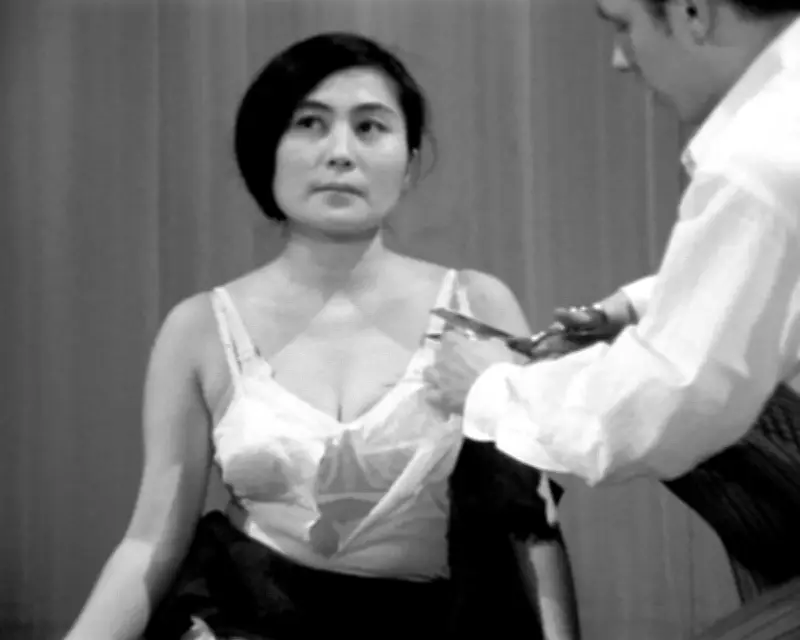
Yoko Ono's Cut Piece, first performed in 1964 at Carnegie Recital Hall in New York, is being restaged in Los Angeles sixty years later. The performance, which involves the artist sitting motionless while audience members cut away pieces of her clothing, is part of the retrospective Yoko Ono: Music of the Mind at The Broad museum. The live restaging will take place at the Redcat theater on 17 and 18 July, performed by Los Angeles-based artist MPA.
A Landmark of Performance Art
Cut Piece is a landmark in performance art history. In the original 1964 performance, a 31-year-old Ono sat on stage as strangers used scissors to cut her clothing. The piece is emblematic of the Fluxus tradition, where the audience's actions complete the work. Sarah Loyer, curator at The Broad, explains that the piece relies on the audience to finish the performance, leaving the artist vulnerable to unpredictable whims. Ono herself described it as "a frightening piece to perform" in a 1992 interview with art historian Ina Blom.
The tension in archival footage is palpable, especially when a young man cuts the straps of Ono's undergarments. However, Loyer notes that viewing documentation removes some impact, which is why the museum opted for live performances.
MPA's Approach to the Piece
MPA accepted the invitation from Ono's studio with both pride and trepidation. Known for durational and political body art, MPA was less concerned about the physical risks than about making the piece feel contemporary. “Can it still have that sting?” she asked. “Or will it just fall back into like a re-enactment?”
Since 1964, Cut Piece has been performed by many artists, including Peaches twice, and Ono herself six times. Connor Monahan, director of Ono's studio, cautions against calling these "restagings," emphasizing that each performance is new, defined by its context. “Yoko didn’t conceive of the piece as something that would produce a fixed outcome or meaning,” he says. “The instructions remain the same, but the people and the circumstances never do.”
Evolution of the Work
MPA observed that Ono's own relationship with the piece evolved. Still images from 1964 show vulnerability in Ono's eyes, which lessened over time. Ono initially created the piece from anger about the treatment of women's bodies, but it eventually became a gesture of peace. Before her 2003 performance, Ono wrote: “When I first performed this work, in 1964, I did it with some anger and turbulence in my heart. This time I do it with love for you, for me, and for the world.”
MPA sees kinship in Ono's violent subtext. Reflecting on her own early work, such as standing motionless for hours or lying on broken glass, she says, “I was really working out the anger in my own heart. I had been raped and violated, and as a young queer person, I felt there were things that we had to fight for to exist.” Now, like Ono, she aims to hold the duality of anger and love.
Preparing for the Performance
Ono always performed Cut Piece in her best suit, a "total offering" to the audience. MPA chose garments by designers familiar with war and state violence: Víctor Barragán for Saturday and Aliona Kononova for Sunday. She prepares through meditation and long walks, drawing on her experience as a figure model for stillness.
Uncertainty remains about how the piece will unfold. “I think still the act of having like kind of cool cold scissors on me is going to feel provocative for me, and what that does for the audience, we will have to live and see how it feels,” MPA says. She worries slightly that someone might cut her ponytail, but her apprehensions have cooled, partly due to Ono's composure. “There really is such a potency in remaining wordless and having such a commanding presence. It really reaffirms for me within live art what our power is.”
MPA performs Yoko Ono's Cut Piece at the Redcat theater, Los Angeles, on 18 and 19 July. Yoko Ono: Music of the Mind is at The Broad until 11 October.