David Lynch's The Straight Story (1999) stands as a unique entry in the director's filmography, offering a gentle, family-friendly narrative that contrasts sharply with his usual surreal and dark themes. The film tells the true story of Alvin Straight, a 73-year-old World War II veteran who travels 300 miles across the American Midwest on a lawnmower to reconcile with his estranged brother. Released in May 1999, it remains a relatively obscure gem, yet it has become a beloved comfort film for many, including this writer, who first encountered it at age 15.
A Departure from Lynch's Signature Style
Unlike the nightmarish road movie Wild at Heart or the sinister suburbia of Blue Velvet, The Straight Story eschews sexual depravity and grisly malevolence. Instead, it presents a sparse and only slightly strange hymn to Americana, finding poetry in everyday moments. The title not only names the protagonist but also signals Lynch's intention to play it straight, offering a film that is as wholesome as it is quietly profound.
The film's origins trace back to Mary Sweeney, Lynch's longtime editor, producer, and then partner. She discovered Alvin Straight's story in a New York Times article and was charmed by his plucky determination. Sweeney optioned the rights, co-wrote the screenplay with childhood friend John Roach, and brought the project to Lynch. This collaboration resulted in a film that feels both personal and universal, a testament to the power of simple storytelling.
Richard Farnsworth's Swan Song
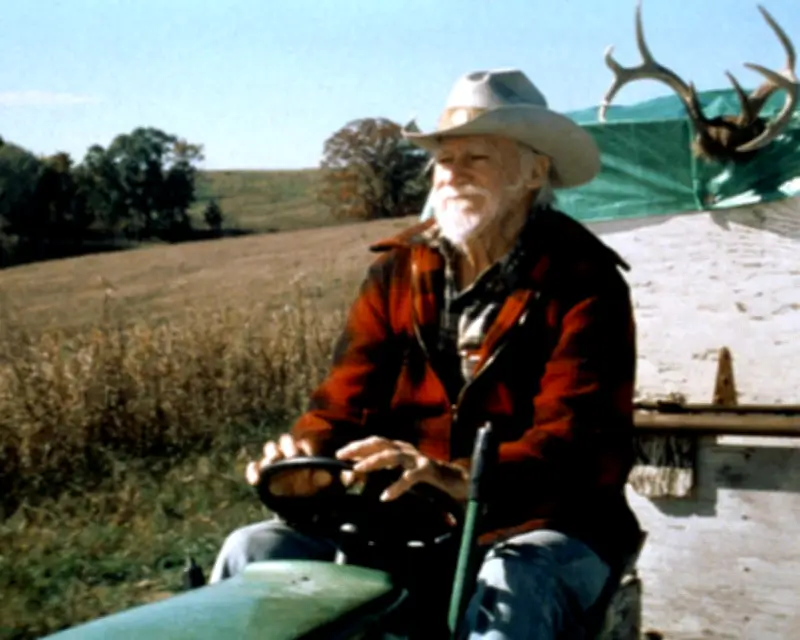
In the lead role, Richard Farnsworth delivers a career-defining performance. A former stuntman who earned an Oscar nomination for Comes a Horseman (1978), Farnsworth embodies Alvin Straight's contradictions: stubborn yet tender, infirm yet unstoppable. His stoic defiance, captured in his red plaid jacket and cowboy hat, is paired with a low-key dignity that shimmers in his rheumy eyes. Knowing that this was his final role—he was terminally ill during the shoot—adds layers of ache and acceptance to his grizzled face. Farnsworth was 79 at the time and lost the 2000 Oscar to Kevin Spacey; he died later that year.
The film's score, composed by Lynch stalwart Angelo Badalamenti, blends mournful Spanish guitar with folksy fiddle, perfectly complementing Farnsworth's performance. The movie drifts from scene to scene with hushed profundity, featuring encounters with a pregnant runaway, a woman hysterical after hitting a deer, squabbling twin mechanics, and a retired John Deere employee who lets Alvin camp in his backyard. The most poignant moment occurs in a tavern in Iowa, where Alvin, sipping milk, opens up to a fellow veteran: “That is one thing I can’t shake loose. All my buddies’ faces are still young. And the thing is, the more years I have, the more they’ve lost.”
Visual Poetry and Emotional Depth
Cinematographer Freddie Francis, who also worked on his final film here, holds his lens on Farnsworth's face during that tavern scene, capturing subtle twitches that speak volumes. Francis's work throughout is Oscar-worthy, though not nominated, with sweeping vistas, crops bathed in magic-hour light, and roads stretching into infinity. Each shot is as evocative as the protagonist's weathered visage, creating a visual poem of the American heartland.
Watching The Straight Story now, after Lynch's death in January 2025, carries added pathos. In his final years, Lynch also struggled with walking, his lungs ravaged by decades of smoking, much like Alvin's. Despite critical acclaim, the film grossed only $6.2 million at the US box office against a $10 million budget, making it a relatively unknown treasure. Yet, those who have seen it often describe it as deeply moving, a sentiment echoed by this writer's personal experiences.
A Flawless Ending
The exquisite final scene belongs to Harry Dean Stanton, an actor known for laconic devastation in films like Paris, Texas. Stanton's Lyle, Alvin's brother, glances at the lawnmower and asks, “Did you ride that thing all the way out here to see me?” with a quivering lip, years of resentment dissolving in a single frame. Alvin replies, “I did, Lyle.” It is a flawless ending, leaving viewers deeply touched. The Straight Story is available on Disney+ and the Criterion Channel in the US, for digital rental in the UK, and on Mubi in Australia.